
























First direct observation of Askaryan radiation in ice confirms new method for detecting ultrahigh-energy neutrinos
By
Julie Kiel Holm
Summary
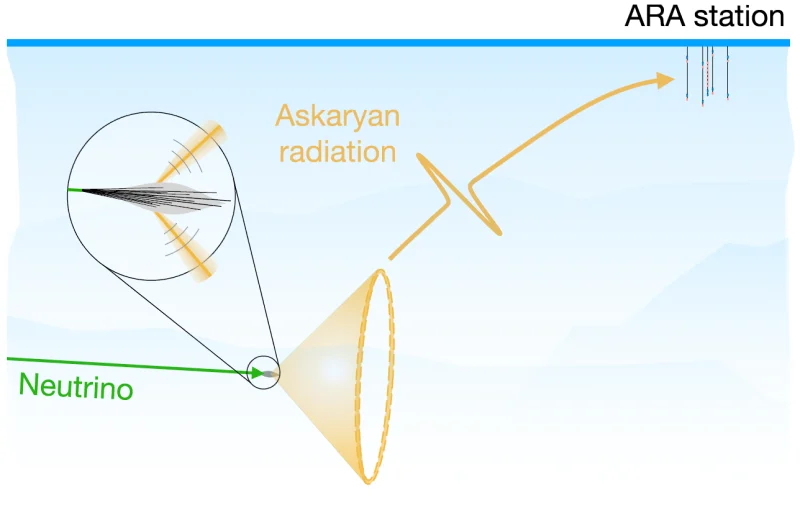
This paper presents the first direct observation of Askaryan radiation in ice induced by high-energy cosmic rays, serving as a proof-of-concept for detecting ultrahigh-energy neutrinos. The ARA (Askaryan Radio Array) collaboration detected radio signals generated by high-energy particles interacting with ice, confirming a long-predicted phenomenon. This breakthrough demonstrates that radio-based detection methods can work for studying the most energetic particles in the universe, opening a new window into cosmic phenomena that are otherwise difficult to observe.
Source
 bskyFirst direct observation of Askaryan radiation in ice confirms new method for detecting ultrahigh-energy neutrinosastrobites.org
Key quotes
· 3 pulledUltrahigh-energy neutrinos can be our gateway to studying some of the Universe's most energetic but least understood phenomena.
Today's paper presents a proof-of-concept for a new, promising way to detect these ultrahigh-energy particles.
The ARA collaboration detected radio signals generated by high-energy particles interacting with ice, confirming a long-predicted phenomenon.
You might also wanna read

Antarctica's Cosmic Particle Detector Detects Strange Radio Pulses
A cosmic particle detector in Antarctica has detected strange radio pulses at steep angles below the ice surface, challenging current partic
psu.edu·1y ago
ALMA Identifies Ancient Starburst Galaxy as Likely Source of IceCube High-Energy Neutrino
Astronomers using ALMA have identified a compact, intensely star-forming galaxy from 11 billion years ago as the most likely source of a hig
 almaobservatory.org·4d ago
Astronomers trace high-energy neutrino to distant 'Shadow Blaster' galaxy 11 billion light-years away
Astronomers have traced a high-energy neutrino (a "ghost particle") detected by the IceCube Neutrino Observatory in 2021 back to its source:
 space.com·2d ago
Astronomers trace high-energy neutrino to distant 'Shadow Blaster' galaxy 11 billion light-years away
Astronomers have traced a high-energy neutrino (a "ghost particle") detected by the IceCube Neutrino Observatory in 2021 back to its source:
space.com·2d ago
Machine Learning Validates Unrecognized Transient Astronomical Phenomena in Historical Observatory Images
This research paper uses machine learning to validate the existence of previously unrecognized transient astronomical phenomena in historica
 arxiv.org·2mo ago
VLT Study Reveals Dramatic Nickel Emission and CN Outgassing in Interstellar Comet 3I/ATLAS
Astronomers using the Very Large Telescope (VLT) have conducted spectroscopic observations of interstellar comet 3I/ATLAS (C/2025 N1) as it
arxiv.org·9mo ago
New Analysis Confirms "Wow!" Signal Was Likely Extraterrestrial and More Powerful Than Estimated
A new analysis of the famous "Wow!" signal from 1977 reveals that the mysterious radio signal detected by the Big Ear radio telescope was li
 iflscience.com·10mo ago
Comments
Sign in to join the conversation.
No comments yet. Be the first.