





















VLT Study Reveals Dramatic Nickel Emission and CN Outgassing in Interstellar Comet 3I/ATLAS
By
bikenaga

Crackling crust, pillowy middle. The kind of bagel that earns a second cup of coffee.
Summary
Astronomers using the Very Large Telescope (VLT) have conducted spectroscopic observations of interstellar comet 3I/ATLAS (C/2025 N1) as it approaches the Sun from 4.4 to 2.85 astronomical units. The study reveals a dust-dominated coma with a red optical continuum and reports the first detection of CN emission and numerous Nickel (Ni I) lines, while finding no evidence of other common cometary species like oxygen, carbon compounds, or ammonia. The research shows dramatic increases in nickel and CN production rates as the comet approaches perihelion, with nickel production scaling as r_h^-8.43 and CN as r_h^-9.38. The findings suggest nickel release mechanisms inconsistent with direct sublimation, instead favoring low-activation-energy processes like photon-stimulated desorption or thermolysis of metalated organics, potentially including nickel-carbonyl complexes.
Key quotes
· 4 pulledWe report detection of CN emission and also detect numerous Ni I lines while Fe I remains undetected, potentially implying efficiently released gas-phase Ni
We observe a steep heliocentric-distance scaling for the production rates Q(Ni) ∝ r_h^-8.43 ± 0.79 and for Q(CN) ∝ r_h^-9.38 ± 1.2
Energetic considerations of activation barriers show that this behavior is inconsistent with direct sublimation of canonical metal/sulfide phases and instead favors low-activation-energy release from dust
These hypotheses are testable with future coordinated ground-based and space-based monitoring as 3I becomes more active during its continued passage through the solar system
You might also wanna read

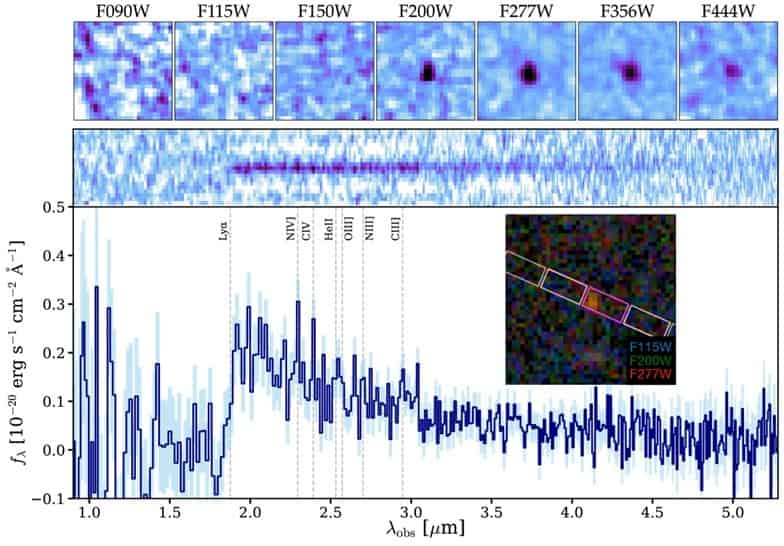
JWST Confirms Discovery of Exceptionally Luminous Galaxy at z=14.44, 280 Million Years After Big Bang
The James Webb Space Telescope has confirmed the discovery of MoM-z14, an exceptionally luminous galaxy that existed just 280 million years
 astro.theoj.org·3mo ago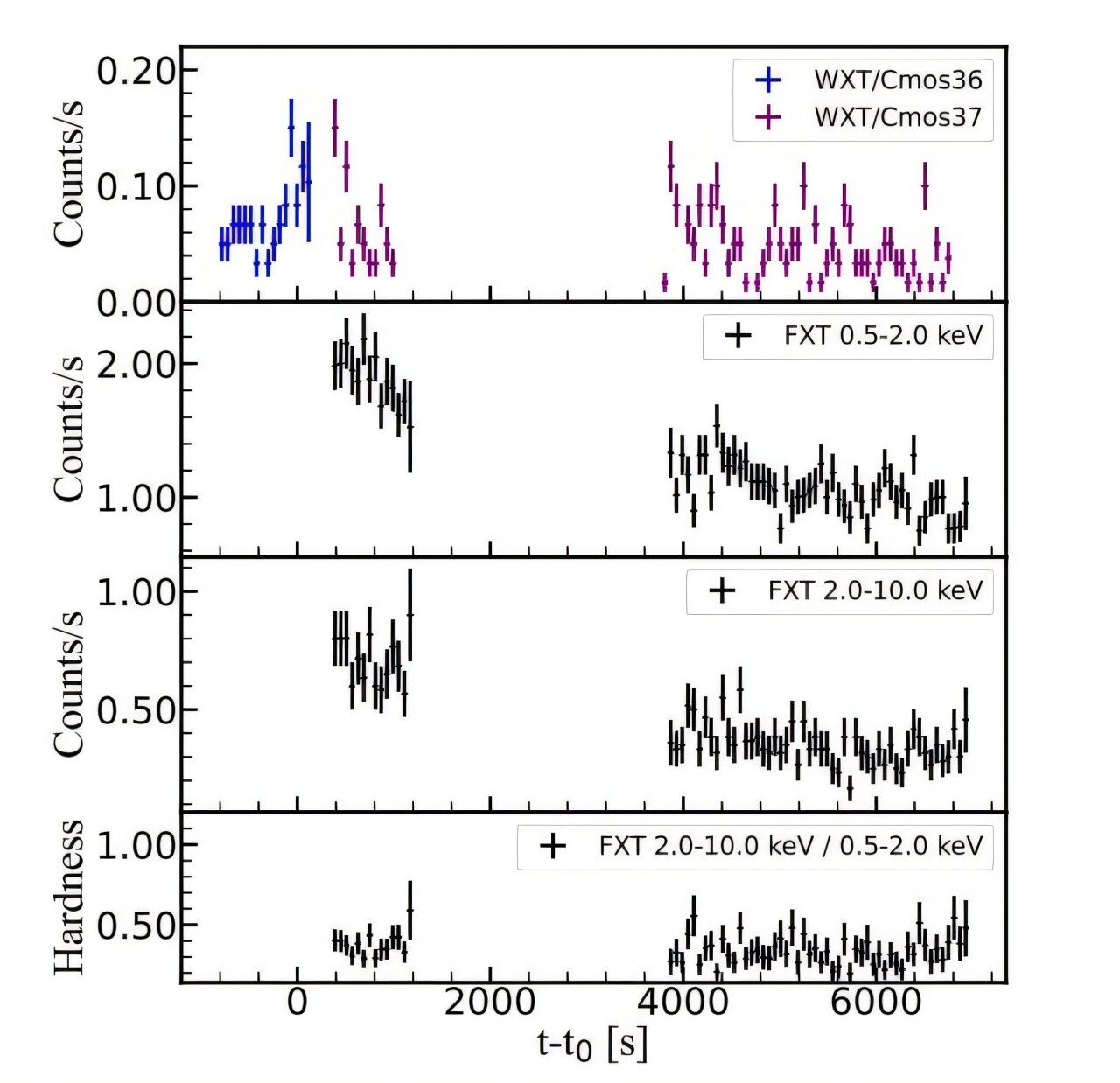
Einstein Probe Detects X-ray Flare from Nearby Star 150 Light Years Away
Astronomers using the Einstein Probe (EP) have detected a new X-ray transient event identified as an X-ray flare from the star PM J23221-030
 phys.org·4mo ago
Astronomers Discover Most Distant and Powerful Black Hole Flare from Star Destruction
Astronomers have discovered the most powerful and distant flare of energy ever recorded from a supermassive black hole, likely caused by a m
 caltech.edu·6mo ago
Interstellar Comet 3I/ATLAS Shows Rapid Brightening and Gas Emission Near Perihelion
Interstellar comet 3I/ATLAS, approaching its October 29, 2025 perihelion, has been difficult to observe from Earth due to its position oppos
 arxiv.org·7mo ago
Scientists Detect Lowest Mass Dark Object Ever Measured
Scientists have detected the lowest mass dark object ever measured, providing new insights into the nature of dark matter. The discovery hel
 mpg.de·7mo ago
First Image Captured of Two Black Holes Orbiting Each Other in Distant Quasar
Scientists have captured the first confirmed image of two black holes orbiting each other in quasar OJ287, located five billion light-years
 helsinkitimes.fi·7mo ago