
























Self-RAG: A Self-Reflective Framework for Improving LLM Factuality and Output Quality
By
Akari Asai1
Summary
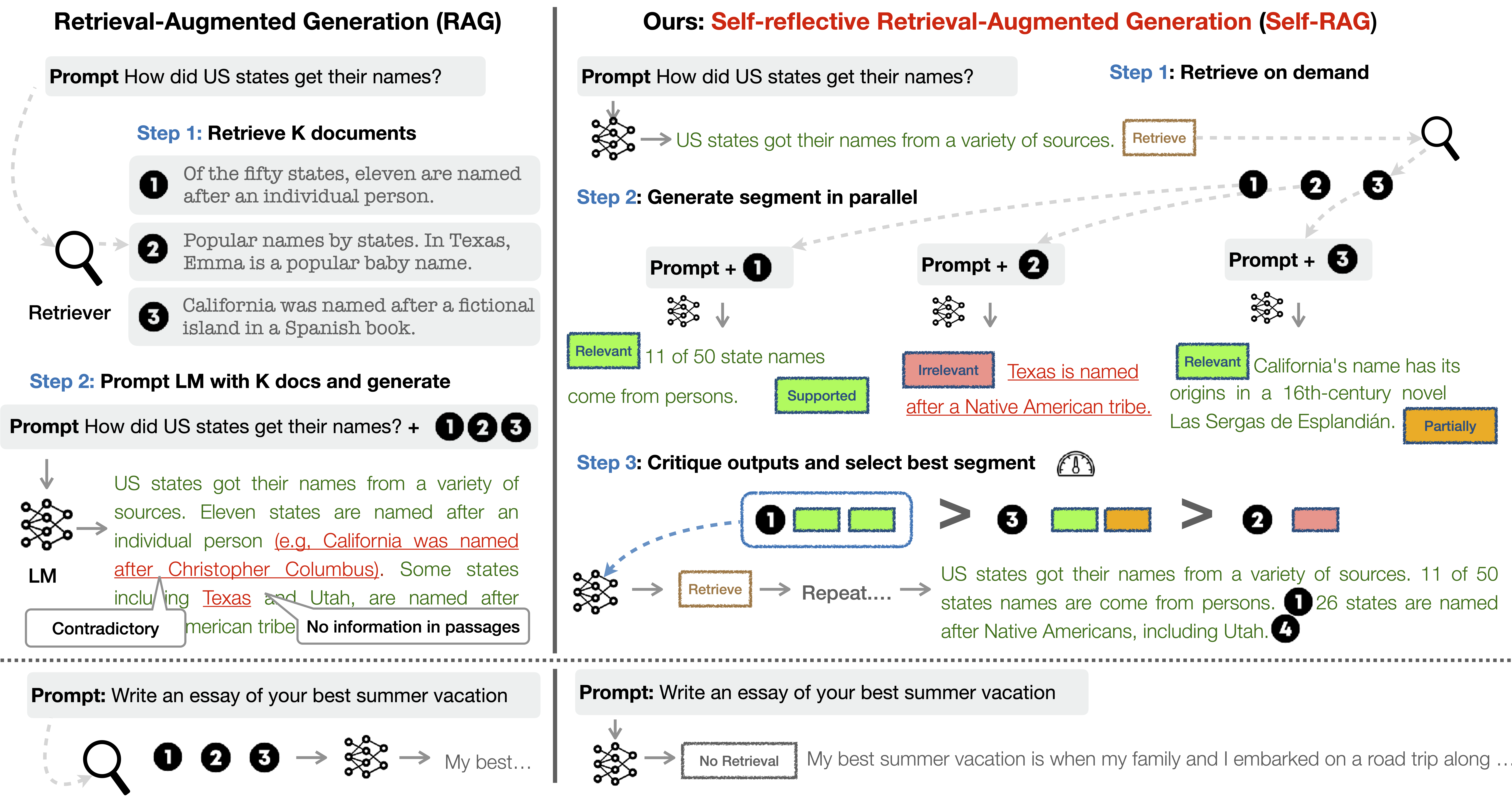
Self-RAG is a framework that enhances large language models by training them to retrieve relevant information, generate responses, and critique their own outputs through self-reflection. It addresses the problem of factual inaccuracies and hallucinations in LLMs by incorporating on-demand retrieval and self-critique mechanisms. The approach outperforms ChatGPT and retrieval-augmented LLama2 Chat across six tasks by improving factuality and output quality without requiring additional training data.
Source
 Twitter / XSelf-RAG: A Self-Reflective Framework for Improving LLM Factuality and Output Qualityselfrag.github.io
Key quotes
· 3 pulledSelf-RAG learns to retrieve, generate and critique to enhance LM's output quality and factuality, outperforming ChatGPT and retrieval-augmented LLama2 Chat on six tasks.
Despite their remarkable capabilities, large language models (LLMs) often produce responses containing factual inaccuracies due to their sole reliance on the parametric knowledge they encapsulate.
They often generate hallucinations, especially in long-tail, their knowledge gets obsolete.
You might also wanna read


R-Zero: A Self-Evolving LLM Framework That Generates Its Own Training Data Without Human Input
R-Zero is a fully autonomous framework for training self-evolving Large Language Models (LLMs) that generates its own training data from scr
 arxiv.org·9mo ago
Building a Minimal RAG System from Scratch: PDF to Highlighted Answers in ~100 Lines of Python
A hands-on tutorial that builds the smallest functional RAG (Retrieval-Augmented Generation) system from scratch using about 100 lines of Py
 towardsdatascience.com·27d ago
CoT-PoT Ensembling: Efficient LLM Reasoning with Self-Consistency from Just Two Samples
This paper introduces a hybrid ensembling approach called CoT-PoT that combines Chain-of-Thought (CoT) and Program-of-Thought (PoT) reasonin
arxiv.org·18d ago
Zebra-Llama: Efficient Hybrid Language Models Combining SSMs and Attention Layers
Researchers propose Zebra-Llama, a family of hybrid language models (1B, 3B, 8B) that combine State Space Models (SSMs) and Multi-head Laten
arxiv.org·6mo ago
Strategies for Mitigating Context Failures in LLM Applications
This article provides practical strategies for mitigating and avoiding context failures in large language model applications, focusing on in
 dbreunig.com·10mo ago
Building a Metadata-Aware RAG Chatbot for Household Questions via Local LLM Fine-Tuning
A personal project describes building a chatbot for household questions (maintenance, appointments, etc.) that uses RAG with a vector databa
Comments
Sign in to join the conversation.
No comments yet. Be the first.