





















R-Zero: A Self-Evolving LLM Framework That Generates Its Own Training Data Without Human Input
By
lawrenceyan

Properly proved. Has structure, has flavour, has a point.
Summary
R-Zero is a fully autonomous framework for training self-evolving Large Language Models (LLMs) that generates its own training data from scratch, eliminating the need for human-curated tasks and labels. It initializes two independent models—a Challenger and a Solver—that co-evolve through interaction: the Challenger proposes tasks near the edge of the Solver's capability, while the Solver learns to solve increasingly difficult challenges. This creates a self-improving curriculum without any pre-existing data. Empirically, R-Zero significantly boosts reasoning performance across different backbone LLMs, including a +6.49 improvement on math-reasoning benchmarks and +7.54 on general-domain reasoning benchmarks using Qwen3-4B-Base.
Key quotes
· 5 pulledSelf-evolving Large Language Models (LLMs) offer a scalable path toward super-intelligence by autonomously generating, refining, and learning from their own experiences.
Existing methods for training such models still rely heavily on vast human-curated tasks and labels, typically via fine-tuning or reinforcement learning, which poses a fundamental bottleneck to advancing AI systems toward capabilities beyond human intelligence.
R-Zero, a fully autonomous framework that generates its own training data from scratch.
The Challenger is rewarded for proposing tasks near the edge of the Solver capability, and the Solver is rewarded for solving increasingly challenging tasks posed by the Challenger.
Empirically, R-Zero substantially improves reasoning capability across different backbone LLMs, e.g., boosting the Qwen3-4B-Base by +6.49 on math-reasoning benchmarks and +7.54 on general-domain reasoning benchmarks.
You might also wanna read

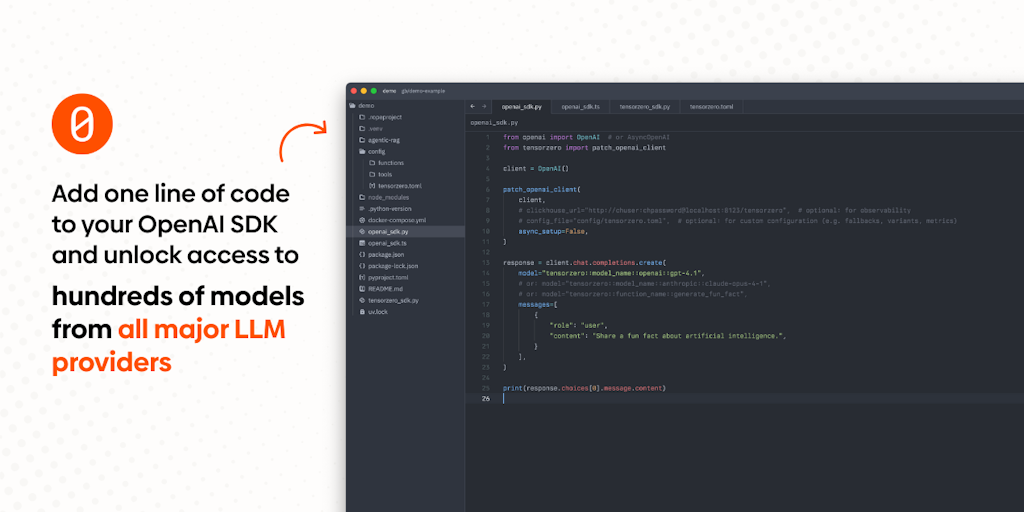
TensorZero: Open-Source Stack for Industrial-Grade LLM Applications
TensorZero is an open-source stack designed for building industrial-grade large language model (LLM) applications. It offers a unified API f
 Product Hunt·9mo ago
Researchers Develop Method to Predict Real-Time Progress in Reasoning Language Models
This research paper investigates whether real-time progress prediction is feasible for reasoning language models that use long latent chains
 arxiv.org·4d ago