

























New 10Be production rate constraints from north-west Scotland improve cosmogenic surface-exposure dating for the last glacial termination
By
Gordon R. M. Bromley, Brenda L. Hall, Aaron E. Putnam, and Thomas V. Lowell
Summary
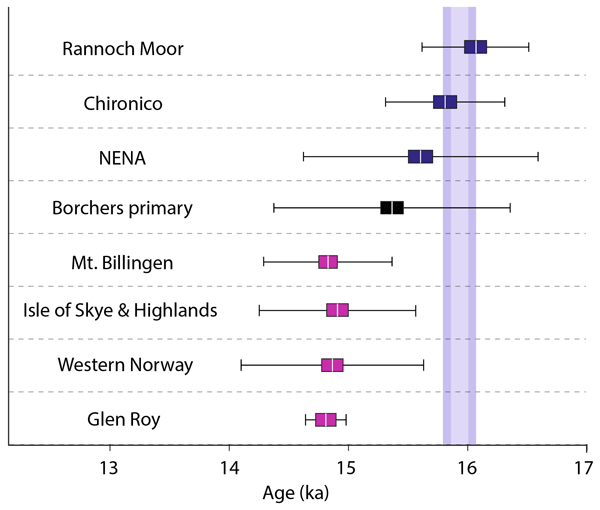
This paper reports new in situ cosmogenic 10Be (beryllium-10) production rate measurements from deglacial surfaces on the Redpoint Peninsula in north-west Scotland, exposed during retreat of the last British ice sheet. By comparing eight current 10Be production rates against local radiocarbon constraints for deglaciation, the study evaluates the viability of each production rate and reports a maximum sea-level high-latitude (SLHL) value of 3.925 ± 0.07 atoms g−1 yr−1. The Rannoch Moor 10Be production rate, calibrated against independently dated glacial landforms in the central Scottish Highlands, provides the best match with radiocarbon control and is deemed appropriate for Late Pleistocene applications at these geomagnetic latitudes. The research addresses ongoing uncertainties in cosmogenic nuclide surface-exposure dating, particularly for short-lived climate events like the last glacial termination.
Source
 bskyNew 10Be production rate constraints from north-west Scotland improve cosmogenic surface-exposure dating for the last glacial terminationgchron.copernicus.org
Key quotes
· 3 pulledCosmogenic nuclide surface-exposure dating (SED) is a rapidly growing tool in geoscience owing to its unrivalled potential for directly dating rock surfaces and thus the geomorphic and climatic events they represent.
There remains sufficient variability among production rates to undermine the reliability of derived surface-exposure ages, particularly for applications to short-lived events such as the abrupt climate shifts of the last glacial termination.
This study also demonstrates that the Rannoch Moor 10Be production rate, calibrated against independently dated glacial landforms in the central Scottish Highlands, gives the best match with the 14C control and thus is appropriate for Late Pleistocene applications at these geomagnetic latitudes.
You might also wanna read
Geochronology supports LGM age for human tracks at White Sands, New Mexico


Machine Learning Validates Unrecognized Transient Astronomical Phenomena in Historical Observatory Images
This research paper uses machine learning to validate the existence of previously unrecognized transient astronomical phenomena in historica
 arxiv.org·1mo ago
Geothermal Amoeba Sets New Upper Temperature Limit for Eukaryotes at 63°C
Researchers have discovered a novel geothermal amoeba, Incendiamoeba cascadensis, that divides at 63°C (145.4°F), establishing a new record
 biorxiv.org·6mo ago
New analysis suggests Snowball Earth climate cycles may be more complex than current models predict
This article examines the Snowball Earth and Slushball Earth hypotheses during the Sturtian glacial period of the Neoproterozoic Era. It dis
 Science X·1mo ago
VLT Study Reveals Dramatic Nickel Emission and CN Outgassing in Interstellar Comet 3I/ATLAS
Astronomers using the Very Large Telescope (VLT) have conducted spectroscopic observations of interstellar comet 3I/ATLAS (C/2025 N1) as it
arxiv.org·9mo ago
Antarctica's Cosmic Particle Detector Detects Strange Radio Pulses
A cosmic particle detector in Antarctica has detected strange radio pulses at steep angles below the ice surface, challenging current partic
psu.edu·1y agoComments
Sign in to join the conversation.
No comments yet. Be the first.