
























JWST Panchromatic Study Reveals KELT-7 b is a Metal-Enriched Ultra-Hot Jupiter Orbiting a Young Star
This paper presents the first panchromatic JWST transmission spectrum of KELT-7 b, an ultra-hot Jupiter exoplanet. The researchers combined NIRISS and NIRSpec observations to study the planet's atmosphere. They identified and mitigated charge migration artifacts in NIRISS data between 1-1.5 μm using a novel "late-ramp-fit" method. The analysis revealed that KELT-7 is a young (640±100 Myr), metal-rich star ([Fe/H]=0.46±0.02). Atmospheric retrievals found strong evidence for H₂O, CO₂, and TiO, but no H⁻ or clouds. The study constrained a super-stellar metallicity (M/H=92× Solar) and C/O ≤0.9, suggesting enhanced metal accretion during the planet's later formation stages. General Circulation Models explained the lack of limb asymmetry through superrotating jet-driven horizontal mixing. The work demonstrates the value of broad wavelength coverage for exoplanet atmosphere studies.
Key quotes
We present the first panchromatic JWST transmission spectrum of an ultra-hot Jupiter, combining NIRISS and NIRSpec observations to constrain KELT-7 b's atmospheric properties.
Our free retrieval, two equilibrium retrievals, and self-consistent grid fit all prefer a high metallicity but find discrepant C/O ratios.
The stark contrast between our panchromatic analysis and prior analyses on subsets of these data demonstrates the value of broad wavelength coverage for the comprehensive study of exoplanet atmospheres.
We constrain a super-stellar M/H=92^{+24}_{-23}× Solar and C/O ≤0.9, suggesting enhanced metal accretion in the later stages of KELT-7 b's formation.
Using the transit-derived stellar mean density during stellar property inference reveals that KELT-7 is a 640±100 Myr-old, [Fe/H]=0.46±0.02 star.
From the article
You might also wanna read


VLT Study Reveals Dramatic Nickel Emission and CN Outgassing in Interstellar Comet 3I/ATLAS
Astronomers using the Very Large Telescope (VLT) have conducted spectroscopic observations of interstellar comet 3I/ATLAS (C/2025 N1) as it
 arxiv.org·10mo ago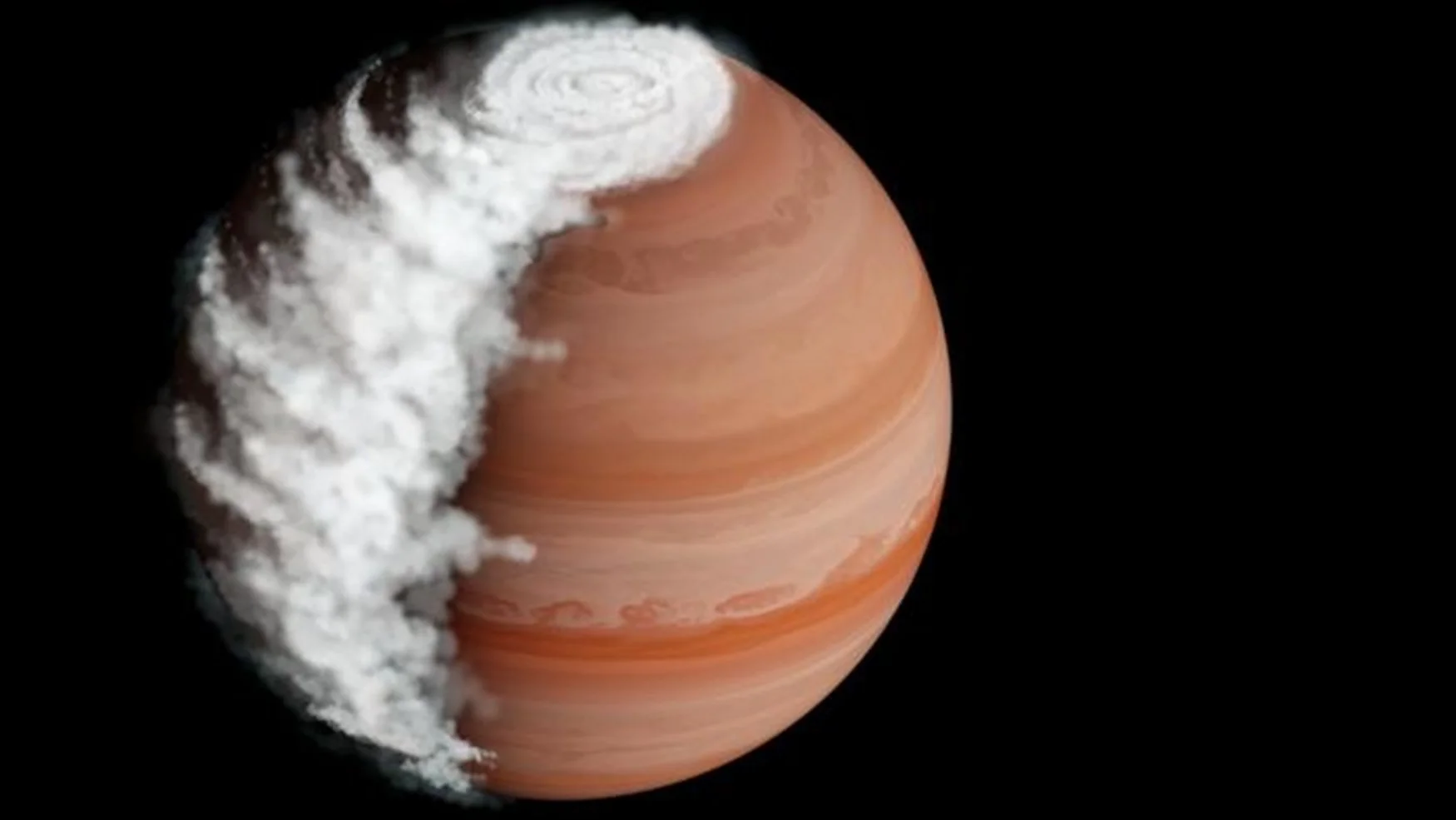
JWST reveals surprising atmospheric changes from morning to evening on Hot Jupiter WASP-94A b
The James Webb Space Telescope has revealed that WASP-94A b, a Hot Jupiter exoplanet with extreme temperatures and intense radiation, has an
 universal-sci.com·4d ago
JWST reveals Kamo`oalewa asteroid is enstatite-rich, not lunar-like, with 18-meter diameter
JWST observations of near-Earth asteroid (469219) Kamo`oalewa — a stable quasi-satellite of Earth and target of China's Tianwen-2 mission —
arxiv.org·5d agoAerosols and hydrocarbons in the atmosphere of a white dwarf planet
There is a planet that survived the death of its star, and now we know how it did it.

Candidate Giant Planet Detected in Habitable Zone of α Cen A via JWST Observations
The article reports on coronagraphic observations of the star α Cen A using the James Webb Space Telescope's MIRI instrument. A candidate gi
arxiv.org·11mo ago
Comments
Sign in to join the conversation.
No comments yet. Be the first.