
























New iron-based MOF captures CO₂ from flue gas and converts it to CO using light
By
Vera Koester
Summary
Researchers from City University of Hong Kong and USTC have developed a new family of iron-based metal–organic frameworks (MOFs) that can both capture CO₂ from gas streams (including dilute mixtures like flue gas) and use light to photochemically convert it into carbon monoxide (CO) in a single step. CO is a valuable precursor for fuels and industrial chemicals. The MOFs mimic enzyme-like pockets to achieve this two-in-one capture-and-conversion process.
Source

 bskyNew iron-based MOF captures CO₂ from flue gas and converts it to CO using lightchemistryviews.org
Key quotes
· 3 pulledBin Liu, City University of Hong Kong, P.R. China, Hai-Long Jiang, University of Science and Technology of China (USTC), Hefei, P.R. China, and colleagues have built a family of metal–organic frameworks (MOFs) that i) captures CO₂ from a gas stream and ii) uses light to convert it to carbon monoxide.
CO is a valuable precursor for fuels and other chemicals.
The team tested their MOFs in gas mixtures containing o
You might also wanna read


AI and Laboratory Automation Accelerate Discovery and Synthesis of Metal–Organic Frameworks: A Review
This review article examines how artificial intelligence and laboratory automation are converging to transform the discovery and synthesis o
 go.acs.org·2d ago
Sustainable Carbon-to-Acetylene Process with Barium Compounds
This article discusses a sustainable methodology for converting carbon sources into acetylene and carbon monoxide while capturing CO2 based
pubs.rsc.org·11mo ago
Nobel Prize in Chemistry 2025 Awarded for Development of Metal-Organic Frameworks
The 2025 Nobel Prize in Chemistry was awarded to Susumu Kitagawa, Richard Robson, and Omar M. Yaghi for their development of metal-organic f
 nobelprize.org·8mo ago
University of Helsinki Researchers Develop Efficient Carbon Dioxide Capture Method Using Superbase-Alcohol Compound
Researchers at the University of Helsinki have developed a new carbon capture method using a superbase-alcohol compound that can absorb 156
 helsinki.fi·5mo ago
Magnetic-field-assisted CO2 electroreduction using precision-engineered Ga–Gd oxide nanodomain interfaces
This article presents original scientific research on a novel approach to CO2 electroreduction using magnetic-field-assisted catalysis at pr
 pubs.acs.org·15h ago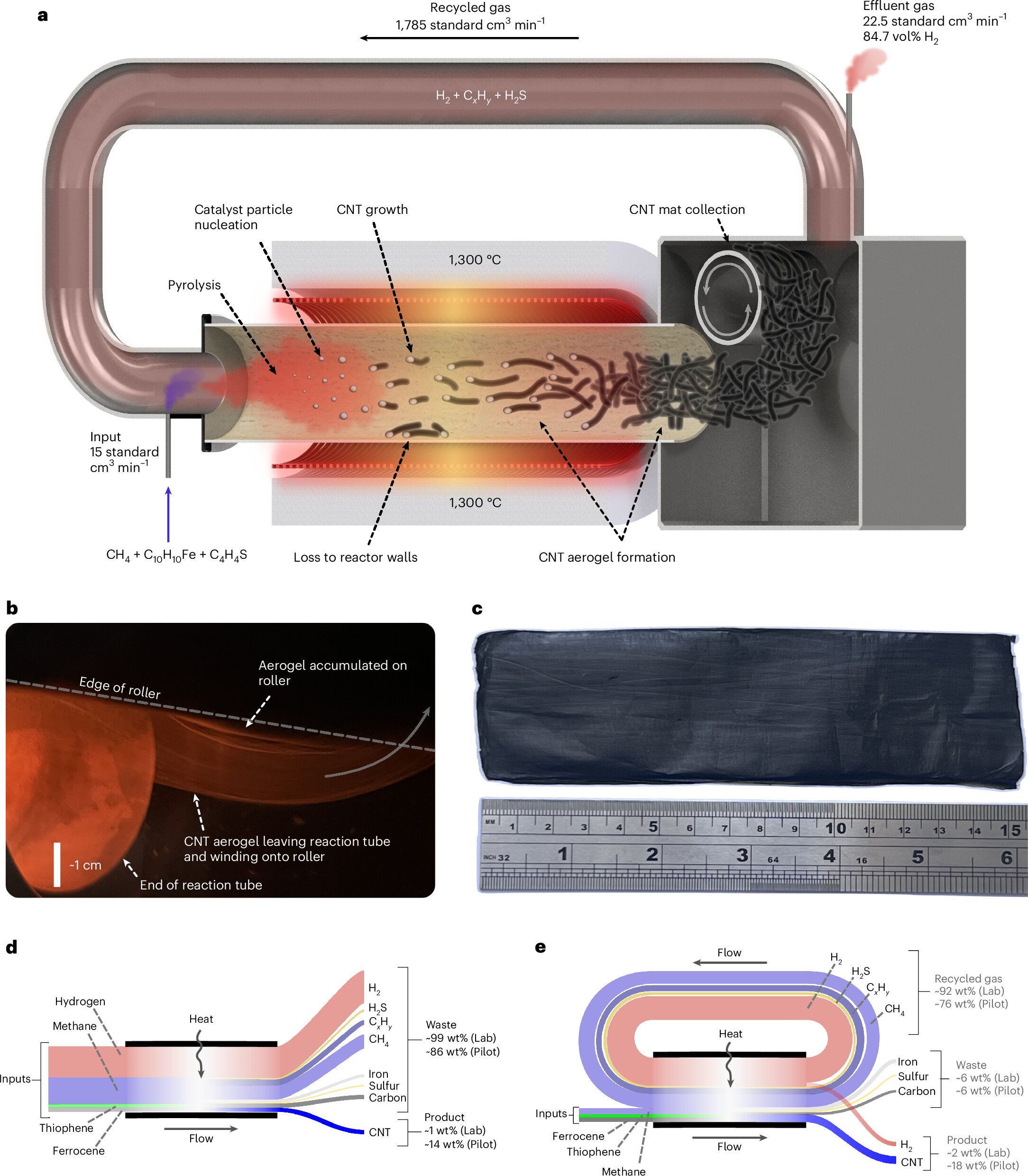
Cambridge Researchers Develop Reactor That Produces Hydrogen and Carbon Nanotubes from Natural Gas
University of Cambridge scientists have developed a novel reactor that simultaneously produces clean hydrogen fuel and carbon nanotubes from
 phys.org·6mo ago
Comments
Sign in to join the conversation.
No comments yet. Be the first.