
























AI and Laboratory Automation Accelerate Discovery and Synthesis of Metal–Organic Frameworks: A Review
By
Zhuo Wang
Summary
This review article examines how artificial intelligence and laboratory automation are converging to transform the discovery and synthesis of metal–organic frameworks (MOFs). MOFs are tunable crystalline materials with applications in energy storage, drug delivery, and environmental remediation, but their synthesis is complex due to high structural diversity. The review highlights how automation streamlines repetitive tasks, enables high-throughput screening of reaction conditions, and accelerates optimization of synthesis processes, while AI contributes to predicting structures and guiding experimental design.
Source

 Twitter / XAI and Laboratory Automation Accelerate Discovery and Synthesis of Metal–Organic Frameworks: A Reviewgo.acs.org
Key quotes
· 3 pulledThis review discusses the transformative impact of the convergence of artificial intelligence (AI) and laboratory automation on the discovery and synthesis of metal–organic frameworks (MOFs).
MOFs, known for their tunable structures and extensive applications in fields such as energy storage, drug delivery, and environmental remediation, pose significant challenges due to their complex synthesis processes and high structural diversity.
Laboratory automation has streamlined repetitive tasks, enabled high-throughput screening of reaction conditions, and accelerated the optimization of synthesis.
You might also wanna read


Nobel Prize in Chemistry 2025 Awarded for Development of Metal-Organic Frameworks
The 2025 Nobel Prize in Chemistry was awarded to Susumu Kitagawa, Richard Robson, and Omar M. Yaghi for their development of metal-organic f
 nobelprize.org·8mo ago
New iron-based MOF captures CO₂ from flue gas and converts it to CO using light
Researchers from City University of Hong Kong and USTC have developed a new family of iron-based metal–organic frameworks (MOFs) that can bo
 chemistryviews.org·16h ago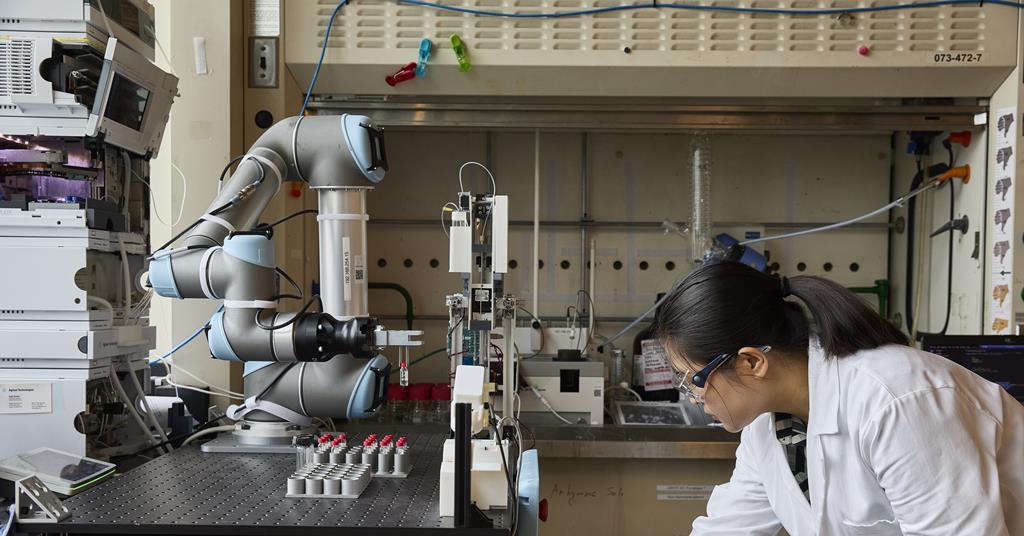
AI agents accelerate catalyst discovery from simulation to industrial scale-up
AI agents are revolutionizing catalyst research by automating tasks that previously took computational chemists days, completing them in min
 chemistryworld.com·10d ago
Light-activated MOF captures and converts carbon dioxide from power plant exhaust
This article discusses a new metal-organic framework (MOF) that uses light to capture and convert carbon dioxide from simulated power plant
 cen.acs.org·1d ago
Facilitating structure-based drug discovery with an artificial intelligence-driven virtual screening platform

OpenAI and Molecule.one demonstrate GPT-5.4-powered AI chemist improving medicinal chemistry reactions
OpenAI and Molecule.one demonstrate a near-autonomous AI chemist using GPT-5.4 that successfully improved a challenging reaction in medicina
 openai.com·8d ago
Comments
Sign in to join the conversation.
No comments yet. Be the first.