
























JWST Observations Reveal Sun-like Starspot Properties on Young Solar Analog V1298 Tau
By
[Submitted on 15 Jun 2026]
Summary
This scientific paper analyzes JWST NIRISS/SOSS transit observations of the young (20-30 Myr) solar analog star V1298 Tau and its exoplanets b, c, and d. Researchers identified 14 starspot crossing events across two visits and derived 0.8-2.8μm starspot contrast spectra. They found that the starspots on V1298 Tau have umbral temperatures of 3265-3436 K and penumbral temperatures of 4388-4659 K, with spots being ~30% umbrae by area. The relationship between spot contrast and umbral-to-penumbral area ratio is similar to that of the Sun, suggesting that while total spot coverage evolves over time, the relative temperatures of surface heterogeneities on Sun-like stars may remain consistent throughout their lifetimes. The study also used long-baseline multi-band photometry to estimate global unocculted spot distributions, revealing at least 5 additional large active regions.
Source

 bskyJWST Observations Reveal Sun-like Starspot Properties on Young Solar Analog V1298 Tauarxiv.org
Key quotes
· 5 pulledThe spot temperatures are broadly consistent between visits, suggesting that V1298~Tau ($T_\mathrm{phot}=4880\pm20$ K) has starspots with $T_{\mathrm{umbra}}$ = 3265--3436 K umbrae and $T_{\mathrm{penumbra}}$ = 4388--4659 K penumbrae, and are $\sim$30% umbrae by area.
The differences between these spot components and the stellar photosphere are consistent with sunspots.
These measurements suggest that while the total spot coverage evolves in time, the relative temperatures of surface heterogeneities on Sun-like stars may be consistent throughout their lifetimes.
These results demonstrate that JWST exoplanet transit observations can be useful for starspot substructure characterization.
Transiting exoplanets provide a unique laboratory for studying stellar surface heterogeneities via starspot or facular occultations.
You might also wanna read


JWST captures stunning image of protostar system FS Tau, revealing episodic star formation
A new JWST image captures the FS Tau star system, located 450 light-years away, revealing protostars with dramatic outflows of gas and dust.
 space.com·16h ago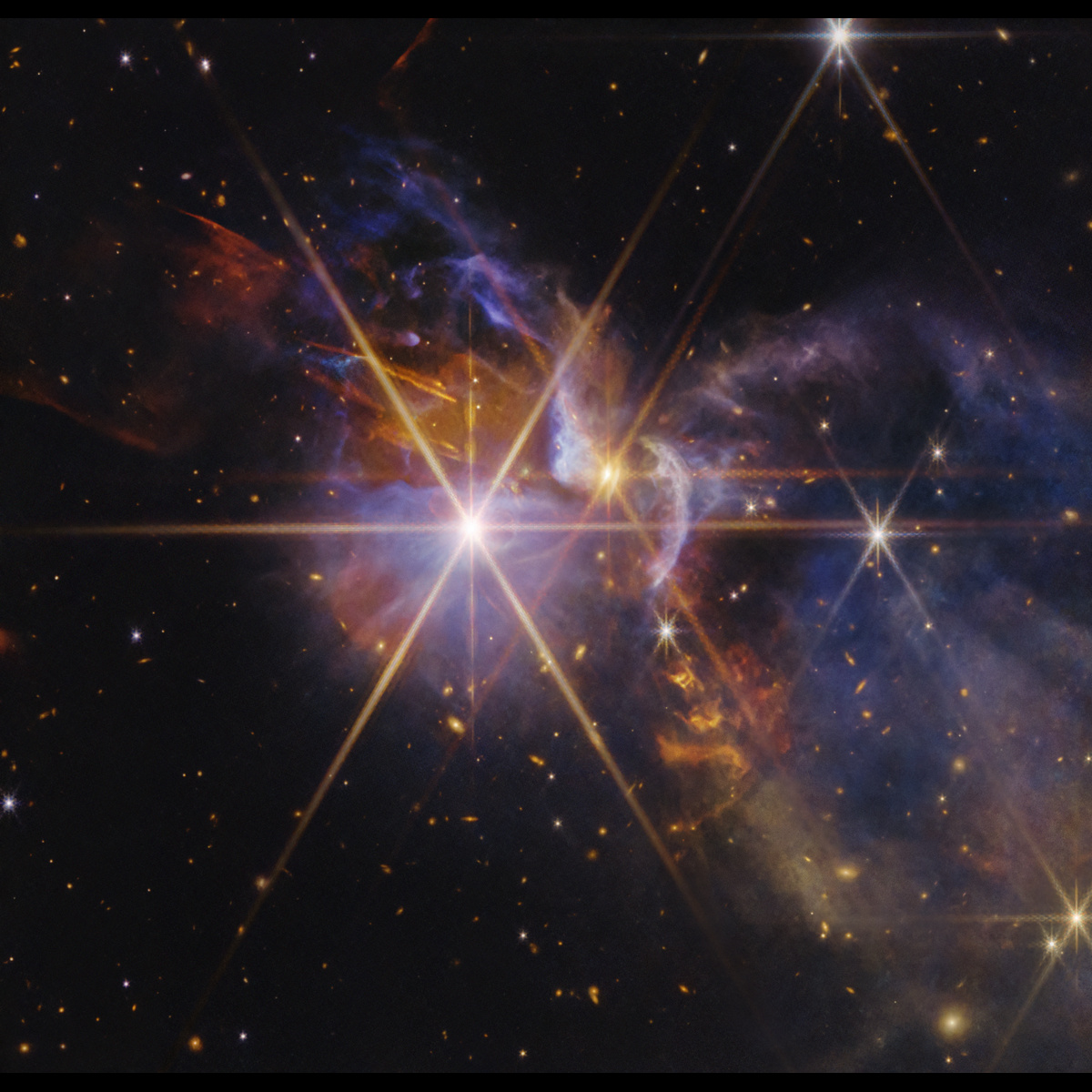
NASA's Webb Telescope Reveals Protostars Shaping Their Environment in the FS Tau System
NASA's James Webb Space Telescope has captured high-resolution images of the FS Tau young star system, located about 450 light-years away. T
 news.stsci.edu·1d ago
Candidate Giant Planet Detected in Habitable Zone of α Cen A via JWST Observations
The article reports on coronagraphic observations of the star α Cen A using the James Webb Space Telescope's MIRI instrument. A candidate gi
arxiv.org·11mo ago
JWST reveals Kamo`oalewa asteroid is enstatite-rich, not lunar-like, with 18-meter diameter
JWST observations of near-Earth asteroid (469219) Kamo`oalewa — a stable quasi-satellite of Earth and target of China's Tianwen-2 mission —
arxiv.org·9h ago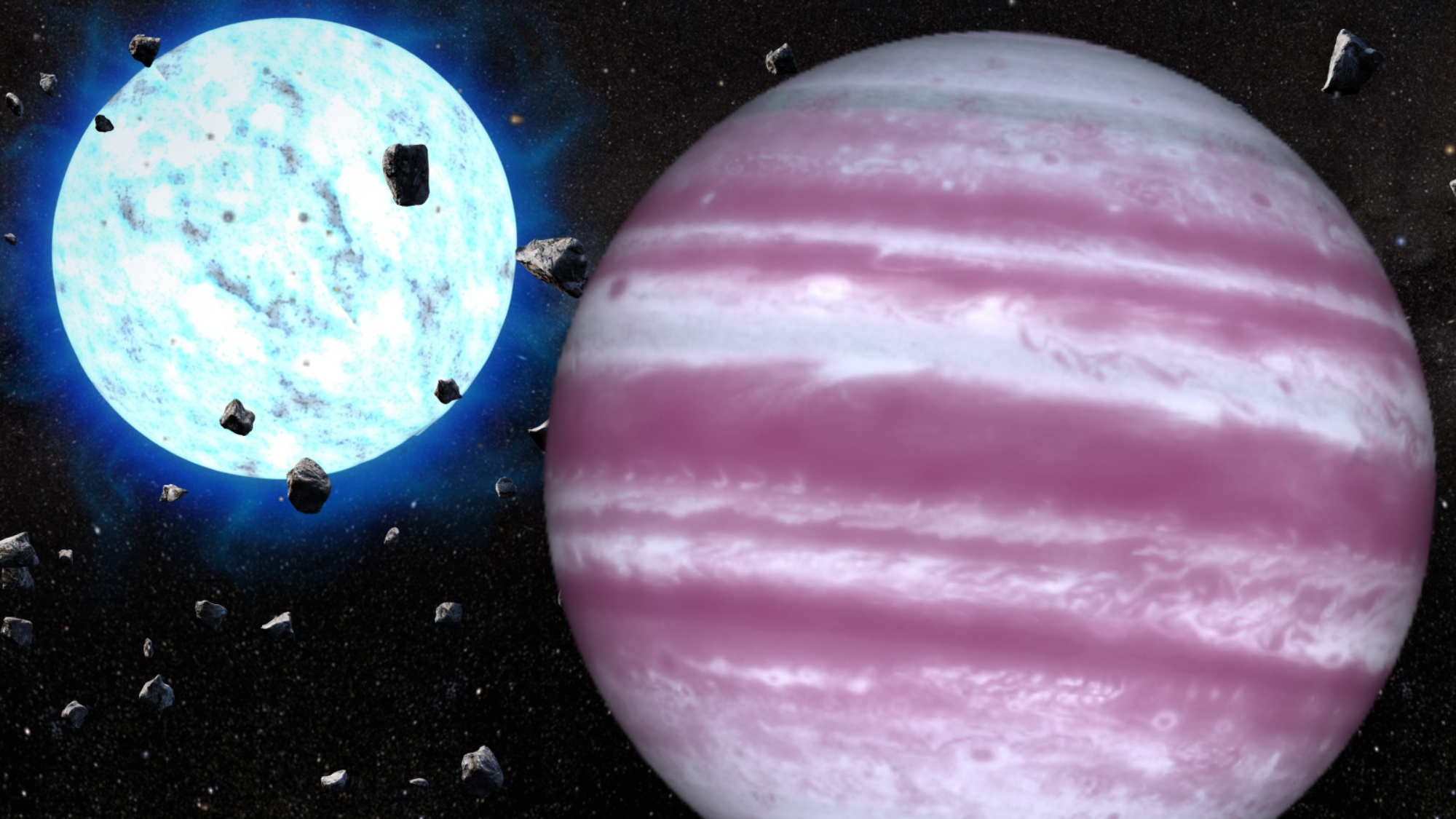
James Webb Space Telescope observes gas giant orbiting a dead white dwarf star, foreshadowing the solar system's distant future
Astronomers using the James Webb Space Telescope (JWST) observed the gas giant exoplanet WD 1856 b orbiting a white dwarf star 80 light-year
 space.com·1d ago
James Webb Space Telescope observes gas giant orbiting a dead white dwarf star, foreshadowing the solar system's distant future
Astronomers using the James Webb Space Telescope (JWST) observed the gas giant exoplanet WD 1856 b orbiting a white dwarf star 80 light-year
space.com·1d ago
VLT Study Reveals Dramatic Nickel Emission and CN Outgassing in Interstellar Comet 3I/ATLAS
Astronomers using the Very Large Telescope (VLT) have conducted spectroscopic observations of interstellar comet 3I/ATLAS (C/2025 N1) as it
arxiv.org·10mo ago
Comments
Sign in to join the conversation.
No comments yet. Be the first.