
























JWST and Dark Energy Camera Data Revisit the Bullet Cluster's Mass Mystery
By
Kerry Hensley
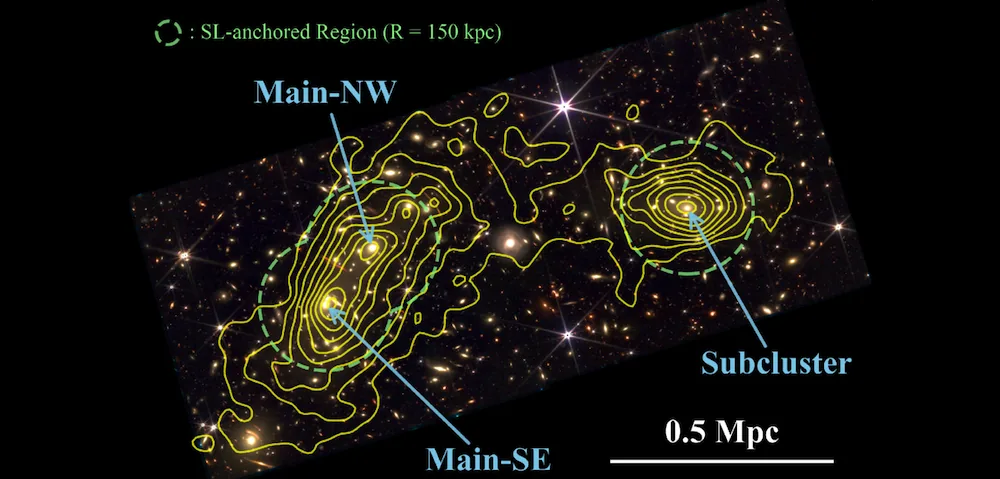
Summary
Researchers led by Boseong Young Cho (Yonsei University) used new data from JWST and the Dark Energy Camera to revisit the Bullet Cluster — a galaxy cluster long considered key evidence for dark matter. They aimed to resolve a two-decade-old discrepancy in measurements of the merging clusters' dynamical mass ratio, which has yielded vastly different results across different studies.
Source
 bskyJWST and Dark Energy Camera Data Revisit the Bullet Cluster's Mass Mysteryaasnova.org
Key quotes
· 3 pulledThe Bullet Cluster is best known for being considered a 'smoking gun' for the existence of dark matter, but even a famous galaxy cluster like this one has its secrets.
For more than two decades, different measurements of the merging clusters' dynamical mass ratio have yielded vastly different results.
Boseong Young Cho (Yonsei University) and collaborators used data from JWST and the Dark Energy Camera to revisit the Bullet Cluster and measure its mass ratio using new data.
You might also wanna read

Astrophysicists Grapple with Unexpected JWST Discoveries of Early Galaxies and Black Holes
Astrophysicists are grappling with unexpected discoveries from the James Webb Space Telescope (JWST), particularly "little red dots" — myste
 quantamagazine.org·5d ago
Astrophysicists Grapple with Unexpected JWST Discoveries of Early Galaxies and Black Holes
Astrophysicists are grappling with unexpected discoveries from the James Webb Space Telescope (JWST), particularly "little red dots" — myste
quantamagazine.org·5d ago
JWST discovers highly evolved galaxy cluster at cosmic noon, challenging theories of early universe structure formation
Astronomers using the James Webb Space Telescope have observed XLSSC 122, a massive and densely packed galaxy cluster at 'cosmic noon' — a p
 space.com·8d ago
JWST discovers highly evolved galaxy cluster at cosmic noon, challenging theories of early universe structure formation
Astronomers using the James Webb Space Telescope have observed XLSSC 122, a massive and densely packed galaxy cluster at 'cosmic noon' — a p
space.com·8d ago
Echo mapping technique reveals hints of dark matter clusters around supermassive black holes
Astronomers using a technique called echo mapping have found evidence suggesting that supermassive black holes, including Sagittarius A* at
 space.com·17d ago
JWST Discovers Mysterious 'Little Red Dots' in Early Universe, Possibly New Celestial Objects
NASA's JWST telescope has discovered hundreds of 'little red dots' in the early universe, which may represent a new type of celestial object
 science.org·11mo ago
Comments
Sign in to join the conversation.
No comments yet. Be the first.