
























Study suggests Homo floresiensis scavenged meat left by Komodo dragons rather than hunting big game
By
James Woodford
Summary
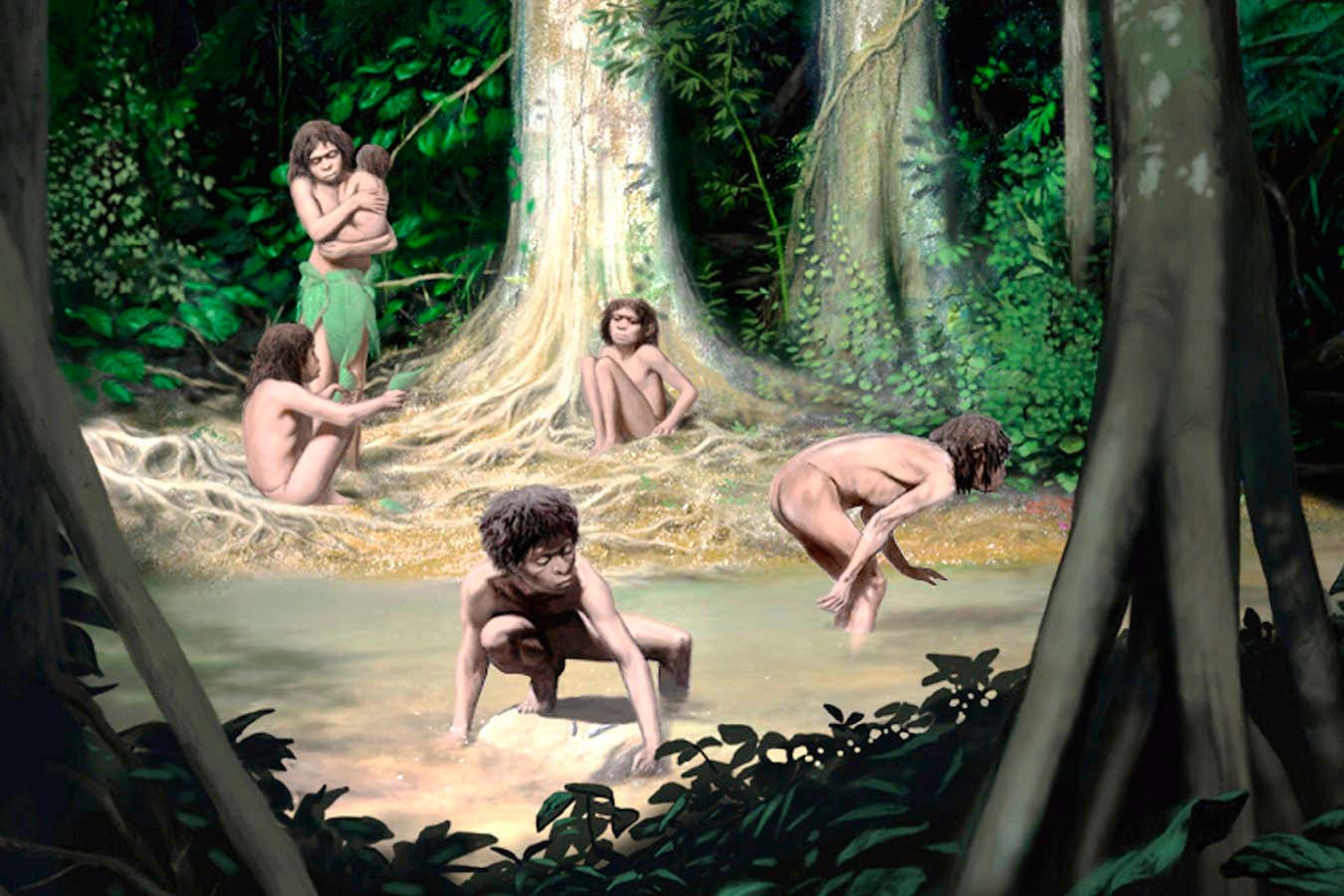
A study of animal bones found in caves on Flores, Indonesia, suggests that Homo floresiensis (the 'hobbit' hominins) had limited hunting skills and likely scavenged meat left behind by Komodo dragons. The research involved feeding a dead goat to a Komodo dragon and analyzing thousands of ancient bones, challenging earlier assumptions that these small ancient humans were skilled hunters of big game or masters of fire.
Source
 Twitter / XStudy suggests Homo floresiensis scavenged meat left by Komodo dragons rather than hunting big gamenewscientist.com
Key quotes
· 3 pulledThe diminutive ancient humans nicknamed hobbits that lived on the Indonesian island of Flores until around 50,000 years ago had limited hunting skills, according to a study of animal bones found in their caves.
Instead, researchers think they scavenged meat that was left behind by Komodo dragons.
An experiment that involved feeding a dead goat to a Komodo dragon as well as an analysis of thousands of ancient bones suggests that Homo floresiensis was neither a skilled hunter of big game nor a master of fire
You might also wanna read


The agropastoral debate in context: the relationship between the consumption and management of animals at Azoria on Crete - Archaeological and Anthropological Sciences

Archaeological Study Reveals Complex Plant-Based Diets of Prehistoric Europeans Through Pottery Residue Analysis
Archaeological research analyzing pottery residues from prehistoric European sites reveals complex plant-based diets and cooking practices.
 arstechnica.com·3mo ago
Proteins from 400,000-year-old Homo erectus teeth reveal genetic links to Denisovans and modern humans
A new study published in Nature reveals that researchers have successfully extracted and analyzed proteins from the enamel of six Homo erect
 doi.org·15d ago
How food processing by women and children shaped human evolution beyond hunting
This article challenges the traditional "man the hunter" narrative of human evolution by arguing that food processing—primarily done by wome
 brewminate.com·23d ago
Million-Year-Old Skull Discovery May Rewrite Timeline of Modern Human Origins
A million-year-old human skull discovered in China, previously classified as Homo erectus, has been reanalyzed using sophisticated reconstru
 theguardian.com·8mo ago
Ancient squirrel feces preserved in permafrost reveal Ice Age ecosystem details through DNA analysis
Researchers analyzed ancient ground squirrel feces (coprolites) preserved in the Yukon permafrost to reconstruct Ice Age ecosystems. The pel
 sciencenews.org·24d ago
Comments
Sign in to join the conversation.
No comments yet. Be the first.