The FinCEN rule reversal isn't just a policy tweak. It guts the corporate transparency rule that forced companies to reveal real owners, making it easier to launder money through US shell companies. The Atlantic frames it as a deliberate reopening of the American economy to corrupt actors.
financeTuesday, August 18, 2026
FinCEN rule reversal opens money laundering door
The big story today is the Trump administration's quiet dismantling of anti-corruption rules, capped by FinCEN scrapping the shell company rule. That's a direct invitation to money launderers, and it's the kind of thing that changes the risk calculus for every financial institution. Meanwhile, the AI wealth effect is warping housing markets, and crypto keeps dancing to equities' tune.
Corruption's green light
The administration's anti-corruption rollback is the day's most consequential financial story, with the FinCEN rule change making the US a haven for illicit wealth.
This open letter to Congress makes a straightforward conflict-of-interest case: Trump can launch crypto ventures and then influence their regulation. It's a pointed reminder that the crypto industry's regulatory fate is tangled with the president's personal finances.
AI's economic ripples
The AI boom's effects are spreading beyond tech stocks, inflating housing prices and boosting server makers, even as some warn of a bubble.
The AI boom is now a housing story. San Francisco's market is frothing again, with tech workers bidding homes a million over asking. That's a concrete, local consequence of the AI wealth concentration, and it's a sign the boom is spilling into the real economy.

A tame inflation report gave stocks a lift, and Goldman is betting on AI infrastructure demand for Dell, HPE, and NetApp. That's a useful counterpoint to bubble fears: the sell-side still sees real spending on servers and storage.
Crypto's equities tether
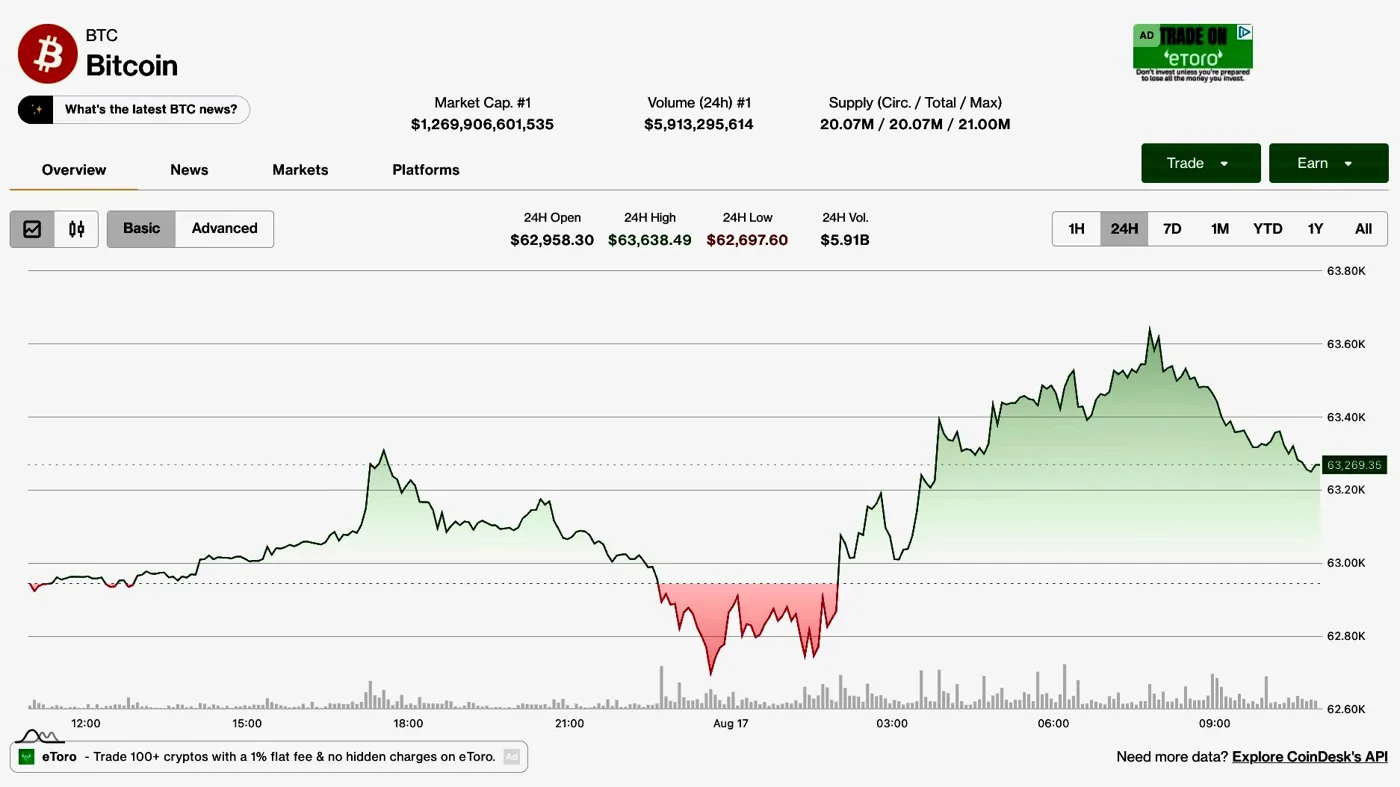
Bitcoin continues to follow stock market moves, with ETF outflows and underperformance against the S&P 500 tempering any optimism.
Bitcoin is still trading like a risk asset, bouncing with equities but held back by a $390 million ETF outflow week. The recovery is real but fragile, and the ETF outflows are the clearest sign of waning institutional appetite.
Also today15
Chase Ink Business Preferred® Credit Card – 3 Reasons It’s One Of The Best!www.pointswithacrew.com
Nasdaq and S&P 500 Outlook Today: Tech Stocks, US Futures and Index Pressurebotpredictai.com
Bitcoin Tops Stocks but Trails S&P 500 Over Three Monthscoinomedia.com
July 2026 Summary!www.finveztor.com
Bitmine Immersion Technologies Surges in Ethereum Holdings, Totaling $11.4 Billionthird-news.com
Binance gave Russia client data used in Ukraine donation casewww.coindesk.com
Widow tax scrapped in exchange for NDIS reform supporttheqldr.com.au
The Australian federal government has scrapped a so-called "widow tax" — an unintended consequence of its budget tax reforms that risked negative gearing entitlements on investment properties. The removal comes after Labor reached a deal with the coalition, exchanging support for
Stripe Purchase Of AI Firm OpenRouter Unlikely To Derail PayPal Dealwww.investors.com
This article from Investor's Business Daily reports on PayPal's stock dip as analysts evaluate how Stripe's acquisition of AI firm OpenRouter could affect a potential takeover of the payments company. The piece analyzes the market reaction and the implications of Stripe's AI-rela
Duos outlines 2027 revenue of at least $160M as Axe Compute expands to 55 MWseekingalpha.com
Duos Technologies Group (DUOT) reported Q2 2026 earnings, highlighting its transformation into a data center and AI infrastructure company. The company outlined revenue guidance of at least $160M for 2027, with 2026 revenue expected to exceed $50M. The earnings call recap covers
World Bank group funds 65% of petrochemicals projects studied by new IEEFA and IAP trackerieefa.org
World Bank group funds 65% of petrochemicals projects studied by new IEEFA and IAP tracker amanocha.ieefa Tue, 08/18/2026 - 16:09
ADI reports Q3 on 19 August. Last quarter 72.5% of every new sales dollar became operating profit; the $3.9bn guide implies about 50%.
What Moves the Japanese Yen? The Forces Behind JPYpiptheory.com
The Japanese yen is driven by Bank of Japan policy, rate differentials (JPY is the classic carry-trade funding currency), safe-haven flows, and periodic government intervention. Here's how each force works.
Sandisk Stock Is Down 30% From Its Peak: Is the Memory Winner Still a Screaming Buy Before September?www.fool.com
Sandisk's future is out of its hands.
Food inflation hits 20.31% in July 2026, highest since September 2025nairametrics.com
Nigeria’s food inflation rate rose to 20.31% year-on-year in July 2026, marking its highest level since September 2025 despite a further decline in the country’s headline inflation rate. The post Food inflation hits 20.31% in July 2026, highest since September 2025 appeared first
NIVEA targets Gen Z with science-backed glow rangewww.thehindubusinessline.com
The range targets common skin concerns, dullness, dark spots, open pores, and dehydration, through a combination of active ingredients
More roundups that day
Kennedy Center, AI, and Art's New Battles
Carbon capture's real hurdle isn't technical
Disability justice meets fat liberation