
























Witness expansion: A unified framework for detecting quantum resources in mixed states
By
Author comments: 19+58 pages, 2 figures, comments are very welcome!
Summary
This paper proposes "witness expansion," a unified theoretical framework for constructing nonlinear criteria to detect quantum resources in both pure and mixed quantum states. The framework is based on polynomial functions of the target state and applies to resources associated with a well-defined group of free unitaries. The authors demonstrate that several well-known resource-detection quantities naturally emerge from their framework, including the l2 norm of coherence, partial-transpose moments for entanglement, stabilizer entropy for nonstabilizerness (quantum magic), and fermionic antiflatness for fermionic non-Gaussianity. Beyond recovering existing structures, the framework yields new criteria for detecting qubit and qudit magic states and provides the first analytical criterion for detecting mixed-state fermionic non-Gaussianity with respect to the convex hull of pure fermionic Gaussian states that remains nontrivial for arbitrary numbers of qubits.
Source

 Twitter / XWitness expansion: A unified framework for detecting quantum resources in mixed statesscirate.com
Key quotes
· 5 pulledQuantum information science aims to harness different kinds of quantum resources to accomplish specific information-processing tasks.
We propose witness expansion, a unified framework for constructing nonlinear criteria for detecting quantum resources that are associated with a well-defined group of free unitaries.
These criteria apply to both pure and mixed quantum states and are based on polynomial functions of the target state, which can be estimated experimentally using multiple copies of the state and evaluated analytically in certain physical models.
We show how several well-known resource-detection quantities naturally emerge from our framework, including the $l_2$ norm of coherence, partial-transpose moments for entanglement, stabilizer entropy for nonstabilizerness (quantum magic), and fermionic antiflatness for fermionic non-Gaussianity.
It gives, to the best of our knowledge, the first analytical criterion for detecting mixed-state fermionic non-Gaussianity with respect to the convex hull of pure fermionic Gaussian states that remains nontrivial for arbitrary numbers of qubits.
You might also wanna read

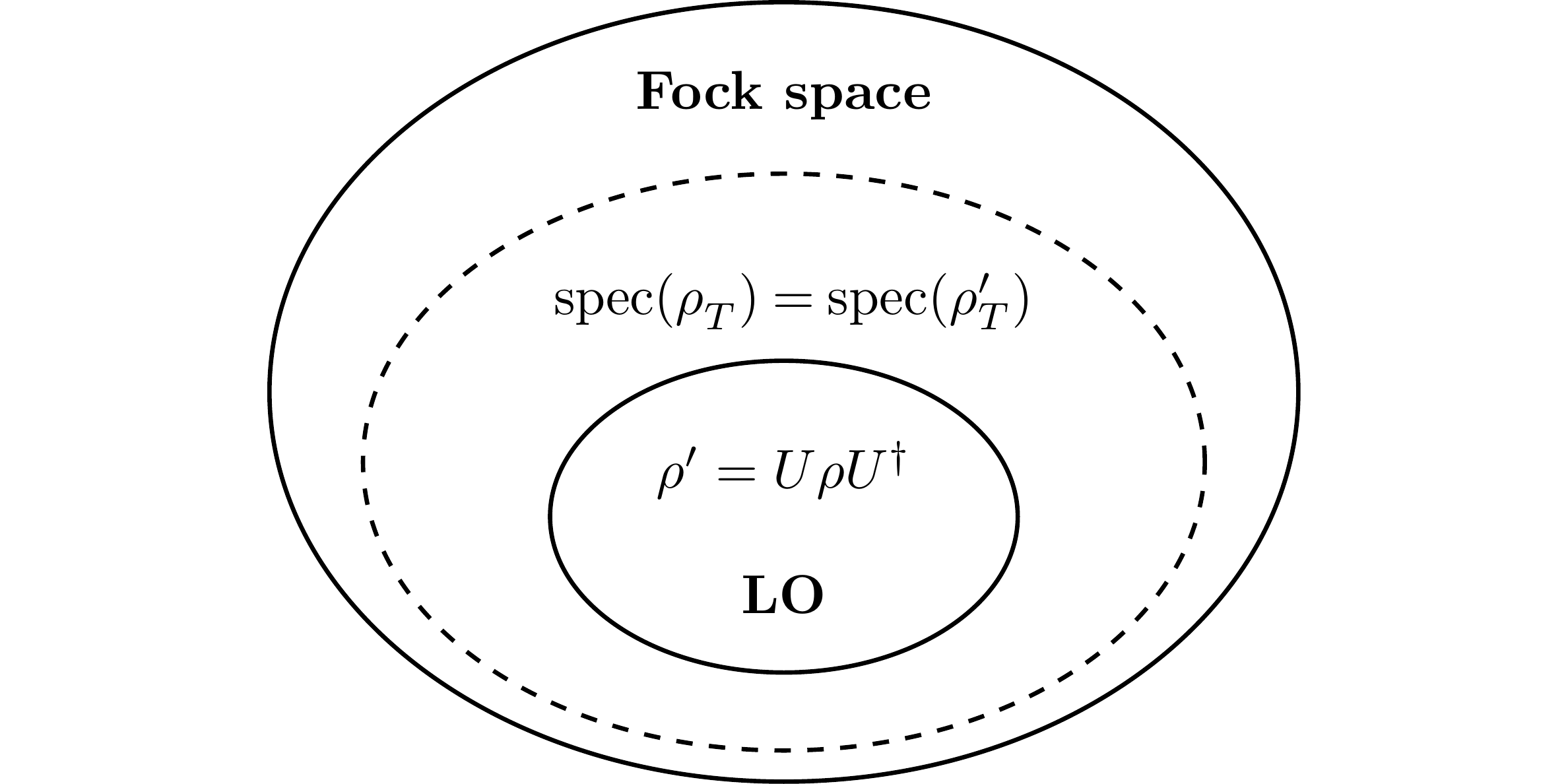
Lie algebraic invariants in passive linear optical quantum systems
This research paper presents a method for deriving conserved quantities (invariants) in quantum linear optics without post-selection. The au
 quantum-journal.org·15d ago
Limitations and improvements of chain rules for conditional entropies in quantum cryptography security proofs
This article discusses chain rules for conditional entropies in quantum cryptography, which are essential for security proofs against genera
 arxiv.org·1mo ago
Anyonic Exchange Statistics Enhance Quantum Machine Learning Performance
This research paper introduces a quantum kernel framework that unifies bosonic, fermionic, and anyonic (fractional) exchange statistics with
arxiv.org·13d ago
Quantum research reveals when entanglement hinders rather than helps channel discrimination
This research paper investigates the role of entanglement in quantum channel discrimination, challenging the common assumption that more ent
arxiv.org·28d ago
New bounds dramatically reduce measurement requirements for quantum simulations
Researchers led by Siheon Park at Seoul National University have derived new bounds on the sample complexity needed for simulating open quan
 iq.fp2.dev·23d ago
New 1D Lattice Framework Enables Near-Optimal Quantum Simulation of Nonunitary Dynamics
Researchers have developed a new framework that converts nonunitary dynamics into unitary dynamics suitable for quantum computers, using a "
quantumzeitgeist.com·22d ago
Comments
Sign in to join the conversation.
No comments yet. Be the first.