
























Lie algebraic invariants in passive linear optical quantum systems
Summary
This research paper presents a method for deriving conserved quantities (invariants) in quantum linear optics without post-selection. The authors provide a recipe to identify invariants in the evolution of arbitrary states through passive linear interferometers, with a key example being the spectrum of a density matrix mapped onto the Lie algebra of passive linear optical Hamiltonians. This work addresses the fundamental limitations of linear optical state preparation, which cannot produce arbitrary quantum states from given inputs without post-selection, hindering applications that require entangled resources.
Source
 bskyLie algebraic invariants in passive linear optical quantum systemsquantum-journal.org
Key quotes
· 4 pulledQuantum linear optics without post-selection is not powerful enough to produce any quantum state from a given input state.
This limits its utility since some applications require entangled resources that are difficult to prepare.
In this work, we give a recipe to derive conserved quantities in the evolution of arbitrary states along any possible passive linear interferometer.
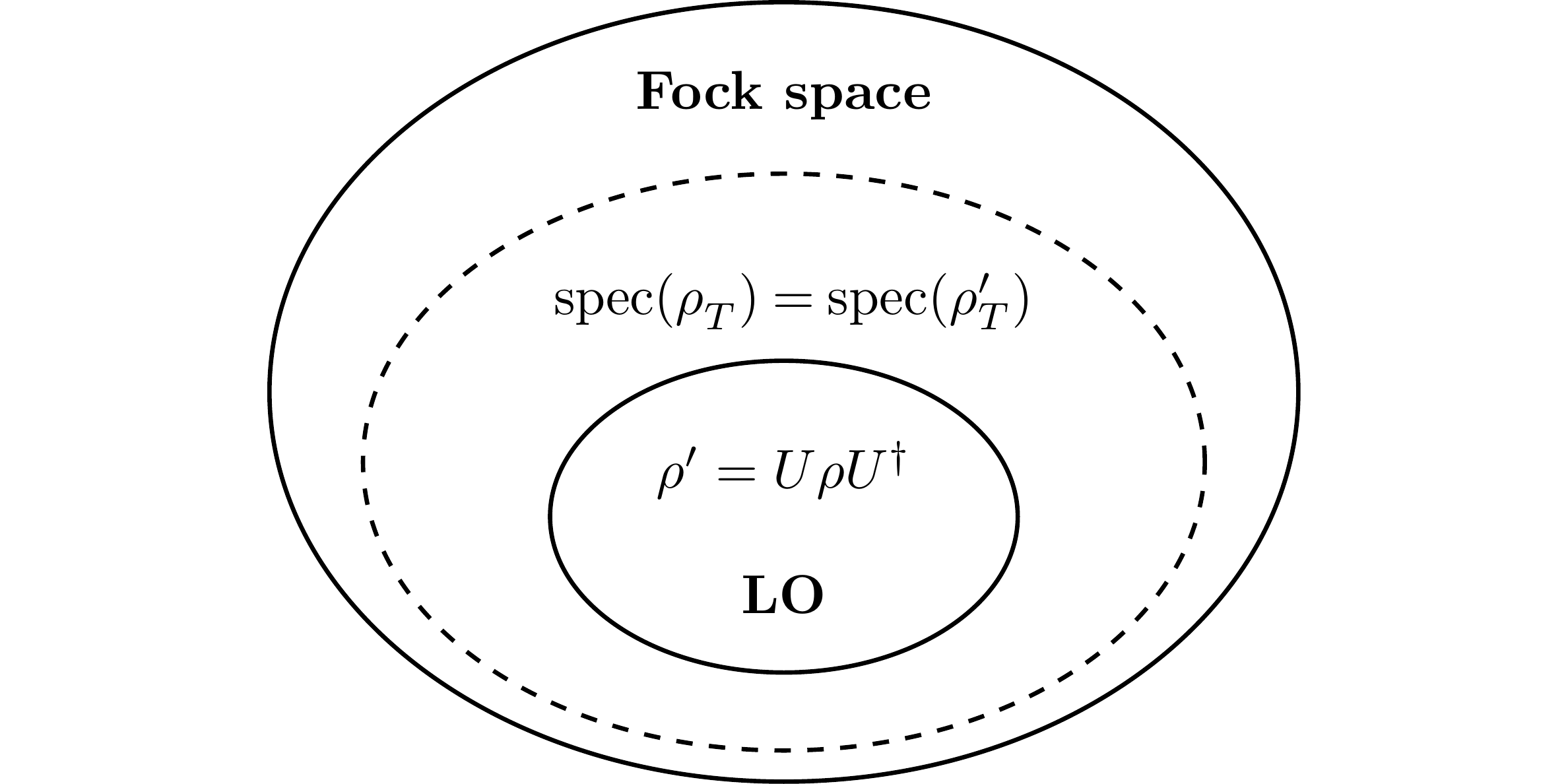
One example of such an invariant is the spectrum of a density matrix mapped onto the Lie algebra of passive linear optical Hamiltonians.
You might also wanna read


Witness expansion: A unified framework for detecting quantum resources in mixed states
This paper proposes "witness expansion," a unified theoretical framework for constructing nonlinear criteria to detect quantum resources in
 scirate.com·3d ago
Generating Gottesman–Kitaev–Preskill Qubit States Using Integrated Photonic Chip
The article discusses the generation of Gottesman–Kitaev–Preskill (GKP) qubit states using an ultra-low-loss integrated photonic chip, pavin
nature.com·11mo ago
Exploring Quantum Brain Dynamics: Super-Radiance with Light and Sound Waves in Microtubules
The article discusses the derivation of super-radiance solutions involving coherent light and sound waves within the environment of a microt
researchgate.net·11mo ago
Emergence of Euclidean 3-Space from Quantum Temporal Correlations
The article discusses how Euclidean 3-space emerges from quantum temporal correlations in sequential measurements of Pauli observables on a
arxiv.org·1y ago
Comments
Sign in to join the conversation.
No comments yet. Be the first.