
























Webb Telescope reveals how a Jupiter-sized exoplanet survived its star's death and now orbits a white dwarf
Summary
An international team of astronomers used the James Webb Space Telescope to study exoplanet WD 1856 b, a Jupiter-sized planet orbiting a white dwarf star. The planet completes an orbit every 34 hours at a distance of less than 3 million km from the stellar remnant. Webb measured the planet's mass, temperature, and detected its atmosphere, finding it significantly warmer than expected. The research provides insights into how this planet survived its host star's red giant phase—which should have engulfed and destroyed nearby planets—and offers a window into the possible future of Jupiter-like planets after the Sun's death billions of years from now.
Source
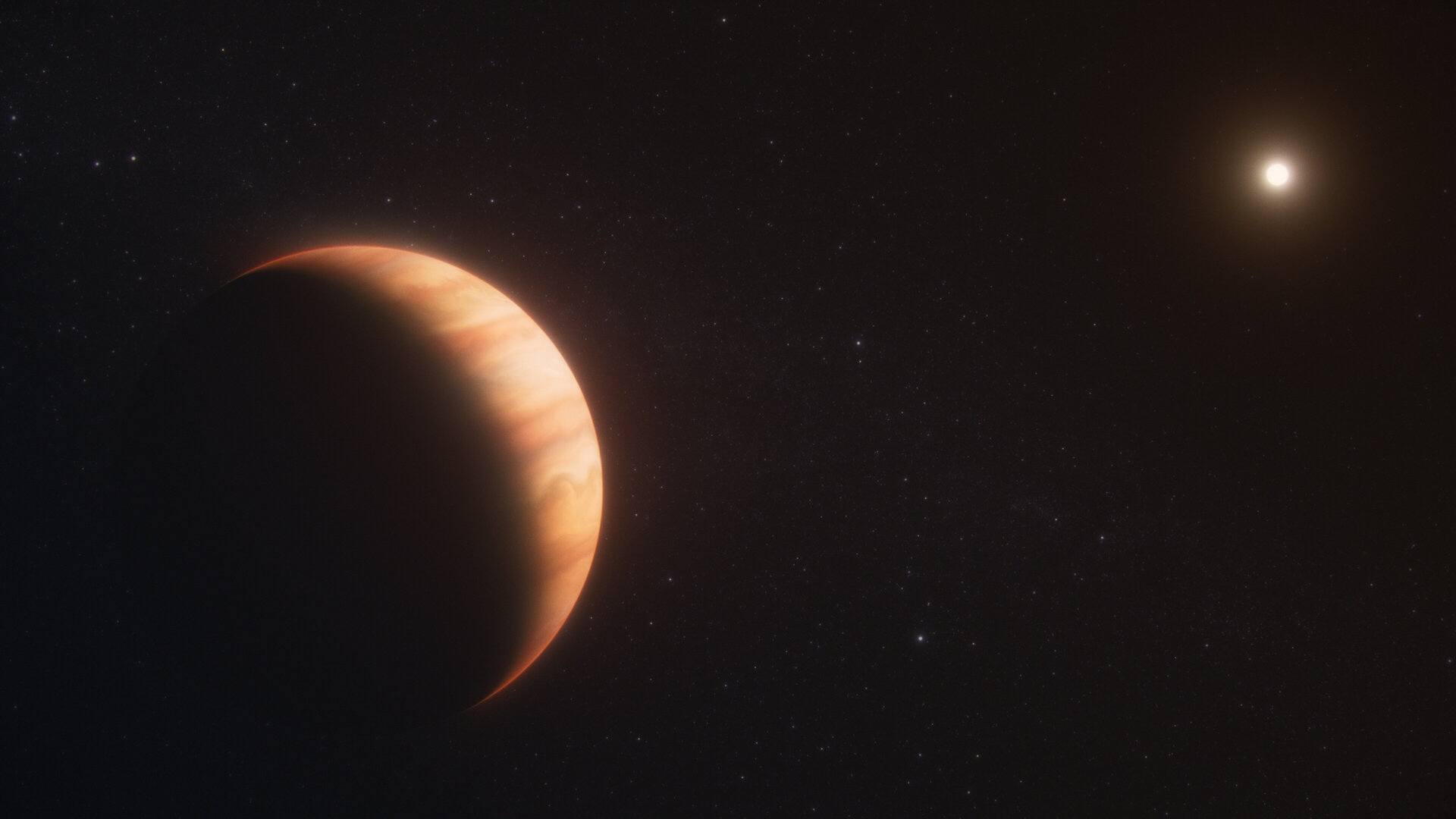 bskyWebb Telescope reveals how a Jupiter-sized exoplanet survived its star's death and now orbits a white dwarfesa.int
Key quotes
· 3 pulledThe results are our first window into the future of planets like Jupiter after the death of the Sun, billions of years into the future.
As a red giant, the star should have engulfed and destroyed any nearby planets.
They found that the planet is significantly warmer than expected and determined how it most likely reached its very tight orbit around the star, a white dwarf.
You might also wanna read


NASA's Webb Telescope Reveals How Exoplanet WD 1856 b Survived Its Star's Death
Astronomers using NASA's Webb Space Telescope studied exoplanet WD 1856 b, a Jupiter-sized world orbiting a white dwarf star at less than 2
 news.stsci.edu·5d ago
James Webb Space Telescope observes gas giant orbiting a dead white dwarf star, foreshadowing the solar system's distant future
Astronomers using the James Webb Space Telescope (JWST) observed the gas giant exoplanet WD 1856 b orbiting a white dwarf star 80 light-year
 space.com·4d ago
James Webb Space Telescope observes gas giant orbiting a dead white dwarf star, foreshadowing the solar system's distant future
Astronomers using the James Webb Space Telescope (JWST) observed the gas giant exoplanet WD 1856 b orbiting a white dwarf star 80 light-year
space.com·4d agoJames Webb Space Telescope observes gas giant orbiting a dead white dwarf star, foreshadowing the solar system's distant future
Astronomers using the James Webb Space Telescope (JWST) observed the gas giant exoplanet WD 1856 b orbiting a white dwarf star 80 light-year
Space·4d agoAerosols and hydrocarbons in the atmosphere of a white dwarf planet

James Webb Space Telescope Captures First Direct Image of Exoplanet
The James Webb Space Telescope has captured its first direct image discovery of an exoplanet by identifying the infrared light of a likely p
smithsonianmag.com·1y ago
JWST reveals surprising atmospheric changes from morning to evening on Hot Jupiter WASP-94A b
The James Webb Space Telescope has revealed that WASP-94A b, a Hot Jupiter exoplanet with extreme temperatures and intense radiation, has an
 universal-sci.com·1d ago
Candidate Giant Planet Detected in Habitable Zone of α Cen A via JWST Observations
The article reports on coronagraphic observations of the star α Cen A using the James Webb Space Telescope's MIRI instrument. A candidate gi
 arxiv.org·11mo ago
Comments
Sign in to join the conversation.
No comments yet. Be the first.