
























Unified Framework for Black-Box Optimization Reveals Hybrid Methods Outperform Constituent Algorithms
By
[Submitted on 24 Jun 2026]
Summary
This paper presents a unified theoretical framework connecting several black-box optimization (BBO) methods — Evolution Strategies (ES), Consensus-Based Optimization (CBO), and Optimization via Integration (OVI) — revealing they differ mainly in fitness aggregation (sharpness preference) and consensus scope (modality control). The authors introduce hybrid optimizers: an ES-OVI hybrid that trades off performance vs. robustness in continuous control, and CBO-OVI hybrids that combine parametric efficiency with multimodal particle-based approaches, achieving competitive results on language model merging under limited budgets. Methods are validated on BBO benchmarks and locomotion tasks.
Source

 Twitter / XUnified Framework for Black-Box Optimization Reveals Hybrid Methods Outperform Constituent Algorithmsarxiv.org
Key quotes
· 4 pulledWe unify these approaches within a common theoretical framework, revealing that they differ primarily in two design choices: fitness aggregation (controlling sharpness preference) and consensus scope (controlling modality).
Our ES-OVI hybrid allows explicit control over the preference for flat minima, enabling a trade-off between performance and robustness in continuous control tasks.
Our CBO-OVI hybrids combine the higher-dimensional efficiency of parametric methods with the multimodal capabilities of particle-based approaches, achieving competitive results on language model merging under limited evaluation budgets.
We validate our methods on standard BBO benchmarks and higher-dimensional locomotion tasks, demonstrating that the hybrid methods can outperform their constituent algorithms.
You might also wanna read


Bidirectional Evolutionary Search: A New Framework for Self-Improving Language Models
This paper introduces Bidirectional Evolutionary Search (BES), a novel search framework for self-improving language models that addresses li
arxiv.org·1mo ago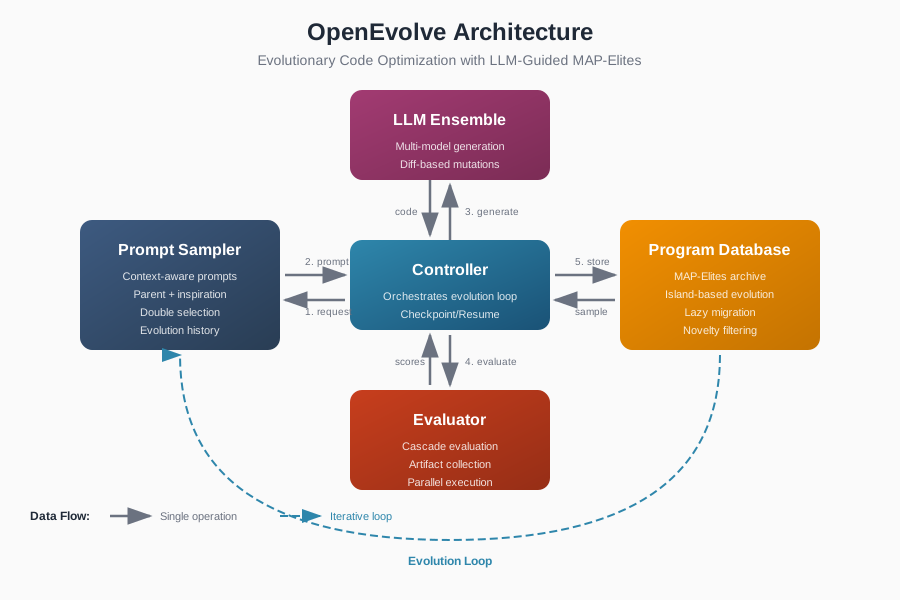
OpenEvolve: Combining LLMs with Evolutionary Search for Algorithm Discovery
OpenEvolve is an open-source evolutionary coding agent that integrates large language models (LLMs) into a quality-diversity search framewor
 algorithmicsuperintelligence.ai·6mo ago
A Perspective Mapping Method for Computing the Continuous Integral R2 Indicator via Box Decomposition
This paper introduces a bidirectional perspective mapping between the continuous integral R2 indicator (a Pareto-compliant refinement used i
arxiv.org·1d ago
The Evolution of AI: From Static Benchmarks to Inference-Time Search for Autonomous Agents
The article explores the shift from traditional AI benchmarking to inference-time search as the future of AI development. It discusses how c
 adlrocha.substack.com·6mo ago
LLMs vs. Classical HPO Algorithms: Hybrid Approach Outperforms Both in Hyperparameter Optimization
This research paper compares classical hyperparameter optimization (HPO) algorithms (CMA-ES, TPE) against LLM-based methods for tuning a sma
arxiv.org·25d agoLLMs vs. Classical HPO Algorithms: Hybrid Approach Outperforms Both in Hyperparameter Optimization
This research paper compares classical hyperparameter optimization (HPO) algorithms (CMA-ES, TPE) against LLM-based methods for tuning a sma
arxiv.org·25d ago
ConSPO: A Contrastive Approach to Improving Reinforcement Learning with Verifiable Rewards for LLMs
This paper analyzes Group Relative Policy Optimization (GRPO), a widely used RLVR algorithm for post-training large language models on reaso
arxiv.org·1mo ago
Comments
Sign in to join the conversation.
No comments yet. Be the first.