
























When weak taste costs organizations more than bad strategy
By
Aurélie Radom
Summary
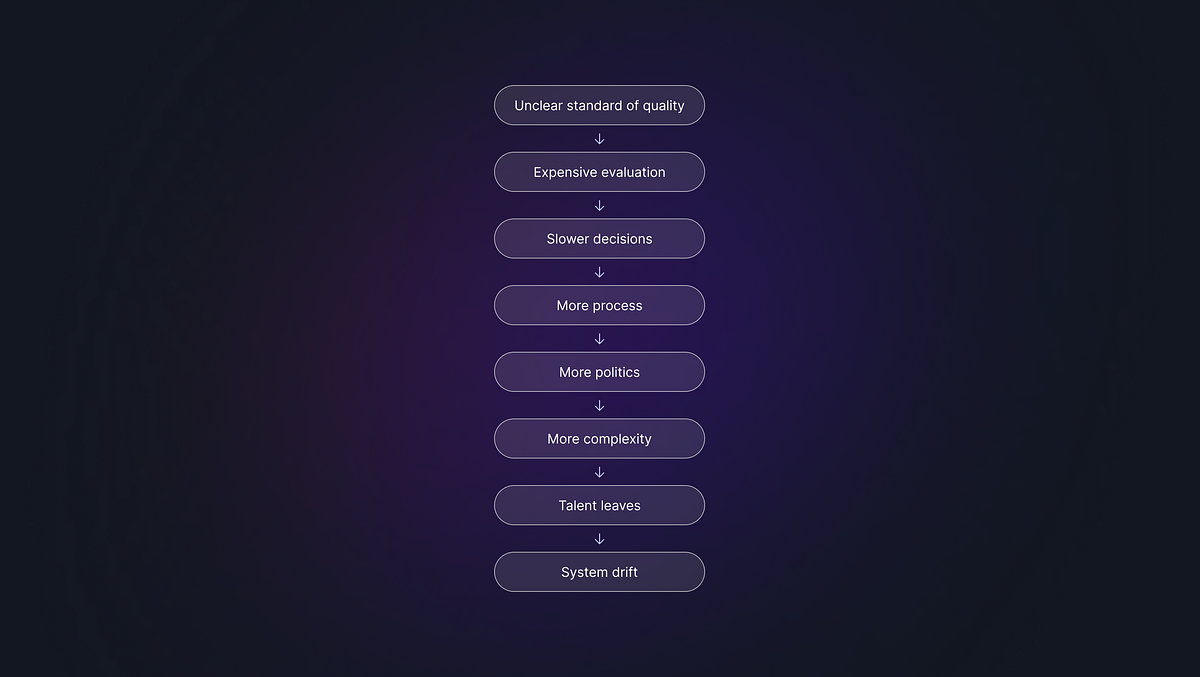
The article argues that as AI makes creation abundant and cheap, the scarce resource becomes judgment — the ability to discern quality. This dynamic, previously observed in individuals, now plays out inside organizations where weak taste leads to decision failures rather than strategic failures. Organizations scale production but fail to scale the judgment needed to separate what's worth keeping from what isn't, creating a systemic cost that manifests in poor decisions across the board.
Source
 SidebarWhen weak taste costs organizations more than bad strategyuxdesign.cc
Key quotes
· 3 pulledWhen taste is weak, organizations don't fail in strategy. They fail in decisions.
Creation is becoming abundant while judgment remains scarce.
What has not scaled is the ability to recognize what is actually worth keeping.
You might also wanna read


The Rising Value of Taste in an AI-Driven World Where Competent Output Is Cheap
The article argues that in an era where AI and large language models have made competent output cheap and easily accessible, the true compet
 rajnandan.com·3mo ago
Ideas Are Cheap, Judgment Is Expensive: How Design Moved to Systems and Code
Pavel Bukengolts reflects on how the design industry has fundamentally shifted from idea-centric work to systems-centric work. He argues tha

Why Human Judgment Becomes a Competitive Advantage in an AI-Driven Marketing World
The article argues that as AI democratizes execution and operational output in marketing, human judgment, strategic clarity, and decision-ma
 forbes.com·20d ago
The Irony of AI Taste Preachers: Those Who Never Demonstrated Taste Before
The article critiques the hypocrisy of designers, marketers, and developers who are suddenly preaching about the importance of 'taste' when
 matthewsanabria.dev·9mo ago
In the age of AI content generation, creative taste matters more than production skills
The article argues that the creative industry has undergone a fundamental shift: production is no longer the bottleneck in creative work. Wi
 Creative Boom·17d ago
Revisiting Good Strategy Bad Strategy: Problem Framing as a Design Kernel
The author revisits Richard Rumelt's classic book "Good Strategy Bad Strategy" after 15 years, prompted by a conversation with a design lead
Comments
Sign in to join the conversation.
No comments yet. Be the first.