
























Neural Particle Automata: Extending Self-Organizing Neural Networks to Particle Systems
By
Ehsan Pajouheshgar* 1,
Summary
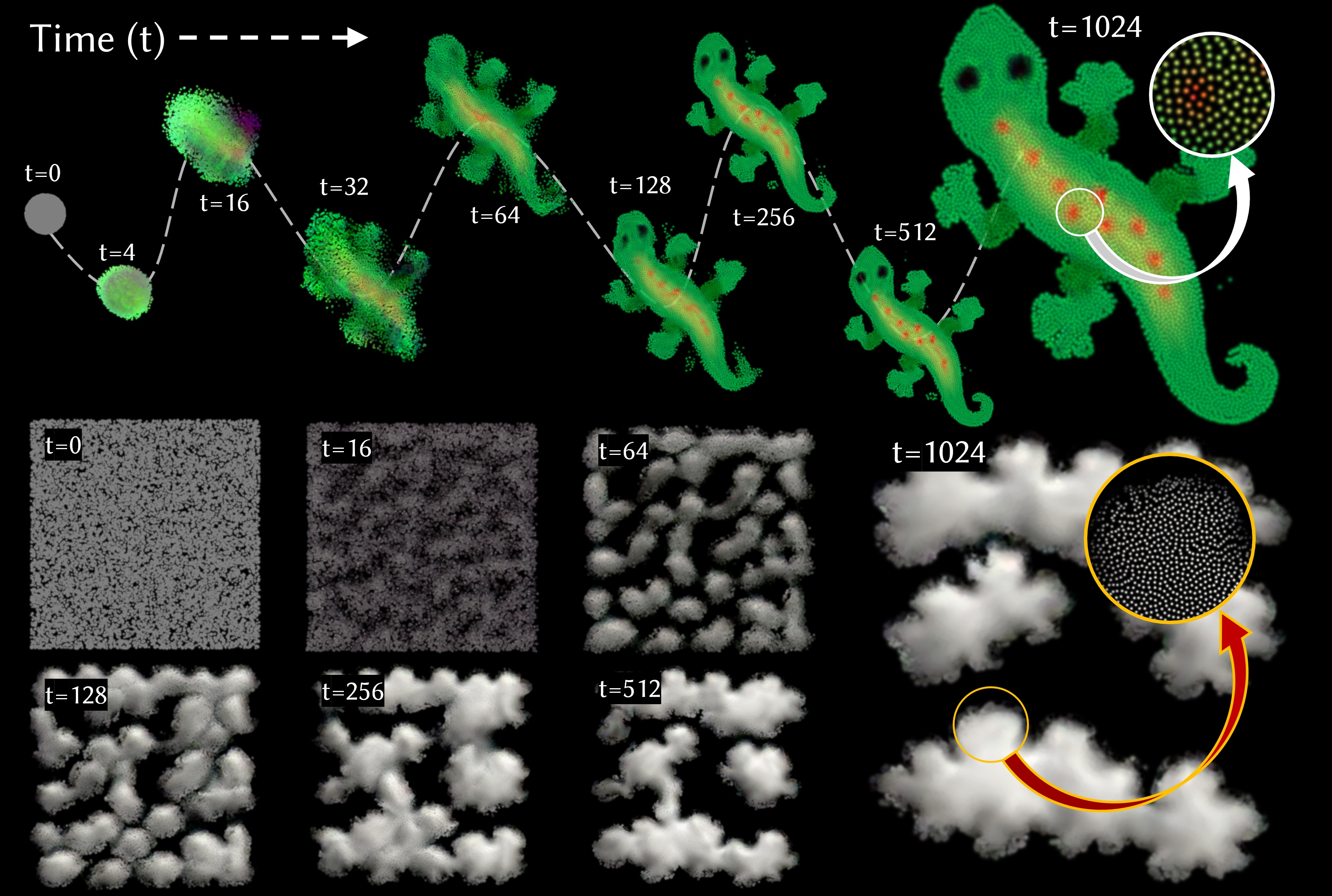
This article introduces Neural Particle Automata (NPA), a novel framework that extends the concept of Neural Cellular Automata (NCA) from grid-based to particle-based systems. Using Smooth Particle Hydrodynamics (SPH) perception, each particle has a continuous position and internal state, aggregating information from nearby particles within a support radius using smooth kernels. This allows for self-organizing particle systems driven by neural networks, where particles can move and change state to grow morphologies and form texture patterns. The approach represents a particle-based counterpart to convolutional perception in grid-based NCAs.
Source
 Hacker NewsNeural Particle Automata: Extending Self-Organizing Neural Networks to Particle Systemsselforg-npa.github.io
Key quotes
· 3 pulledSPH perception is the particle-based counterpart of convolutional perception in grid-based Neural Cellular Automata.
Each particle i has a continuous position x_i and an internal state S_i; instead of reading from fixed lattice neighbors, it aggregates nearby particles j inside a support radius epsilon using smooth kernels.
These local sums estimate quantities such as density rho_i, smoothed state S_i, density gra
You might also wanna read


Emergent Hebbian Dynamics in Regularized Learning: A Theoretical Analysis
This research paper investigates whether observed Hebbian/anti-Hebbian plasticity in synaptic updates necessarily implies an underlying Hebb
 arxiv.org·24d ago
LOGOS: A Unified Generative Foundation Model for the Natural Sciences Using Shared Scientific Grammar
This report introduces LOGOS (Language Of Generative Objects in Science), a scientific generative language model that unifies diverse tasks
arxiv.org·8d agoNew preprint:

AI-Driven Approach for Portable GPU Kernels in High-Performance Computing
This academic paper from North Carolina State University researchers presents an approach to leveraging AI ecosystems for creating portable
 hgpu.org·9d ago
Theoretical Analysis Reveals Why Linear RNNs Are More Parallelizable Than Nonlinear RNNs
This paper establishes a theoretical connection between types of RNNs and standard complexity classes to explain why linear RNNs (LRNNs) are
arxiv.org·22d ago
Researchers Work to Decode the "Black Box" of Reservoir Computing and Brain-Inspired AI
This article explores Reservoir Computing (RC), a specialized form of recurrent neural networks (RNNs) that mimics biological brain processe
 akmaier.substack.com·25d ago
Comments
Sign in to join the conversation.
No comments yet. Be the first.