
























Google researchers develop scalable spherical CNNs for scientific data processing
Summary
This article discusses the development of scalable spherical CNNs (convolutional neural networks) designed to process signals naturally represented on a sphere, such as Earth's atmospheric data (temperature, humidity), cosmological data, and panoramic photos. Unlike traditional CNNs that assume planar (flat) spaces like digital images, spherical CNNs are better suited for scientific applications where data is sampled on spherical surfaces. The article, authored by Google Research scientists Carlos Esteves and Ameesh Makadia, presents technical advances in making spherical CNNs computationally efficient and scalable for real-world scientific use cases.
Source
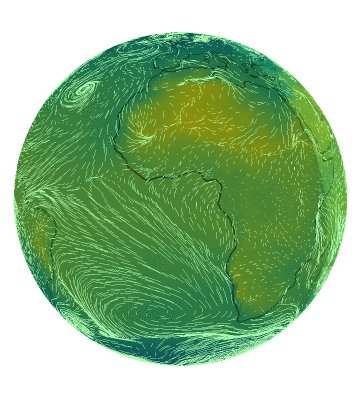
 bskyGoogle researchers develop scalable spherical CNNs for scientific data processingresearch.google
Key quotes
· 3 pulledTypical deep learning models for computer vision, like convolutional neural networks (CNNs) and vision transformers (ViT), process signals assuming planar (flat) spaces.
Variables sampled from the Earth's atmosphere, like temperature and humidity, are naturally represented on the sphere.
Some kinds of cosmological data and panoramic photos are also spherical signals, and are better treated as such.
You might also wanna read


Machine Learning Validates Unrecognized Transient Astronomical Phenomena in Historical Observatory Images
This research paper uses machine learning to validate the existence of previously unrecognized transient astronomical phenomena in historica
 arxiv.org·2mo ago
Using Blender's Geometry Nodes for Cosmology Research Visualization
A Ph.D student in Physics/Cosmology shares how they use Blender's Geometry Nodes (GeoNodes) for scientific visualization in cosmology resear
 blender.org·2mo ago
Sine Landmark Reduction: A Linear-Time Alternative to t-SNE for Browser-Based Data Visualization
The article introduces Sine Landmark Reduction (SLR), a deterministic, linear-time alternative to t-SNE for dimensionality reduction specifi
 medium.com·6mo ago
Neural Particle Automata: Extending Self-Organizing Neural Networks to Particle Systems
This article introduces Neural Particle Automata (NPA), a novel framework that extends the concept of Neural Cellular Automata (NCA) from gr
 selforg-npa.github.io·2d ago
Analytic Fog Rendering with Volumetric Primitives
Neural Networks and Hierarchical Data: Addressing Statistical Limitations in Machine Learning
The article discusses the limitations of standard neural networks when dealing with hierarchical data structures, arguing that neural networ
 blog.sturdystatistics.com·4mo ago
Comments
Sign in to join the conversation.
No comments yet. Be the first.