
























NASA's Hubble Telescope Releases Star-Spangled Image of Globular Cluster M3 for US 250th Anniversary
By
Tracy Vogel
Summary
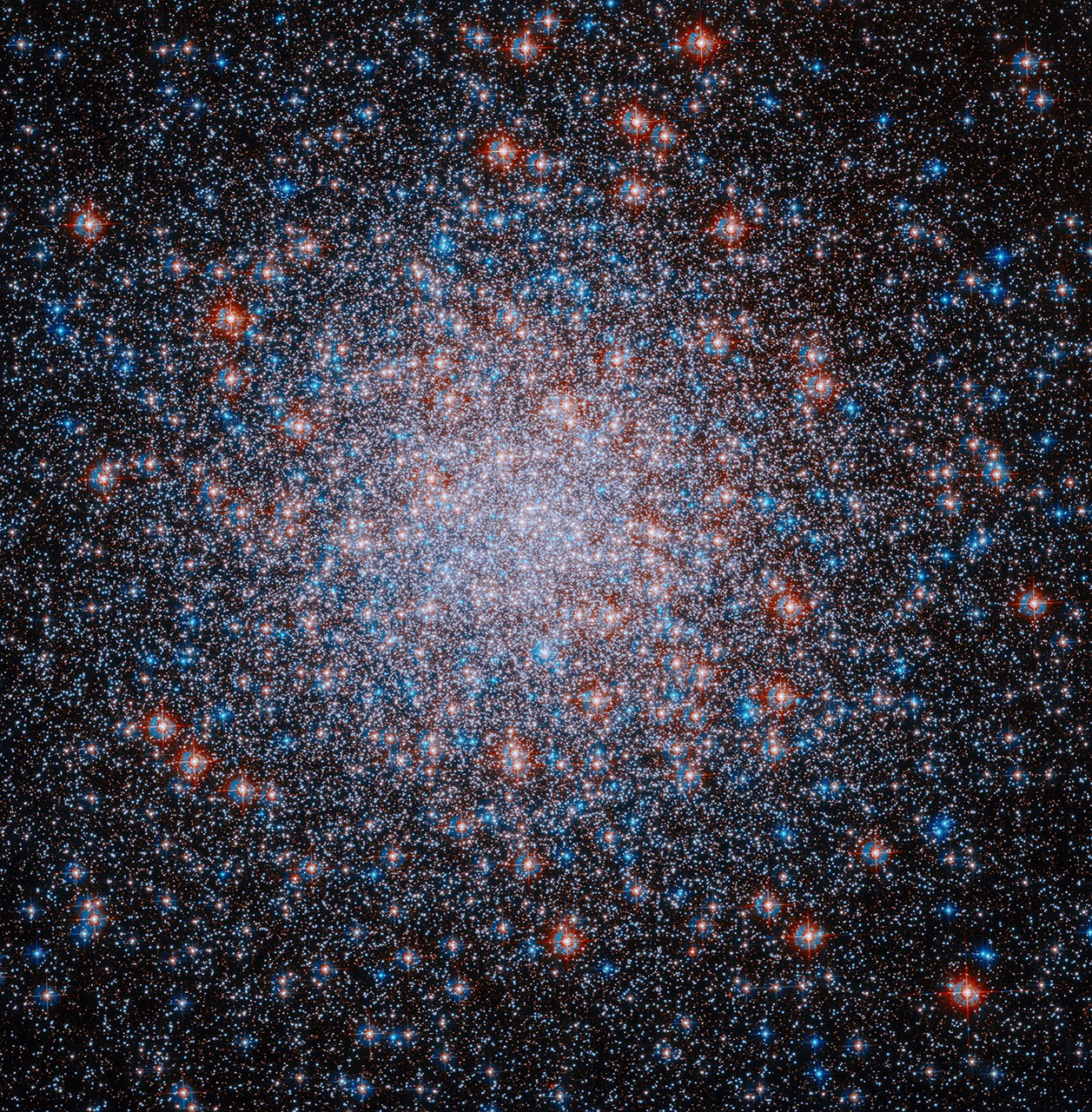
NASA's Hubble Space Telescope released a celebratory image of the globular cluster Messier 3 (M3) in honor of the United States' 250th anniversary. The image features more than 500,000 stars in red, white, and blue hues. M3 is one of the Milky Way's most massive globular clusters — a spherical collection of ancient, gravitationally bound stars that formed at roughly the same time from the same gas cloud. About 150 such clusters are known to orbit the outer regions of the Milky Way.
Source
 Twitter / XNASA's Hubble Telescope Releases Star-Spangled Image of Globular Cluster M3 for US 250th Anniversarygo.nasa.gov
Key quotes
· 4 pulledMore than 500,000 stars blaze red, white, and blue in this image from NASA's Hubble Space Telescope, released in celebration of the United States' 250th anniversary.
The image showcases Messier 3 (M3), one of the Milky Way galaxy's most massive globular clusters, or spherical collections of gravitationally bound stars.
Globular clusters are made up of ancient stars that formed at roughly the same time from the same cloud of gas, giving those stars similar ages.
Around 150 known globular clusters are sprinkled around the outer regions of the Milky Way.
You might also wanna read


Hubble Captures Galaxy Cluster MACS0329-0211 With Gravity-Warped Light Forming Figure-Eight Shape
NASA's Hubble Space Telescope has captured a stunning image of MACS0329-0211, a massive galaxy cluster whose immense gravity warps and bends
 news.bitcoin.com·14d ago
NASA's Webb and Hubble Telescopes Reveal Terzan 5 Is Not a Globular Cluster, Offering New Galaxy Formation Insights
Researchers using NASA's James Webb and Hubble Space Telescopes have reclassified Terzan 5, previously thought to be a globular star cluster
science.nasa.gov·15d ago
Euclid telescope captures detailed image of globular cluster NGC 6397 revealing brightness gap
The article discusses the Euclid space telescope's image of globular cluster NGC 6397, highlighting a brightness "gap" feature observed in t
 stsci.edu·1mo ago
JWST observes normal AGB stars at Cosmic Noon through 5000x gravitational lensing
This article discusses a scientific study where researchers used the James Webb Space Telescope (JWST) to observe a galaxy magnified 5000 ti
 astrobites.org·1mo ago
JWST's Little Red Dots: New Research Explores Whether They Are Young Globular Clusters or Objects with Blue Companions
JWST's discovery of compact reddish objects called "little red dots" has sparked scientific debate about their nature. This article examines
 aasnova.org·3d ago
Hubble Space Telescope Captures New Image of Crab Nebula, Supernova Witnessed in 1054 AD
The article discusses the Hubble Space Telescope's new image of the Crab Nebula, which originated from a supernova explosion witnessed by Ch
 nautil.us·3mo ago
Comments
Sign in to join the conversation.
No comments yet. Be the first.