
























ReMoT: A Reinforcement Learning Framework Using Motion Contrast Triplets to Improve VLM Spatio-Temporal Reasoning
By
[Submitted on 28 Feb 2026 (v1), last revised 10 Jun 2026 (this version, v3)]
Summary
ReMoT (Reinforcement Learning with Motion Contrast Triplets) is a unified training paradigm designed to address spatio-temporal consistency shortcomings in Vision-Language Models (VLMs), particularly for navigation, robotics, and autonomous driving. It introduces two core components: (1) ReMoT-16K, a large-scale motion-contrast dataset of 16.5K triplets generated via a rule-based automatic framework from video meta-annotations, and (2) Group Relative Policy Optimization (GRPO) for optimal contrastive reasoning learning. The paper also presents the first benchmark for fine-grained motion contrast triplets. The resulting model achieves state-of-the-art performance, including a 25.1% improvement on spatio-temporal reasoning tasks.
Source

 bskyReMoT: A Reinforcement Learning Framework Using Motion Contrast Triplets to Improve VLM Spatio-Temporal Reasoningarxiv.org
Key quotes
· 5 pulledWe present ReMoT, a unified training paradigm to systematically address the fundamental shortcomings of VLMs in spatio-temporal consistency -- a critical failure point in navigation, robotics, and autonomous driving.
A rule-based automatic framework that generates ReMoT-16K, a large-scale (16.5K triplets) motion-contrast dataset derived from video meta-annotations, surpassing costly manual or model-based generation.
Group Relative Policy Optimization, which we empirically validate yields optimal performance and data efficiency for learning this contrastive reasoning, far exceeding standard Supervised Fine-Tuning.
We also construct the first benchmark for fine-grained motion contrast triplets to measure a VLM's discrimination of subtle motion attributes (e.g., opposing directions).
The resulting model achieves state-of-the-art performance on our new benchmark and multiple standard VLM benchmarks, culminating in a remarkable 25.1% performance leap on spatio-temporal reasoning tasks.
You might also wanna read


GLM-5V-Turbo: A Native Multimodal Foundation Model for Agentic AI Tasks
GLM-5V-Turbo is a new multimodal foundation model developed by the GLM-V Team that integrates perception, reasoning, planning, tool use, and
arXiv.org·1mo ago
Skill-MAS: A Meta-Skill Approach to Improving Multi-Agent Systems Without Retraining
Skill-MAS proposes a novel approach to LLM-based automatic Multi-Agent Systems (MAS) generation that bridges the gap between inference-time
arxiv.org·3d agoSkill-MAS: A Meta-Skill Approach to Improving Multi-Agent Systems Without Retraining
Skill-MAS proposes a novel approach to LLM-based automatic Multi-Agent Systems (MAS) generation that bridges the gap between inference-time
arxiv.org·3d ago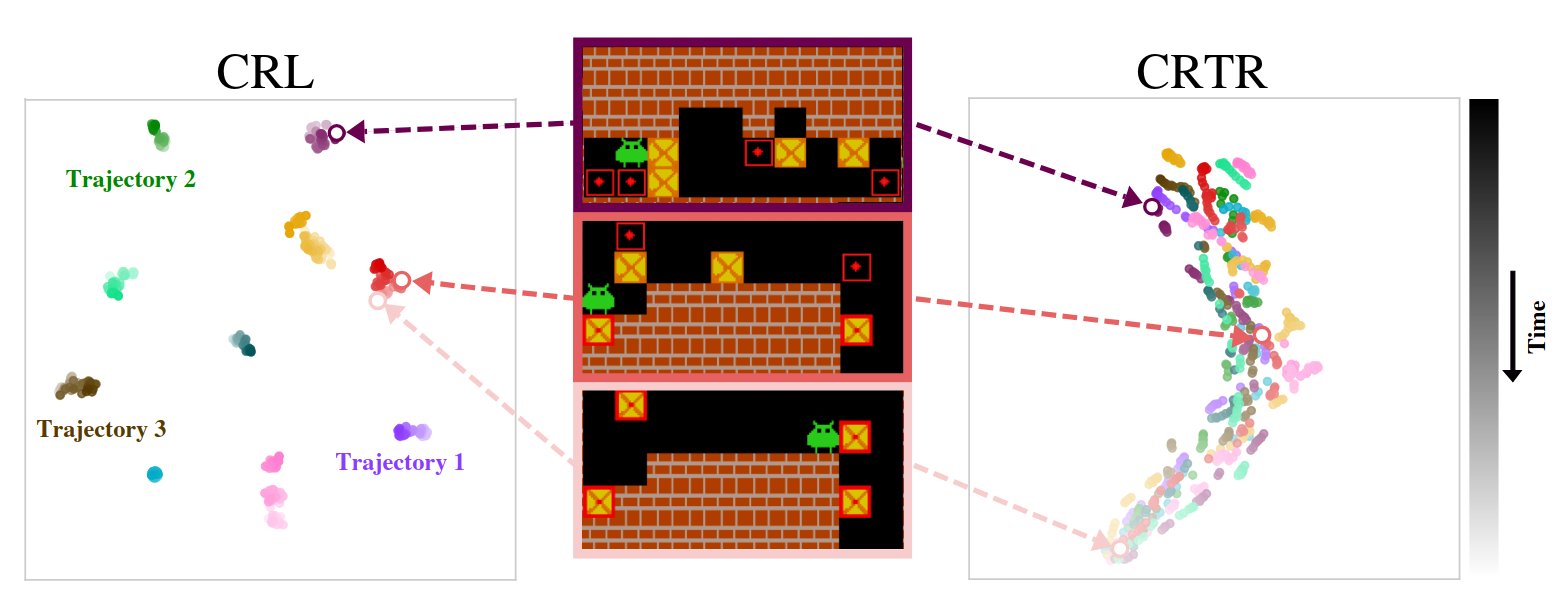
Research on Contrastive Representations for Temporal Reasoning in AI Systems
The article presents research on Contrastive Representations for Temporal Reasoning (CRTR), examining whether temporal reasoning can emerge

AgentGym-RL: A Reinforcement Learning Framework for Training LLM Agents in Multi-Turn Decision Making
This paper introduces AgentGym-RL, a unified reinforcement learning framework for training LLM agents to perform multi-turn interactive deci
arxiv.org·3d agoAgentGym-RL: A Reinforcement Learning Framework for Training LLM Agents in Multi-Turn Decision Making
This paper introduces AgentGym-RL, a unified reinforcement learning framework for training LLM agents to perform multi-turn interactive deci
arxiv.org·3d ago
StreamingVLM: Real-Time Vision-Language Model for Infinite Video Stream Processing
StreamingVLM is a new vision-language model designed for real-time understanding of infinite video streams, addressing the computational cha
arxiv.org·8mo ago
Ultralytics YOLO26: A Unified Real-Time Vision Model Family with NMS-Free Inference and Advanced Training Pipeline
Ultralytics YOLO26 is a new family of real-time vision models that addresses key limitations of prior YOLO detectors. It introduces a dual-h
arxiv.org·1d agoComments
Sign in to join the conversation.
No comments yet. Be the first.