
























Malware and Cryptography: Implementing Shamir Secret Sharing in C
By
cocomelonc
Summary
This article from a cybersecurity and cryptography series explores the Shamir Secret Sharing (SSS) cryptographic scheme. It explains how to split a secret (e.g., a private key or payload) into multiple shares so that no single share reveals the secret, but a threshold number of shares can reconstruct it. The post covers the mathematical foundation (polynomial interpolation over finite fields), provides a complete C language implementation with code examples, and discusses practical applications in malware development for distributed payload storage and key management. The article includes detailed explanations of prime field selection, share generation, and secret reconstruction using Lagrange interpolation.
Source
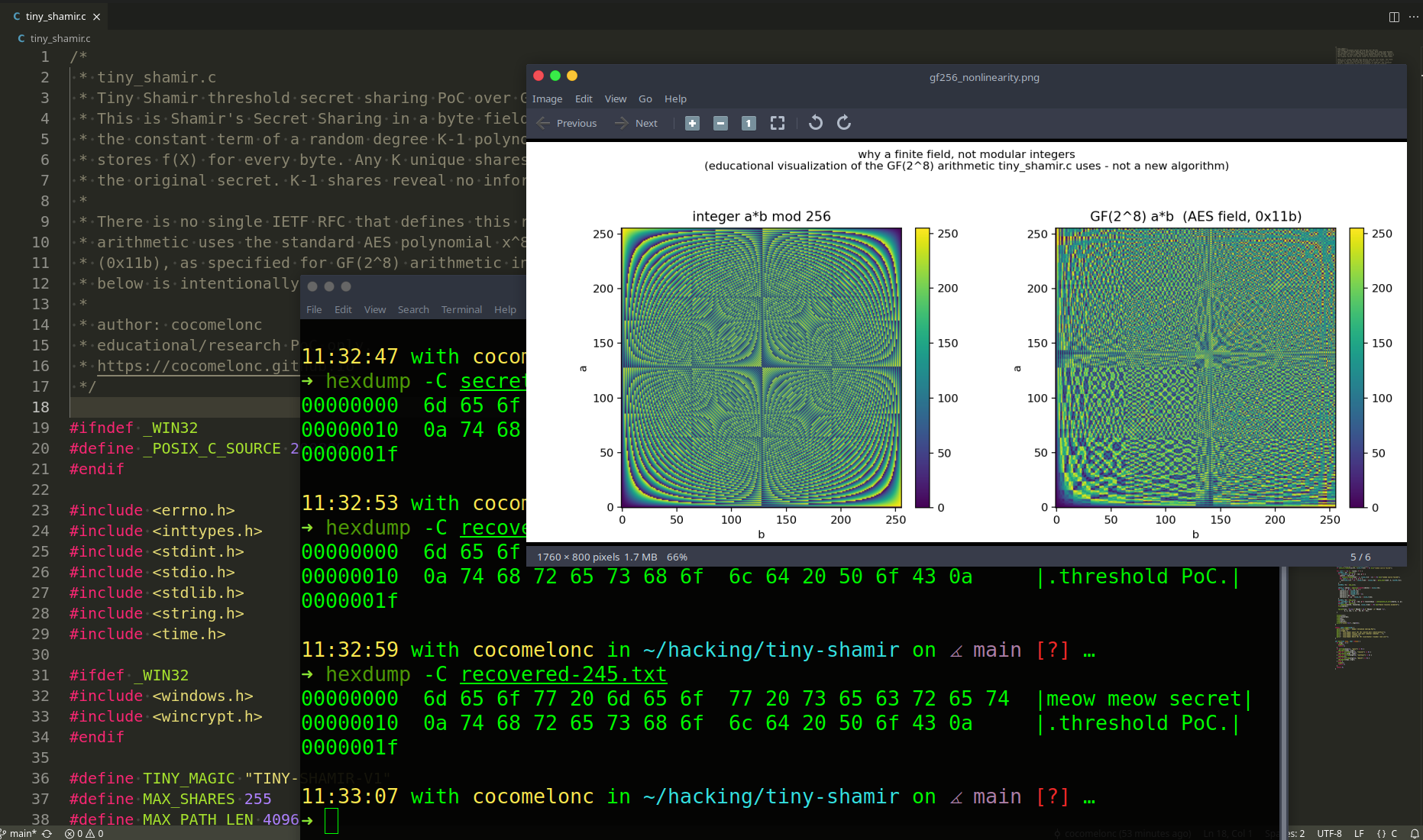 Twitter / XMalware and Cryptography: Implementing Shamir Secret Sharing in Ccocomelonc.github.io
Key quotes
· 3 pulledIn previous posts of the malware and cryptography series, we mostly looked at payload hiding: block ciphers, stream ciphers, S-boxes, DFT tricks, and other ways to transform bytes before executing or storing them.
Today I want to look at a different problem: how do we split a secret so that no single person, file, or server has enough information to recover it.
The core idea is simple: you take a secret, encode it as a point on a polynomial, and distribute shares that are other points on that same polynomial.
You might also wanna read


How Shamir's Secret Sharing Algorithm Enables Threshold Cryptography
This article explains Adi Shamir's Secret Sharing algorithm, a cryptographic method published in 1979 that splits a secret into multiple pie
 ente.com·1mo ago
Understanding Beaver Triples: A Primer on Secure Multiparty Computation
The article introduces the concept of Beaver Triples in the context of secure multiparty computation (MPC). It uses an analogy about a frien
 stoffelmpc.com·1mo ago
An Interactive Introduction to Elliptic Curve Cryptography: From Mathematics to Practical Applications
This article provides an interactive introduction to Elliptic Curve Cryptography (ECC), explaining how it enables secure communication over
 growingswe.com·4mo ago
The Anatomy of Privilege Escalation Attacks: Techniques, Risks, and Defenses
This article provides a comprehensive technical analysis of privilege escalation attacks in cybersecurity. It explains how attackers transfo
 undercodetesting.com·14d ago
Shor's algorithm: the one quantum algo that ends RSA/ECC tomorrow
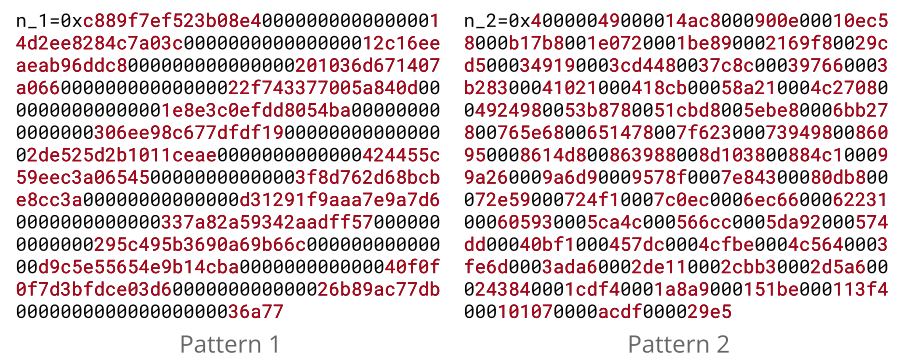
Researchers find hundreds of weak RSA keys with biased bits, factorable via polynomial technique
Researchers discovered hundreds of weak RSA and DSA keys in the wild where the private key bits are heavily biased toward 0 instead of being
 blog.trailofbits.com·23d ago
Comments
Sign in to join the conversation.
No comments yet. Be the first.