
























An Interactive Introduction to Elliptic Curve Cryptography: From Mathematics to Practical Applications
A hands-on introduction to elliptic curve cryptography. Start with curve geometry, build point addition and scalar multiplication, see why ECDLP is hard, and then use that math in ECDH, ECDSA, and…
Read the full articleYou might also wanna read


Quantum Computing Research Advances Threaten to Break Current Encryption Standards Sooner Than Expected
For decades, the bedrock of modern digital life—from securing online banking to validating blockchain transactions—has rested upon the stren
 akmaier.substack.com·1mo ago
A curve by any other name
Winter Break Of Code Day 7 Yesterday was a day of meetings. Discussion and debate flourished. Conversations ranged over all parts of every p

Exploring post-quantum signature design for Ethereum asset protection
This article focuses on the design space of post-quantum solutions for Ethereum users, centered on protecting assets and therefore on the ex
 riva.xyz·24d ago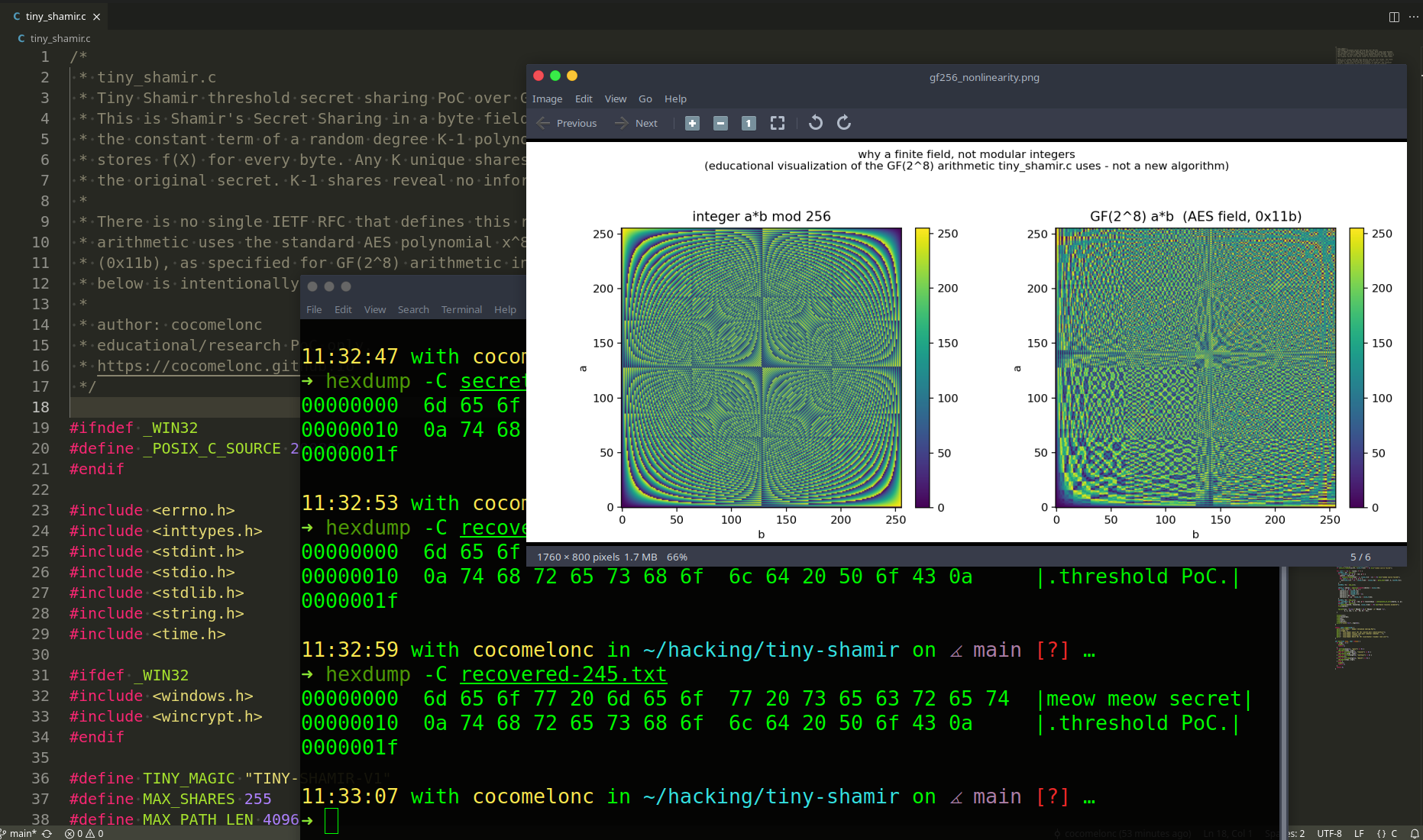
Malware and Cryptography: Implementing Shamir Secret Sharing in C
﷽

Mathematicians Use Gödel's Incompleteness Theorems to Develop New Cryptographic Tool
A graduate student recently harnessed the complexity of mathematical proofs to create a powerful new tool in cryptography.
 quantamagazine.org·1mo ago
Post-Quantum Cryptography: Why Business Leaders Must Treat It as a Continuity Risk, Not Just a Math Problem
Beyond advanced mathematics or theoretical computing breakthroughs, PQC is about protecting the systems enterprises already depend on to ope
 forbes.com·7d ago
Comments
Sign in to join the conversation.
No comments yet. Be the first.