
























Beyond the Chat Bubble: Matching AI Interfaces to User Intent and Context
By
About The Author
Summary
This article critiques the design industry's over-reliance on chat-based interfaces for AI interactions, arguing that conversational UIs are often not the optimal modality. It advocates for matching the interface modality to the user's context, intent, and cognitive load — whether that means buttons, forms, visual dashboards, or other non-chat interactions. The piece provides design principles and frameworks for choosing the right AI interface based on task complexity, user expertise, and situational needs.
Source

 Smashing MagazineBeyond the Chat Bubble: Matching AI Interfaces to User Intent and Contextsmashingmagazine.com
Key quotes
· 5 pulledWe've fallen into conversational tunnel vision, defaulting every AI capability into a chat-based interface simply because LLMs are trained on dialogue data.
Great UX is about matching modality to users' context, intent, and cognitive load, so the interface adapts to the user, not the other way around.
The design community has entered a period of conversational tunnel vision.
Because Large Language Models (LLMs) are trained on dialogue, the industry has collectively decided that the chat bubble is the natural home for every AI capability.
While the chat interface is a viable and powerful option...
You might also wanna read


Designing for AI Agents and Humans: Rethinking the Concept of "User" in Interface Design
The article explores how AI agents are increasingly interacting with digital interfaces alongside human users, challenging traditional UX de
 nngroup.com·19d ago
The awkward gap between chatbot usage and Big Tech's agentic AI vision
The article discusses the current awkward phase in AI development where despite 95-99% of users interacting with generative AI through class
 buildcognitiveresonance.substack.com·15d ago
Beyond the interface: How probabilistic AI is reshaping the designer's role across every layer of user experience
This article examines how the rise of probabilistic AI systems is fundamentally reshaping the practice of design. Drawing on Jesse James Gar
 emilycampbell.co·1d ago
Designing Command-Line Interfaces for AI Agents: A New Paradigm
The article discusses the need to redesign command-line interfaces (CLIs) specifically for AI agents rather than humans. The author shares t
 justin.poehnelt.com·4mo ago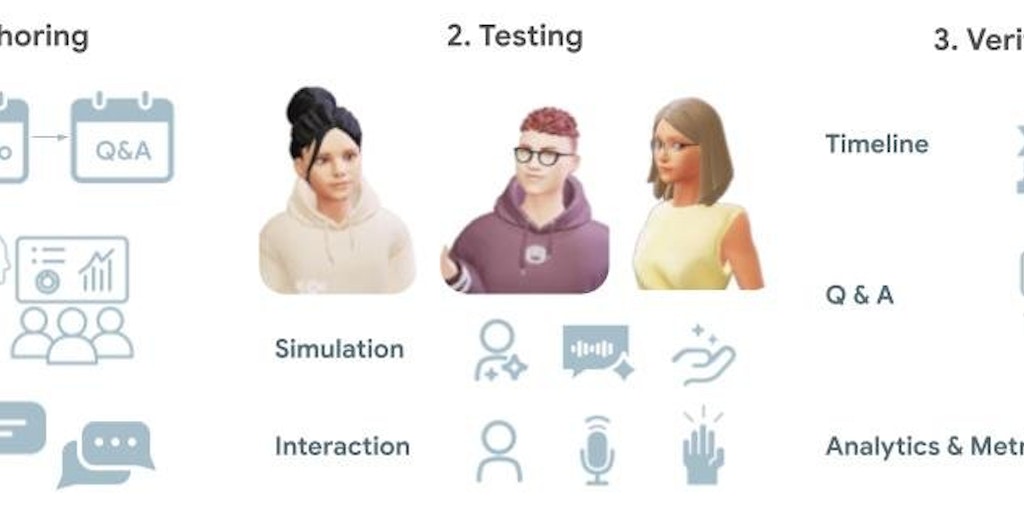
DialogLab: A Research Prototype for Authoring and Testing Human-AI Group Conversations
DialogLab is a research prototype tool that provides a unified interface for designing and testing human-AI group conversations. It allows d
 Product Hunt·4mo ago
AI development pivots to simulated worlds as chatbot limitations become apparent
The article explores how AI development is shifting from training chatbots on static text data to building AI agents that learn by interacti
 science.org·8d ago
Comments
Sign in to join the conversation.
No comments yet. Be the first.