
























Beyond the interface: How probabilistic AI is reshaping the designer's role across every layer of user experience
By
Emily Campbell
Summary
This article examines how the rise of probabilistic AI systems is fundamentally reshaping the practice of design. Drawing on Jesse James Garrett's 2000 essay "The Elements of User Experience" as a framework, the author argues that designers can no longer focus solely on surface-level interfaces and user experience layers. Instead, they must engage with deeper structural planes — the systems, constraints, behaviors, and data models that underlie AI-driven products. As AI introduces unpredictability and emergent behaviors, the designer's role expands from crafting static screens to shaping probabilistic systems, defining boundaries, training data, reward functions, and failure modes. The piece explores how each layer of the UX model transforms when outcomes become probabilistic rather than deterministic, calling for a new design practice that operates across technical, ethical, and experiential dimensions.
Source
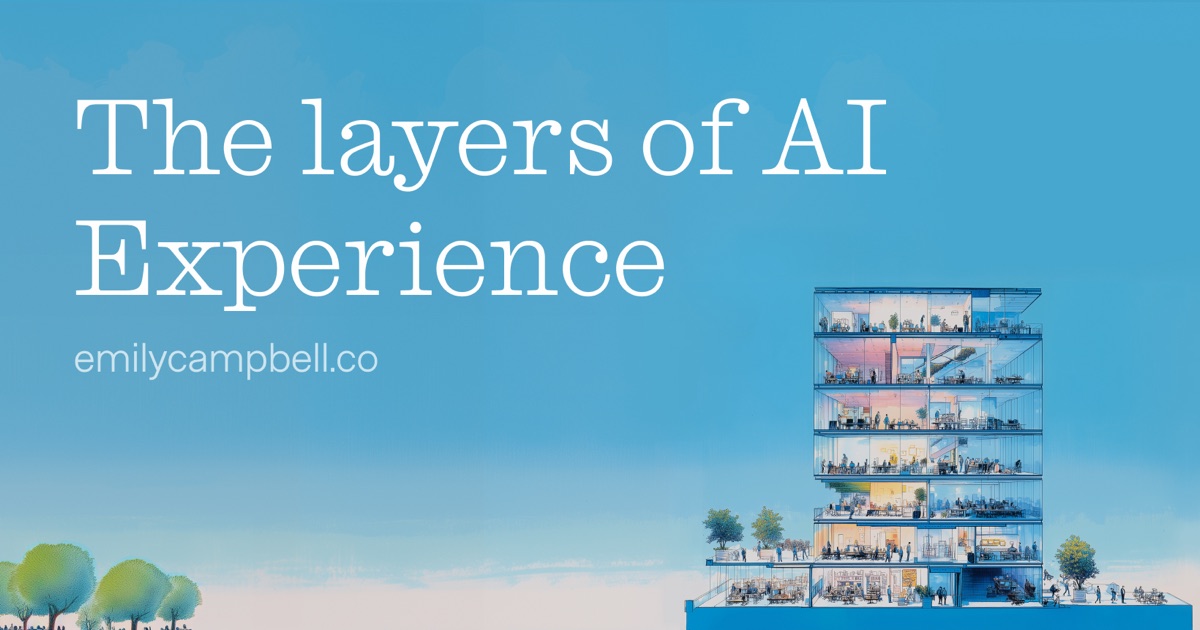
 Twitter / XBeyond the interface: How probabilistic AI is reshaping the designer's role across every layer of user experienceemilycampbell.co
Key quotes
· 3 pulledIn the early web, work was often segmented by role. Visual designers owned website UIs; information architects owned site navigation and structure; business stakeholders owned requirements; etc.
In 2000, Jesse James Garrett published his seminal essay, The Elements of User Experience, describing an alternative model. He explored how websites were actually composed of multiple planes, each dependent
As AI makes product experiences more probabilistic, designers must move beyond interfaces to shape the systems, constraints, and behaviors beneath them.
You might also wanna read


Designing for AI Agents and Humans: Rethinking the Concept of "User" in Interface Design
The article explores how AI agents are increasingly interacting with digital interfaces alongside human users, challenging traditional UX de
 nngroup.com·19d ago
The Evolving Role of UX Designers in AI-Accelerated Workflows
The article discusses how UX design is evolving in the age of AI, with designers transitioning from creators of outputs to directors of inte
 Smashing Magazine·4mo ago
AI's Impact on UX Design: Blurring Lines Between Design and Engineering
The article examines how the rapid adoption of AI is fundamentally changing the UX design profession, blurring traditional boundaries betwee
Smashing Magazine·2mo ago
Practical Guide to Explainable AI for UX Designers: Building Trust Through Transparency
This article focuses on practical approaches to Explainable AI (XAI) for UX practitioners, emphasizing that XAI is not just a technical chal
Smashing Magazine·7mo ago
Prompting as Design: A Structured Approach to AI Interaction and Creative Briefing
This article presents prompting as a design discipline rather than simple instruction-giving, framing it as a creative act that blends creat
Smashing Magazine·10mo ago
Practical UX Design Patterns for Building Trustworthy Agentic AI Systems
The article provides practical UX design patterns and frameworks for building agentic AI systems that prioritize user control, consent, and
Smashing Magazine·4mo ago
Comments
Sign in to join the conversation.
No comments yet. Be the first.