
























M10R Solar Cell Explained: Benefits, Size, Efficiency
Unknown ([email protected])7mo ago
From the article
M10R Solar Cell: The New Rectangular Format Driving Solar Efficiency As the global solar industry advances toward higher performance and reduced system costs, wafer formats continue to evolve. One of the latest innovations gaining momentum is the M10R solar cell — a rectangular variation of the widely adopted M10 (182 mm) wafer standard. The M10R format is designed to unlock higher module power without requiring major upgrades to existing M10-based production lines. This makes it an appealing choice for manufacturers striving for efficiency gains while maintaining cost control. In this article, we explore everything you need to know about M10R solar cells — including technical specifications, benefits, and industry applications. 🔍 What Is an M10R Solar Cell? An M10R solar cell is a rectangular monocrystalline silicon wafer designed by modifying the standard M10 square format (182 × 182 mm). Typical dimensions of M10R wafers range between: 📐 182 mm × 183–210 mm This extended height allows the wafer to increase surface area , resulting in higher power generation per cell — while still conforming to M10-compatible manufacturing tools . 📏 M10 vs. M10R vs. G12R — Key Differences Feature M10 M10R G12R Shape Square Rectangular Rectangular Typical Size 182×182 mm 182×190–210 mm 182×210 mm Cell Area ~331 cm² ~345–382 cm² ~382 cm² Module Power 550–600 W 580–660 W 600–720 W Manufacturing Compatibility Excellent Excellent High Applications Rooftop & Utility Rooftop & Utility Utility-scale M10R positions itself between M10 and G12R , offering a practical boost in power without increasing module size excessively. ⚙️ M10R Solar Cell Technical Specifications Parameter Typical Value Wafer Type Monocrystalline Silicon Dimensions 182 mm × 183–210 mm Cell Technologies PERC, TOPCon, HJT Efficiency ~23% (PERC), 24–25%+ (TOPCon / HJT) Module Power Range 580–660 W Recommended Applications Commercial & utility-scale solar As the market shifts away from p-type PERC toward high-efficiency n-type TOPCon and HJT , M10R is becoming even more relevant. 🌞 Why Manufacturers Are Choosing M10R 1️⃣ Higher Power Output The extended wafer height increases the active light-absorbing area → more watts per module . 2️⃣ Seamless Production Integration M10R is designed to run on existing M10 equipment , minimizing capex for manufacturers. 3️⃣ Lower Cost per Watt Higher module power leads to: Fewer modules per installation Less mounting hardware Reduced cabling and labor All of which lower Balance of System (BOS) costs . 4️⃣ Better for Rooftop and Utility Projects M10R modules maintain a manageable panel size and weight , making them suitable for: Large commercial rooftops Utility-scale power plants 🏭 Market Adoption and Industry Direction Several leading PV manufacturers are already testing or deploying M10R solar cells — particularly those focused on TOPCon expansion . Why? Because M10R aligns perfectly with: ✔ Global shift toward n-type technologies ✔ Demand for high-efficiency modules in compact footprints ✔ Factory upgrades happening within the 182 mm ecosystem M10R is expected to play a significant role during the transition phase between today’s mainstream M10 modules and the larger G12-based ultra-high-power modules. 🌍 Future Outlook: Where M10R Fits in Solar’s Roadmap M10R does not attempt to disrupt the market — it enhances it. Its mission: deliver more power with minimal disruption to existing supply chains. As wafer size standardization continues, formats like M10R provide an incremental yet impactful improvement , especially for installers and developers optimizing energy density per site . The M10R solar cell represents a smart and cost-efficient evolution in photovoltaic design. By extending the proven M10 wafer format into a rectangular shape, M10R delivers: Higher power density ⚡ Better compatibility with current tools 🏭 Lower cost per watt for installers 💰 Suitability for both rooftop & utility systems 🌱 M10R is positioned perfectly for the next generation of high-efficiency, n-type modules — accelerating the world’s transition to clean energy. 👋 Thank You for Reading! We appreciate your time and interest in renewable energy, EVs, and cutting-edge tech. Your curiosity helps drive a sustainable future forward. 📱 Follow Us on Social Media: 🌐 Visit our website
Continue reading on omkarmhatre.inYou might also wanna read
Updation of List (Manufacturers and Models of Solar PV Modules) of ALMM Order, 2019 – Reg. – EQ
Solar Quarter·1d ago


MNRE Clarifies ALMM Cell Norms for Rooftop Solar Projects on Government Buildings
Saur Energy·2d ago

China's New Rules For PV Efficiency And Impact On India
Saur Energy·22h ago
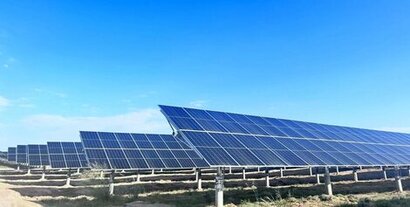
Trinasolar launches 620W Vertex N Shield solar module in North America
Trinasolar has launched its new 620W Vertex N Shield photovoltaic module in North America. The module is built on 210mm n-type TOPCon techno
 renewableenergymagazine.com·26d ago
Cosmic PV, Solarium, Havells and NRG Sol Power Enter ALMM With New Capacities
Saur Energy·1d ago

Kyushu University achieves 130% quantum yield in solar cells using molybdenum spin-flip emitter and singlet fission
Researchers at Kyushu University, in collaboration with German scientists, have achieved a 130% quantum yield in solar energy conversion usi
 energiesmedia.com·1mo ago
Comments
Sign in to join the conversation.
No comments yet. Be the first.