
























FP8 Tensor Cores Enable FP64-Equivalent 3-D FFT on NVIDIA Blackwell Ultra via Ozaki-Bailey Decomposition
By
[Submitted on 28 May 2026 (v1), last revised 26 Jun 2026 (this version, v2)]
Summary
This technical paper presents the Ozaki-Bailey FFT, a method for achieving full FP64-equivalent 3-D FFT performance on NVIDIA's Blackwell Ultra (B300) GPU, which has severely reduced native FP64 throughput (~1.3 TFLOPS, ~30x below B200). The approach uses the Ozaki Scheme II framework to route dense matrix multiply through FP8 tensor cores with mantissa-sliced Chinese-remainder reconstruction. The FFT implementation uses Bailey's six-step decomposition with both 1-D FFT GEMMs on FP8 tensor cores. Garner reconstruction splits into Phase A (inner products on FP8/INT8 tensor cores) and Phase B (per-output reduction), where the authors identify Kulisch fixed-point complete arithmetic as a reformulation that maintains full FP64 accuracy on the INT32 SIMT pipe. The paper derives bandwidth-parity floors and projects ~18 ms for 1024^3 at full FP64, approaching the 12.9 ms memory roof. If the projection holds, B300 becomes viable for full-FP64 FFT through software alone, motivating a libKulisch library and benchmark campaign.
Source

 bskyFP8 Tensor Cores Enable FP64-Equivalent 3-D FFT on NVIDIA Blackwell Ultra via Ozaki-Bailey Decompositionarxiv.org
Key quotes
· 5 pulledThe Ozaki Scheme II framework recovers FP64-equivalent throughput by routing dense matrix multiply through FP8 tensor cores with a mantissa-sliced Chinese-remainder reconstruction.
Garner reconstruction splits into Phase A (inner products on FP8/INT8 tensor cores, ~1 ms for 1024^3 on B300) and Phase B (per-output reduction).
We identify Kulisch fixed-point complete arithmetic as a Phase B reformulation that keeps full FP64 accuracy while running entirely on the INT32 SIMT pipe.
A GPU meets memory-roof FFT parity if it satisfies either the native floor or both Kulisch floors.
If the projection holds in practice, B300 becomes viable for full-FP64 FFT through software alone, motivating a libKulisch library and benchmark campaign.
You might also wanna read

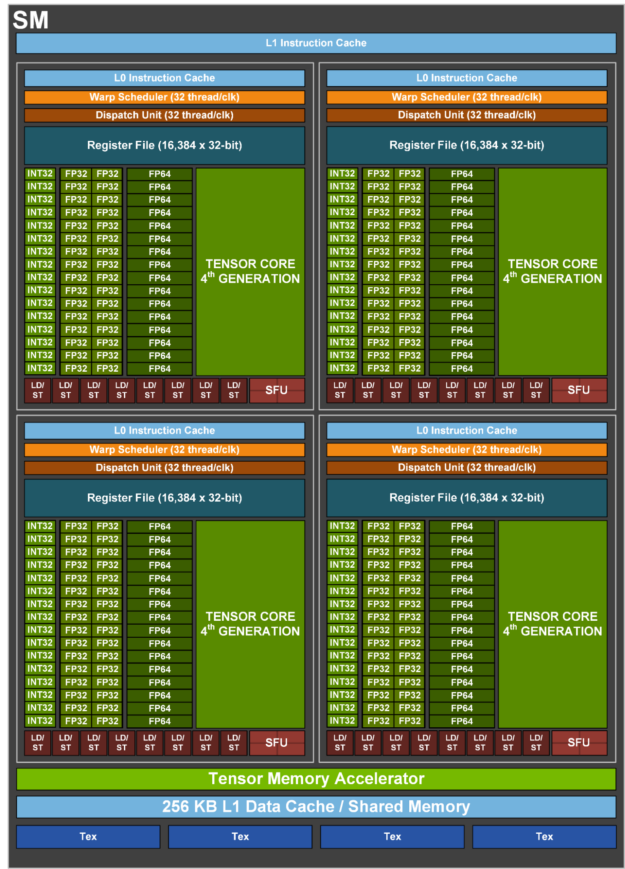
Re-evaluating Warp Specialization for Modern Tensor Core GPUs
This technical blog post examines the necessity of warp specialization for high-performance kernels on modern Tensor Core GPUs like NVIDIA's
 rohany.github.io·9mo ago
Orthogonal Approximate Message Passing for Double Linear Transformation Model

Researchers build million-p-bit probabilistic computer by networking FPGAs, breaking single-chip limit
Researchers have built a programmable probabilistic computer using networked FPGAs that achieves one million p-bits (probabilistic bits), br
arxiv.org·9d ago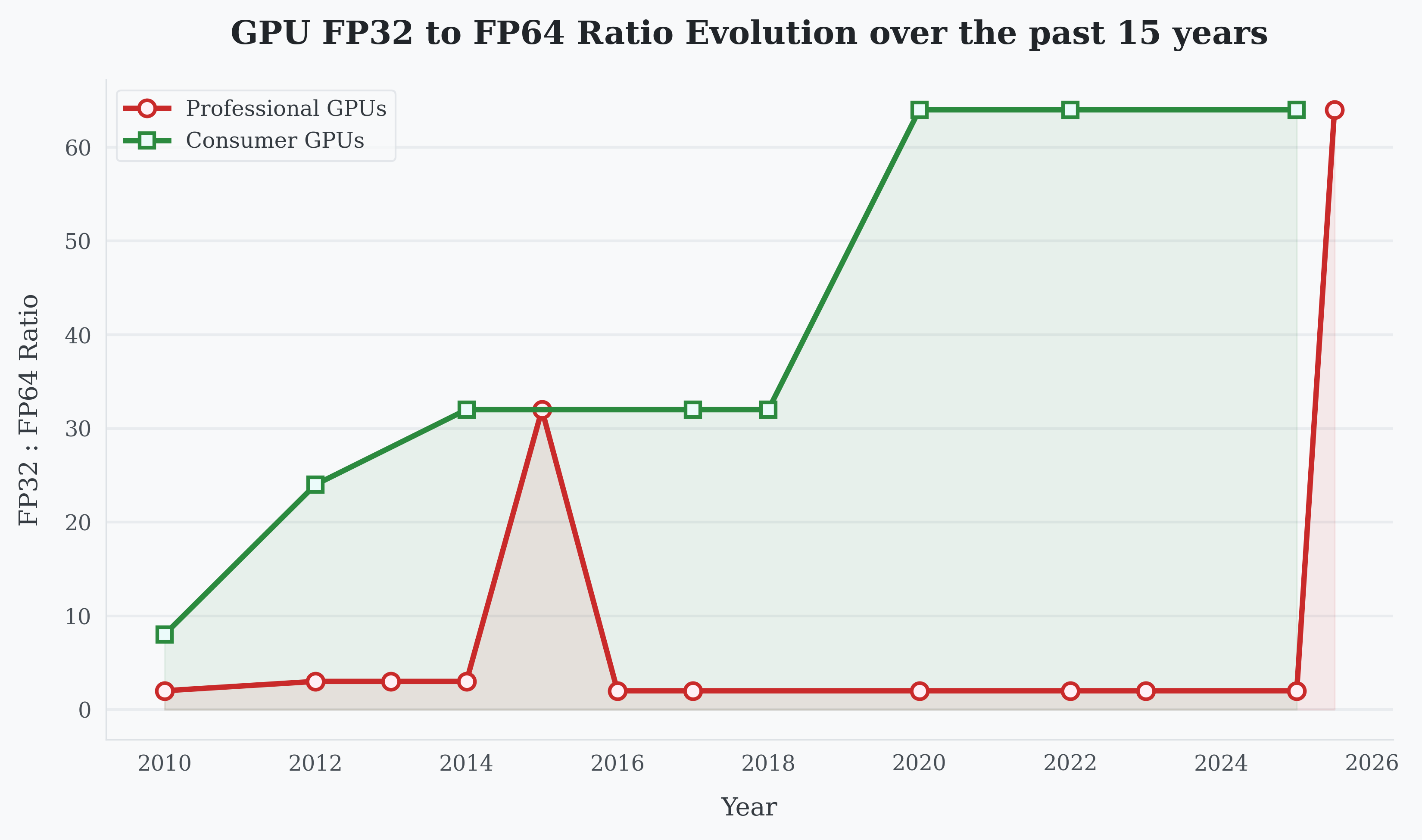
How the AI Boom is Changing Nvidia's 15-Year FP64 Segmentation Strategy on GPUs
The article examines the historical trend of FP64 (double-precision) performance segmentation between consumer and enterprise GPUs over the

Understanding the Cooley-Tukey Fast Fourier Transform Algorithm
This technical article introduces the Cooley-Tukey algorithm, the original and most well-known fast Fourier transform (FFT) algorithm. It ex
connorboyle.io·9mo ago
Comments
Sign in to join the conversation.
No comments yet. Be the first.