All Topics
All Topics
Technology
Technology
AI
AI
Business
Business
Entertainment
Entertainment
News
News
Programming
Programming
Science
Science
Design
Design
Environment
Environment
Finance
Finance
Crypto
Crypto
Politics
Politics
Sports
Sports
Education
Education
Gaming
Gaming
Art
Art
Music
Music
Health
Health
Security
Security
Books
Books
Food
Food
Travel
Travel
Personal
Personal
Bluesky
Twitter

Collaborative Block-Term Tensor Decomposition and Its Application to Image Processing

1mo ago

Source

IEEECollaborative Block-Term Tensor Decomposition and Its Application to Image Processingieee.org
Snippet from the RSS feed
The rank-$(L,M,N)$ block-term tensor decomposition (termed as BTD for convenience), which decomposes a tensor into a summation of multiple block-terms, has shown promise in multidimensional signal processing. However, in real-world applications, different components of a tensor usually have common and individual structures (e.g., shared dictionaries and individual coefficients), while BTD neglects the common structures across different components. Moreover, the corresponding algorithms for BTD (e.g., alternating least squares algorithm (BTD-ALS)) are computationally expensive for large-scale real data. To address these problems, we propose a collaborative block-term tensor decomposition (termed as CBTD), which decomposes a tensor into a summation of different block-terms multiplied by shared matrices. Compared with BTD, CBTD can better capture the structure of the data (i.e., the shared dictionaries and individual coefficients of multiple components), which is important especially in the challenging noisy/missing cases; and CBTD essentially projects the original tensor into a low-dimensional latent tensor by the shared factor matrices and then performs BTD on the latent tensor, which allows us to design more efficient algorithms. Moreover, we discuss the connection between BTD and CBTD and establish the essential uniqueness for CBTD. Empowered with CBTD, we propose the multidimensional signal reconstruction model and develop the corresponding proximal alternating minimization-based algorithm (CBTD-PAM) with the convergence guarantee. Extensive experiments on multispectral images and gray videos under Gaussian/sparse noise removal and tensor completion tasks demonstrate that the CBTD-PAM improves the reconstruction performance over competing methods in most cases. Especially, compared to the BTD-ALS, CBTD-PAM not only delivers higher quality results but also achieves substantial speedup.

You might also wanna read

BIFE: A New Framework for Stable Minute-Long Video Generation Using Semantic Sparse KV Cache and Block Forcing

This paper introduces BIFE (Better Interaction, Fewer Errors), a framework for minute-long video generation that addresses two key challenge

arxiv.org·14d ago

Tensor network compression method for fluid dynamics data using matrix product states

This paper presents a tensor network compression method (using matrix product states/tensor trains) for extreme-scale scientific data, using

arxiv.org·21d ago

FP8 Tensor Cores Enable FP64-Equivalent 3-D FFT on NVIDIA Blackwell Ultra via Ozaki-Bailey Decomposition

This technical paper presents the Ozaki-Bailey FFT, a method for achieving full FP64-equivalent 3-D FFT performance on NVIDIA's Blackwell Ul

arxiv.org·4d ago

Training-Free Single-Image Diffusion Model Achieves Fast, High-Quality Generation

This paper presents a training-free approach to single-image diffusion models. Instead of training a neural network on a single image (which

arxiv.org·1mo ago

Deep Neural Networks Converge to Universal Low-Dimensional Subspaces Across Diverse Tasks

This research article presents empirical evidence that deep neural networks trained on diverse tasks converge to remarkably similar low-dime

arxiv.org·7mo ago
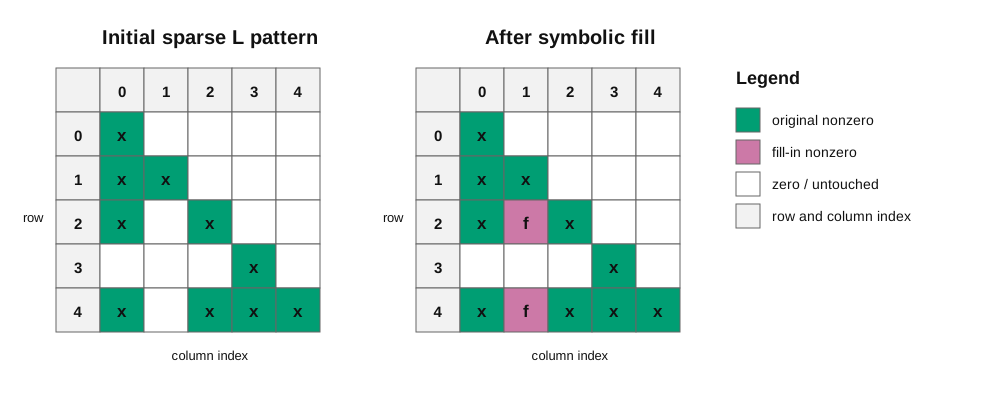
Deriving the Sparse Cholesky Elimination Tree for Matrix Factorization

This article provides a technical derivation of the elimination tree for the right-looking sparse Cholesky algorithm (A = LL^T) for sparse m

Math, Numerics, and Software·1mo ago

Comments

Sign in to join the conversation.

No comments yet. Be the first.