
























Researchers build million-p-bit probabilistic computer by networking FPGAs, breaking single-chip limit
By
[Submitted on 24 Jun 2026]
Summary
Researchers have built a programmable probabilistic computer using networked FPGAs that achieves one million p-bits (probabilistic bits), breaking the single-chip limit that previously constrained such systems. The machine performs Gibbs sampling at over a trillion flips per second while keeping all coupling weights in local on-chip memory, with devices exchanging only 1-bit boundary states. The study identifies a key timing ratio (eta = f_comm/f_p-bit) that determines how frequently boundary information must be refreshed for a distributed machine to behave as a monolithic one. Above a topology-dependent threshold, the distributed machine matches a GPU reference; below it, a quantifiable throughput-accuracy tradeoff emerges. The platform was demonstrated across spin glasses, Max-Cut, and Boolean satisfiability problems, providing a design rule for scaling probabilistic computers beyond single-chip limits.
Source

 Hacker NewsResearchers build million-p-bit probabilistic computer by networking FPGAs, breaking single-chip limitarxiv.org
Key quotes
· 5 pulledHere we break this limit by networking FPGAs into a single Ising machine far larger than any one device could hold, realizing a programmable probabilistic computer with one million p-bits.
The machine performs Gibbs sampling at over a trillion flips per second while keeping every coupling weight in local on-chip memory.
During execution, devices exchange nothing but 1-bit boundary states.
Above a topology-dependent threshold, the distributed machine matches a monolithic GPU reference.
These results provide a programmable million-p-bit platform, demonstrated across spin glasses, Max-Cut, and Boolean satisfiability, together with a quantitative design rule for scaling probabilistic computers beyond the single-chip limit.
You might also wanna read

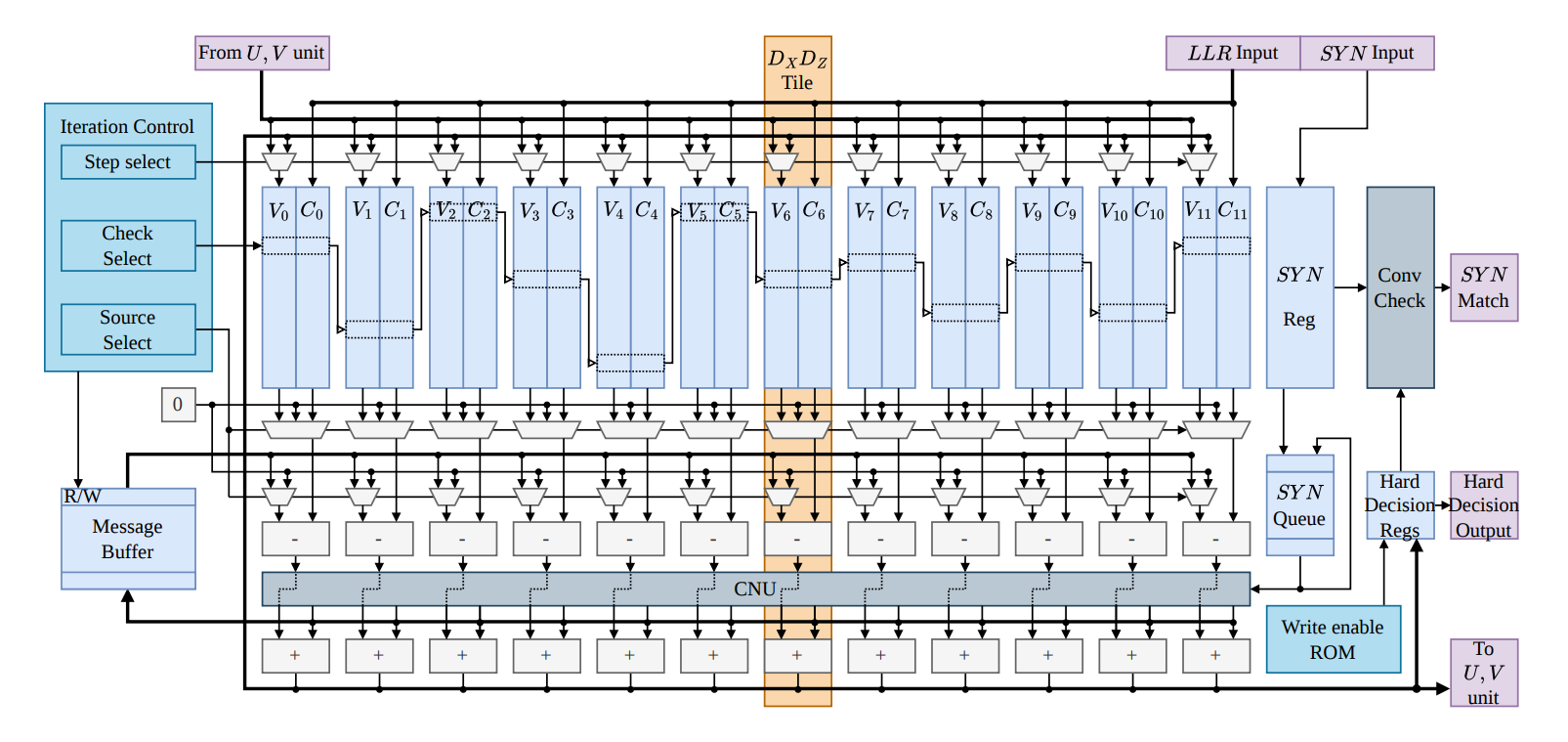
FPGA-Based Hardware Architecture Enables Real-Time Decoding of Quantum LDPC Codes
Researchers from IMDEA Software Institute, Nokia Bell Labs, Complutense University of Madrid, Aalto University, and Quobly have developed an
 quantumcomputingreport.com·3d ago
Quantum Crosstalk Noise Modeling Reveals Higher Error Rates in Fault-Tolerant Computing
Researchers at The University of Melbourne and Monash University have modeled coherent quantum crosstalk noise in quantum computers using hy
 quantumzeitgeist.com·1mo ago
Atomic dynamics model offers alternative computing approach beyond semiconductor limits
Dawit Hiluf Hailu of Bowie State University has developed a novel computing model that uses the dynamics of two-level atoms to perform class
quantumzeitgeist.com·1mo ago
Trapped-ion quantum computer achieves breakeven performance with qLDPC error-correcting codes
Researchers at Quantinuum demonstrated breakeven performance of quantum low-density parity-check (qLDPC) codes on a trapped-ion quantum comp
arxiv.org·24d ago
IBM Nighthawk Quantum Processor Validated in Particle Physics and Cybersecurity Studies
Independent researchers from the IBM Quantum Network have published two peer-reviewed studies validating real-world applications on the IBM
quantumcomputingreport.com·7d ago
Generalized Two-Qubit Hamiltonian Improves Quantum Feature Maps for Machine Learning
This paper introduces a generalized two-qubit Hamiltonian-based Projected Quantum Feature Map (PQFM) that unifies encoding of classical feat
arxiv.org·15d ago
Comments
Sign in to join the conversation.
No comments yet. Be the first.