
























Sheaf-ADMM: A Distributed Consensus Neural Network for Multi-Agent Coordination
By
Jeffrey Seely* Sakana AI
Summary
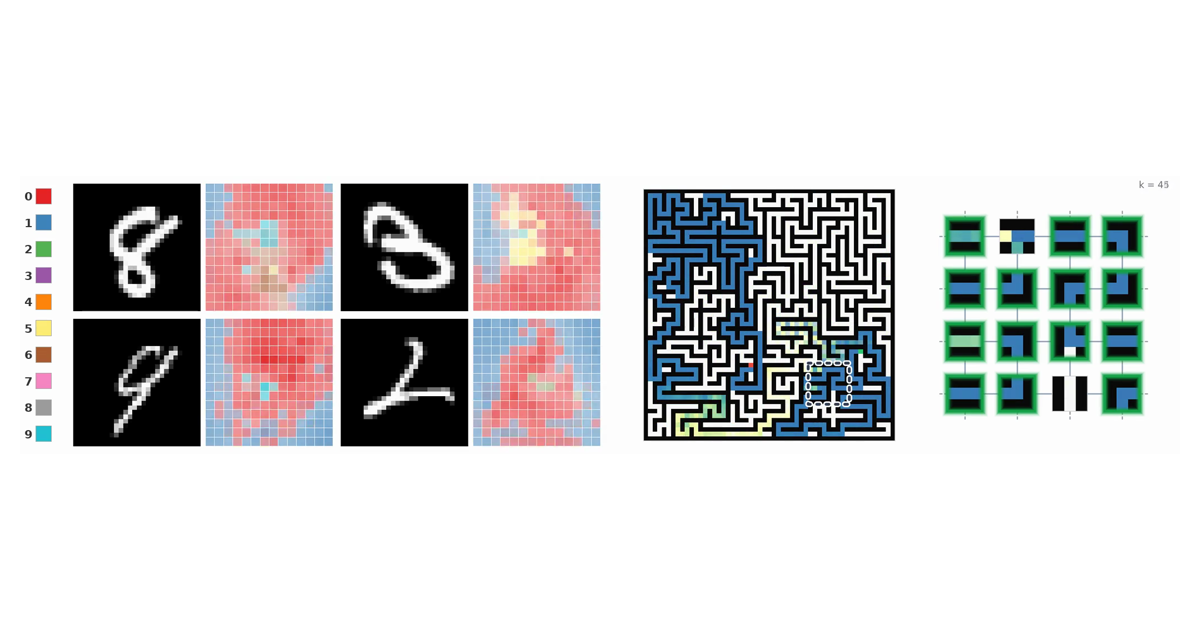
This article introduces Sheaf-ADMM, a novel neural network architecture built on the intersection of sheaf theory and the Alternating Direction Method of Multipliers (ADMM) for distributed consensus. The framework addresses the challenge of multi-agent coordination where agents have limited views and must negotiate a global answer. Unlike traditional centralized multi-agent systems that rely on an orchestrator, Sheaf-ADMM enables distributed consensus among agents. The approach leverages sheaf theory to model local relationships and constraints between agents, combined with ADMM's optimization capabilities for reaching agreement across the network.
Source
 Twitter / XSheaf-ADMM: A Distributed Consensus Neural Network for Multi-Agent Coordinationpub.sakana.ai
Key quotes
· 5 pulledWe introduce Sheaf-ADMM, a different way to build a neural network based on the notion of multi-agent consensus.
The framework is built on the intersection of sheaf theory and ADMM for distributed consensus.
AI systems are increasingly composed of many interacting agents rather than a single monolithic model.
In current practice, multi-agent systems are typically centralized, such as with an orchestrator delegating and assigning subtasks.
Limited-view agents negotiating a global answer.
You might also wanna read
Learning Multi-Agent Coordination via Sheaf-ADMM
Learning Multi-Agent Coordination via Sheaf-ADMM

Latent Agents: Distilling Multi-Agent Debate into Single LLMs via Post-Training Internalization
This paper introduces "Latent Agents," a post-training framework that distills multi-agent debate into a single LLM through a two-stage fine
 arxiv.org·1mo ago
Latent Agents: Distilling Multi-Agent Debate into Single LLMs via Post-Training Internalization
This paper introduces "Latent Agents," a post-training framework that distills multi-agent debate into a single LLM through a two-stage fine
arxiv.org·1mo ago
Decentralized Multi-Agent Reinforcement Learning for Autonomous Aircraft Traffic Management in AAM Corridor Networks
This research paper addresses the challenge of managing high-density autonomous aircraft traffic in Advanced Air Mobility (AAM) corridors. T
arxiv.org·15d ago
Arbor: A Multi-Agent Framework Using Tree Search for Autonomous LLM Inference Optimization
Arbor is a multi-agent framework that uses structured tree search as a cognition layer for autonomous agents operating in large, stateful ac
arxiv.org·23d ago
FLASH-P: AI multi-agent framework builds accurate causal biological networks from literature in under an hour
FLASH-P is a multi-agent AI framework that autonomously curates scientific literature to construct causal, signed-directed network models fo
 sciety.org·15d ago
Comments
Sign in to join the conversation.
No comments yet. Be the first.