All Topics
All Topics
Technology
Technology
AI
AI
Business
Business
Entertainment
Entertainment
News
News
Programming
Programming
Science
Science
Design
Design
Environment
Environment
Finance
Finance
Crypto
Crypto
Politics
Politics
Sports
Sports
Education
Education
Gaming
Gaming
Art
Art
Music
Music
Health
Health
Security
Security
Books
Books
Food
Food
Travel
Travel
Personal
Personal
Bluesky
Twitter

Directed Acyclic Graph Convolutional Networks

2mo ago

Source

IEEEDirected Acyclic Graph Convolutional Networksieee.org
Snippet from the RSS feed
Directed acyclic graphs (DAGs) are central to science and engineering applications including causal inference, scheduling, and the automated design of neural architectures. In this work, we introduce the DAG Convolutional Network (DCN), a novel graph neural network (GNN) architecture designed specifically for convolutional learning from signals supported on DAGs. The DCN leverages causal graph filters to learn nodal representations that account for the partial ordering inherent to DAGs, a strong inductive bias not present in conventional GNNs. Unlike prior art in machine learning over DAGs, DCN builds on formal convolutional operations that admit spectral-domain representations. We further propose the Parallel DCN (PDCN), a model that feeds input DAG signals to a parallel bank of causal graph-shift operators and processes these DAG-aware features using a shared multilayer perceptron. This way, PDCN decouples model complexity from graph size while maintaining satisfactory predictive performance. The architectures’ permutation equivariance and expressive power properties are also established. Comprehensive numerical tests across several tasks, datasets, and experimental conditions demonstrate that (P)DCN compares favorably with state-of-the-art baselines in terms of accuracy, robustness, and computational efficiency. These results position (P)DCN as a viable framework for deep learning from DAG-structured data that is designed from first (graph) signal processing principles.

You might also wanna read

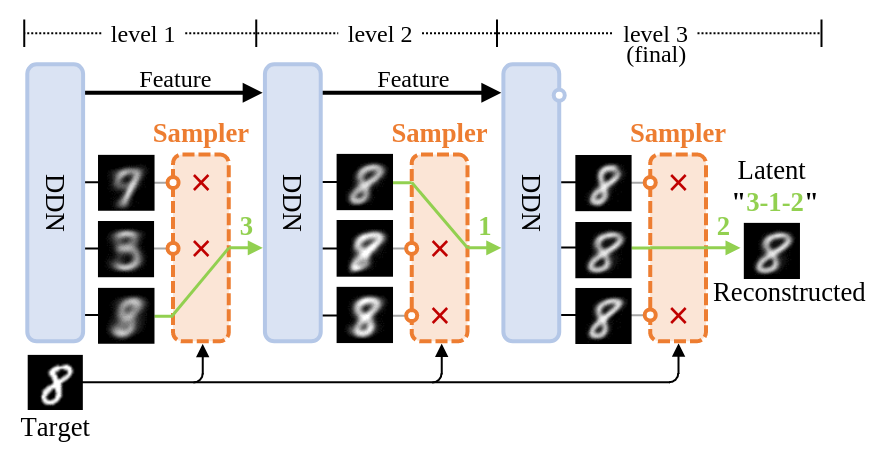
DDN: Discrete Distribution Networks - A Novel Generative Model for Image Reconstruction

DDN (Discrete Distribution Networks) is a novel generative model accepted by ICLR 2025 that introduces a unique approach to image generation

discrete-distribution-networks.github.io·9mo ago

Using Diffusion Models to Visualize What Self-Supervised Neural Networks Actually Learn

This paper introduces the use of Representation Conditional Diffusion Models (RCDM) to visualize what self-supervised learning (SSL) models

arxiv.org·14d ago

Understanding the Mathematical Principles of Generative Adversarial Networks

This article provides a technical explanation of Generative Adversarial Networks (GANs), focusing on the mathematical principles behind thes

jaketae.github.io·10mo ago

Transformers Can Learn to Predict Permuted Congruential Generator Sequences Through Curriculum Learning and Scaling Laws

This research paper investigates whether Transformer models can learn to predict sequences generated by Permuted Congruential Generators (PC

arXiv.org·2mo ago

Generalized Windowed Operation: A Unified Framework for Deep Learning Operations

This research paper introduces the Generalized Windowed Operation (GWO), a theoretical framework that unifies deep learning operations by de

zenodo.org·9mo ago

Rank-Aware Decomposition Technique Reduces Computation in Recommender Systems by 87.5%

This paper presents a rank-aware decomposition technique for deep ranking models in industrial recommender systems. The key insight is that

arxiv.org·1mo ago

Comments

Sign in to join the conversation.

No comments yet. Be the first.