
























The Two Kinds of Random: Why π Compresses and Noise Doesn't — and the Proof Barrier Between Them
By
pcael
Summary
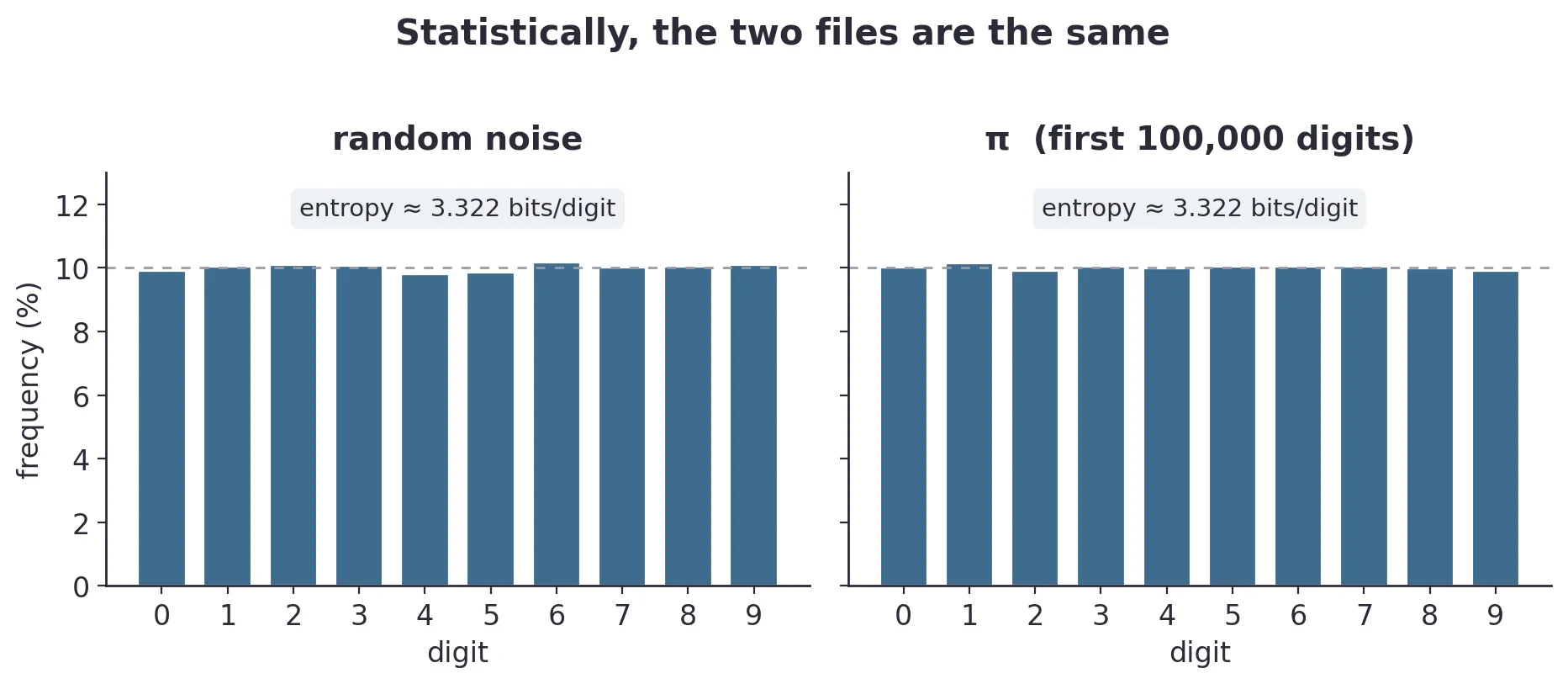
This article explores a deep puzzle in mathematics and information theory: two files of a million digits each — one pure random noise, the other the first million digits of π — are statistically identical (both pass randomness tests), yet one (π) can be compressed to a few lines while the other cannot. The author uses this gap to dissect the concept of 'compressible' into two distinct meanings: compressible in practice (algorithmic) versus compressible in theory (Kolmogorov complexity). The piece traces through randomness, entropy, statistical testing, and the philosophical wall that you can always prove something is compressible but can never prove it isn't — a boundary that touches on Gödel-like incompleteness and the limits of mathematical proof.
Source
 Hacker NewsThe Two Kinds of Random: Why π Compresses and Noise Doesn't — and the Proof Barrier Between Themstillthinking.net
Key quotes
· 3 pulledImagine two files, and each one holds a million digits. The first one is pure noise — imagine I rolled a ten-sided die a million times and wrote down the results. The second one is the first million digits of π.
you can always prove a thing can be compressed, but never that it can't.
Any errors, awkward sentences, and weird tangents are 100% organic, free-range, and human-made.
You might also wanna read


Mathematicians Use Gödel's Incompleteness Theorems to Develop New Cryptographic Tool
This article explores the intersection of mathematical unknowability (inspired by Gödel's incompleteness theorems) and modern cryptography.
 ow.ly·1mo ago
Quantum Jamming and Causality: The Search for Post-Quantum Cryptography
The article discusses how quantum computers pose a threat to current encryption methods, and how cryptographers are responding by developing
 wired.com·28d ago
Limitations and improvements of chain rules for conditional entropies in quantum cryptography security proofs
This article discusses chain rules for conditional entropies in quantum cryptography, which are essential for security proofs against genera
 arxiv.org·1mo ago
NIST scientist uses Gödel's incompleteness theorems to prove AI systems cannot be made fully secure
A NIST senior scientist, Apostol Vassilev, has published a peer-reviewed paper in IEEE Security and Privacy using Gödel's incompleteness the
 nist.gov·23d ago
Quantum state distinguishability in noisy scrambled ensembles exhibits phase-transition behavior
This research paper extends the concept of quantum state distinguishability from pairs of states to quantum state ensembles, characterized t
arxiv.org·1mo ago
Constrained de Finetti Reduction Simplifies Quantum Communication Compression Analysis
Researchers led by Louis Desruisseaux (CNRS) have developed a constrained de Finetti reduction that leverages information about input types
 quantumzeitgeist.com·5d ago
Comments
Sign in to join the conversation.
No comments yet. Be the first.