
























UK Biobank study compares count-based and clustering definitions of multimorbidity and their association with prevalence, health profiles, and mortality
By
Gabriella C. Silva,
Summary
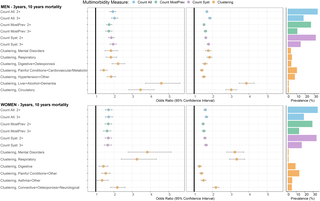
This cohort study using UK Biobank data (n=474,397) compares different definitions of multimorbidity—count-based approaches (using various condition lists and thresholds of ≥2 or ≥3 conditions) versus clustering analysis to identify subtypes. The study evaluates how these different definitions affect the estimated prevalence of multimorbidity, associated health profiles, and mortality outcomes. The research aims to understand how methodological choices in defining multimorbidity influence research findings and clinical implications.
Source
 bskyUK Biobank study compares count-based and clustering definitions of multimorbidity and their association with prevalence, health profiles, and mortalityplos.io
Key quotes
· 3 pulledUsing UK Biobank baseline data (n = 474,397), collected between 2006 and 2010, we compared six count-based definitions of multimorbidity based on different condition lists (extended, most prevalent, or body systems) and thresholds (≥2 versus ≥3 conditions).
We also applied a clustering analysis to characterize subtypes of multimorbidity.
Gabriella Silva and colleagues evaluate different definitions of multimorbidity (count-based versus clustering) and their associations with prevalence, health profiles and mortality in UK Biobank participants.
You might also wanna read


Objective vs. Subjective Sleep Traits: A Phenome-wide Analysis of Disease Associations in 88,461 Adults
The study investigates the associations between accelerometer-derived objective sleep traits and various diseases in 88,461 UK Biobank adult
 spj.science.org·11mo ago
Statistical Analysis Reveals DSM-5 Disorders Don't Align with Natural Symptom Clusters
A groundbreaking study published in Clinical Psychological Science uses statistical clustering methods to analyze DSM-5 psychiatric symptoms
 psychiatrymargins.com·9mo ago
Health data of 500,000 UK Biobank participants found for sale on Alibaba
Medical details of 500,000 UK Biobank participants were discovered for sale on the Chinese e-commerce site Alibaba. The leaked data includes
 bmj.com·2mo ago
Study Finds Household Cohabitation, Not Genetics, Drives Transmission of Diabetes- and Cancer-Linked Microbes
Researchers mapped the environmental and physical dynamics of human microbiome transmission, proving that household cohabitation is the prim
 ow.ly·4d ago
Study Finds Hypotension Strongly Linked to Alzheimer's Disease Risk in Large Cohorts
A cross-sectional study of nearly 800,000 adults from the UK Biobank and All of Us Research Program found that multiple cardiovascular disea
 mdsc.pe·4d ago
First-time mothers in family court care proceedings face 21 times higher mortality risk within 10 years, study finds
This cohort study using linked administrative hospital, mortality, and family court records in England found that first-time mothers involve
 jech.bmj.com·12h ago
Comments
Sign in to join the conversation.
No comments yet. Be the first.