
























Climate model intercomparison study examines off-equatorial stratospheric sulfur injection for solar geoengineering
Summary
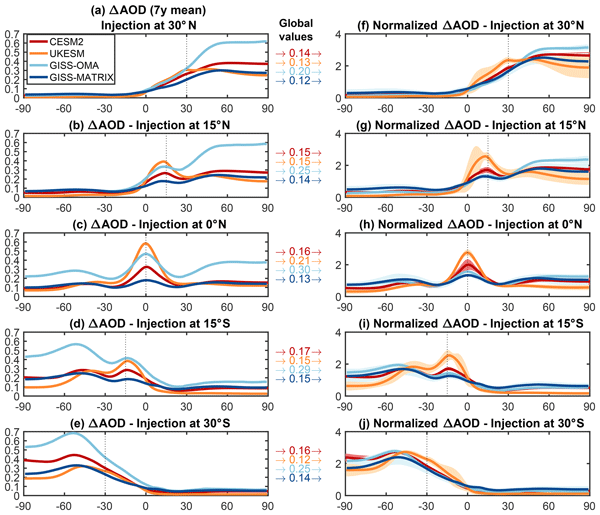
This study presents the first systematic intercomparison of climate responses across three Earth system models (CESM2-WACCM6, UKESM1.0, and GISS-E2.1-G) to off-equatorial stratospheric sulfur injections as a potential solar geoengineering strategy. The research examines how injecting SO2 at different latitudes in the lower stratosphere affects the distribution of reflective sulfate aerosols and surface climate responses. Key findings include large disagreements between models regarding cooling per unit of aerosol optical depth (ranging from 4.7K to 16.7K), but some commonalities in aerosol distribution patterns and inter-hemispheric temperature responses when normalized. The study aims to identify sources of agreement and uncertainty to inform potential comprehensive intervention strategies combining multiple injection locations.
Source
 bskyClimate model intercomparison study examines off-equatorial stratospheric sulfur injection for solar geoengineeringacp.copernicus.org
Key quotes
· 5 pulledWe find large disagreements between GISS-E2.1-G and the CESM2-WACCM6 and UKESM1.0 models regarding the magnitude of cooling per unit of aerosol optical depth (AOD) produced, which varies from 4.7 K per unit of AOD in CESM2-WACCM6 to 16.7 K in the GISS-E2.1-G version with two-moment aerosol microphysics.
The goal of this exercise is not to evaluate these single-point injection simulations as stand-alone proposed strategies to counteract global warming; instead we determine sources and areas of agreement and uncertainty in the simulated responses.
We demonstrate that it is possible to use these simulations to produce more comprehensive injection strategies in multiple climate models.
By normalizing the results with the global mean response in each of the models... we highlight some commonalities in the overall distributions of the aerosols, in the inter-hemispheric surface temperature response and in shifts to the Intertropical Convergence Zone.
Large differences in the injection magnitudes can be expected, potentially increasing inter-model spreads in some stratospheric quantities (such as aerosol distribution) while reducing the spread in the surface response in terms of temperature and precipitation.
You might also wanna read


Startup Proposes Geoengineering Solution to Dim Sun and Combat Global Warming
The article discusses Stardust, an Israeli startup proposing a geoengineering solution to combat global warming by mimicking volcanic erupti
 newyorker.com·7mo ago
Rendering Realistic Skies and Planetary Atmospheres in Real-Time with Shaders
This article explores the technical and visual process of rendering realistic skies, sunsets, and planetary atmospheres in real-time using b
 Maxime Heckel·1mo ago
Scientists explore aerosol-based methods to warm Mars as first step toward terraforming
Scientists are researching methods to terraform Mars, including the dispersion of aerosols to warm the planet's atmosphere as a first step t
 space.com·3d ago
Scientists explore aerosol-based methods to warm Mars as first step toward terraforming
Scientists are researching methods to terraform Mars, including the dispersion of aerosols to warm the planet's atmosphere as a first step t
space.com·3d ago
NASA Taps Rocket Lab to Launch Two Earth and Solar Science Missions Under VADR Contract
NASA has selected Rocket Lab to provide launch services for two Earth and solar science missions — PolSIR (Polarized Submillimeter Ice-cloud
 go.nasa.gov·10h ago
Stanford's STEHM model helps astronomers screen exoplanets for atmosphere retention and habitability
Stanford researchers have developed a new planetary habitability model called STEHM (Smaller Than Earth Habitability Model) that helps astro
 space.com·2d ago
CERES – Clouds and the Earth's Radiant Energy System
 ceres.larc.nasa.gov·6d ago
Comments
Sign in to join the conversation.
No comments yet. Be the first.