
























Basking sharks feed during migration by diving into deep scattering layers in the Northwest Atlantic
By
Jaida N. Elcock ,
Summary
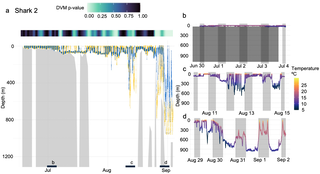
This scientific study examines the overwintering migration behavior of basking sharks (Cetorhinus maximus) in the Northwest Atlantic Ocean using pop-up satellite archival transmitting (PSAT) tags. The research reveals that basking sharks exhibit two main behaviors during migration: shallow epipelagic occupancy on or near the continental shelf, and movements throughout the mesopelagic zone in offshore waters. While offshore, the sharks display strong diel vertical migration (DVM) that overlaps with primary and secondary deep scattering layers, particularly in the southern Sargasso Sea. The findings suggest basking sharks likely forage throughout their large-scale migrations rather than relying primarily on energy stores, and may regularly target prey biomass in deeper, non-migratory prey layers below the primary deep scattering layer. This highlights the ecological importance of mesopelagic prey for basking sharks during migration.
Source
 bskyBasking sharks feed during migration by diving into deep scattering layers in the Northwest Atlanticjournals.plos.org
Key quotes
· 5 pulledOur results suggest basking sharks likely forage throughout these large-scale migrations, rather than relying primarily on energy stores as has been suggested for other highly migratory shark species.
We also suggest that basking sharks may regularly target prey biomass in a deeper, often non-migratory prey layer below the primary deep scattering layer.
These findings highlight the potential ecological importance of mesopelagic prey for basking sharks during migration and contribute to growing recognition of the ecosystem services supported by deep-pelagic food webs within and beyond the primary deep scattering layer.
While offshore, vertical habitat use was characterized by a strong diel vertical migration (DVM) that overlapped with primary and secondary deep scattering layers, particularly in the southern Sargasso Sea.
Long-distance migrations allow animals to exploit seasonal prey opportunities and track favorable oceanographic conditions.
You might also wanna read


Study reveals how long-distance ocean migrators reorient using compass headings in mid-ocean
This scientific research article investigates how animals navigate during long-distance ocean migrations to specific targets. The authors de
 scim.ag·4d ago
Study reveals how long-distance ocean migrators reorient using compass headings in mid-ocean
This scientific research article investigates how animals navigate during long-distance ocean migrations to specific targets. The authors de
scim.ag·4d ago
Climate Change Threatens Great White Sharks with Overheating Due to Ocean Warming
The article discusses how climate change and ocean warming are threatening great white sharks by causing them to overheat. These apex predat
 e360.yale.edu·2mo ago
First methane-powered sea spiders found crawling on the ocean floor

Study identifies liver macrophages as key to pigeon magnetoreception under overcast skies
Researchers have discovered that homing pigeons use superparamagnetic macrophages (iron-containing immune cells) in their livers for magneto
scim.ag·9d ago
Research Cruises to Study Deep-Sea Mining Impact on Abyssal Ecosystems
The article discusses deep-sea mining in the Clarion-Clipperton Zone (CCZ) of the Pacific Ocean, where a robotic vehicle called Patania II c
 science.org·5mo ago
Seabirds Exploit Pound Nets for Easy Prey in the Baltic Sea, Causing Fishery Losses
The article discusses how seabirds like cormorants, gulls, and terns are attracted to pound nets used by fisheries in the Western Baltic Sea
 Defector·1mo ago
Comments
Sign in to join the conversation.
No comments yet. Be the first.