
























JCI review maps biological age tools from epigenetic clocks to AI, calls for stronger evidence before clinical use
By
Pooja Toshniwal Paharia
Summary
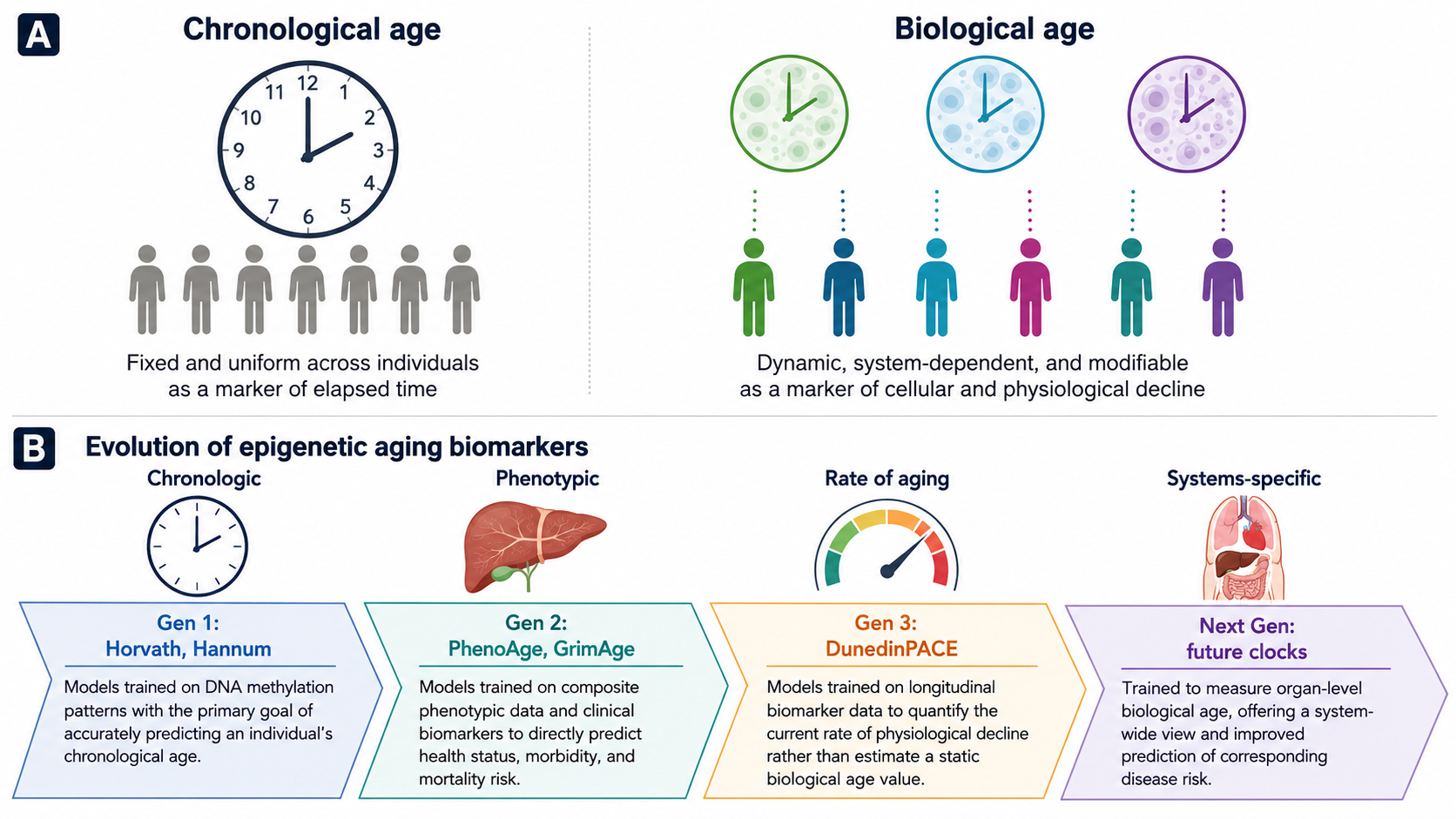
A major JCI review maps the evolution of biological age (BA) measurement tools — from functional tests and blood biomarkers to epigenetic clocks (e.g., Horvath, Hannum, PhenoAge, GrimAge), proteomics, imaging, wearables, and AI-based systems. These tools can predict health risks and mortality better than chronological age alone, but the field lacks standardization, interpretability, and prospective validation before these tools can be used routinely in patient care.
Source
 Twitter / XJCI review maps biological age tools from epigenetic clocks to AI, calls for stronger evidence before clinical usenews-medical.net
Key quotes
· 3 pulledThe distinction between CA and BA and the progression of epigenetic clocks through multiple generations.
First-generation clocks (e.g., Horvath, Hannum) were trained to predict chronological age.
Second-generation clocks (e.g., PhenoAge, GrimAge) ...
You might also wanna read

Harvard Scientists Develop Genetic Clock That Measures Biological Aging Across Species
Harvard scientists have developed a new "genetic clock" that measures biological age at the cellular level, going beyond chronological age t
 singularityhub.com·23d ago
New Gene Activity-Based Clock Improves Biological Aging Predictions
Scientists have developed a new epigenetic 'clock' based on gene activity that can predict lifespan and capture hallmarks of chronic disease
 sciencealert.com·23d ago
Sleep chart of biological ageing clocks in middle and late life
https://doi.org/10.1126/science.aeb6987
Method to reverse cellular ageing is about to be tested in humans
Comments
Sign in to join the conversation.
No comments yet. Be the first.