
























Understanding English Helping Verbs: Modals, Auxiliaries, and the Verb 'To Be'
By
Cindy Blanco, Ph.D.
Summary
This article explains the different categories of English verbs, focusing on helping verbs (modals and auxiliaries) and the verb 'to be'. It covers how to recognize and use various verb types in English grammar, with special attention to the irregular conjugations of 'to be' and its role in forming other tenses and sentence structures. The content is educational, aimed at English language learners seeking to understand verb classifications and usage rules.
Source
 DuolingoUnderstanding English Helping Verbs: Modals, Auxiliaries, and the Verb 'To Be'duolingo.com
Key quotes
· 3 pulledAn important part of English grammar is being able to recognize and use different categories of English verbs—there are often different rules for each verb type!
The verb to be is treated differently from other verbs.
It has very irregular conjugations that you'll have to memorize, and being able to recognize the forms of to be will help you form other verb tenses and sentence structures.
You might also wanna read

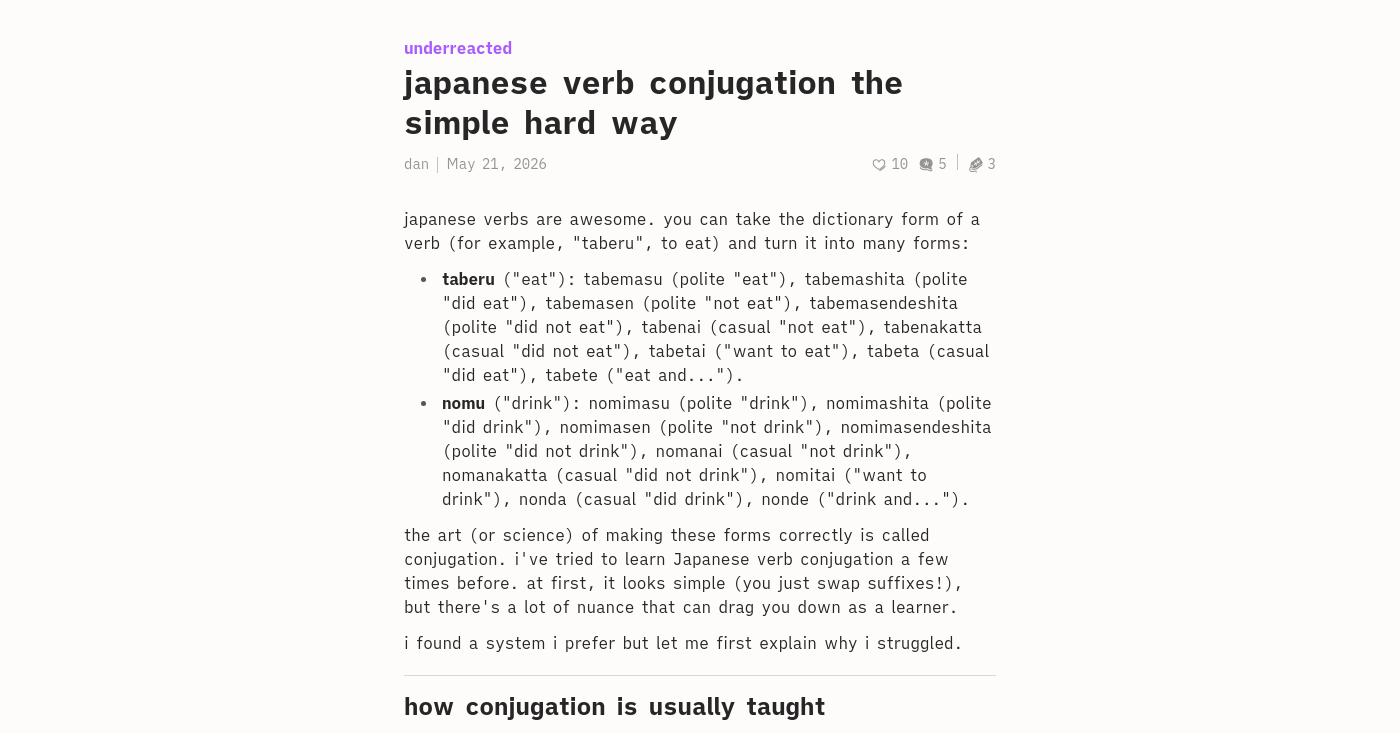
Japanese Verb Conjugation: A Comprehensive Guide to Transforming Dictionary Forms
A detailed guide to Japanese verb conjugation, explaining the patterns and rules for transforming dictionary-form verbs into various forms i
 underreacted.leaflet.pub·16d ago
Exploring Grammatical Diversity: The Usage of 'Try' in North American English
The article discusses the grammatical diversity in North American English, focusing on the usage of 'try' followed by different phrases (nou
ygdp.yale.edu·11mo ago
Decoding the British 'sorry': A cultural reflex beyond apology
This article explores the uniquely British use of the word "sorry" as a cultural reflex rather than a literal apology. It examines how Brito
 BBC·2mo ago
Exploring the Grammar and Cultural Structure of AAVE
A brief follow-up discussion on African American Vernacular English (AAVE), touching on its grammar mechanics, cultural and structural aspec
 spreaker.com·14d ago
Comments
Sign in to join the conversation.
No comments yet. Be the first.