
























Timeline of the Far Future: Scientific Predictions for Earth, the Solar System, and the Universe
By
Contributors to Wikimedia projects
Summary
A comprehensive Wikipedia article outlining scientifically-grounded predictions for the far future of the universe, covering events from Earth's geological and biological evolution, the Sun's transformation into a red giant, the fate of the Solar System, stellar and galactic evolution, to the ultimate fate of the universe in the very distant future (including heat death, proton decay, and black hole evaporation). The article draws from astrophysics, particle physics, and evolutionary biology to project events on timescales ranging from thousands to trillions of years.
Source

 bskyTimeline of the Far Future: Scientific Predictions for Earth, the Solar System, and the Universeen.wikipedia.org
Key quotes
· 3 pulledWhile the future cannot be predicted with certainty, present understanding in various scientific fields allows for the prediction of some far-future events, if only in the broadest outline.
These fields include astrophysics, which studies how planets and stars form, interact and die; particle physics, which has revealed how matter behaves at the smallest scales; evolutionary biology, which studies how life evolves over time.
Artist's concept of the Earth 5–7.5 billion years from now, when the Sun has become a red giant
You might also wanna read


'The fate of Earth depends on a delicate balance': Our planet may survive the death of the sun after all, new models hint
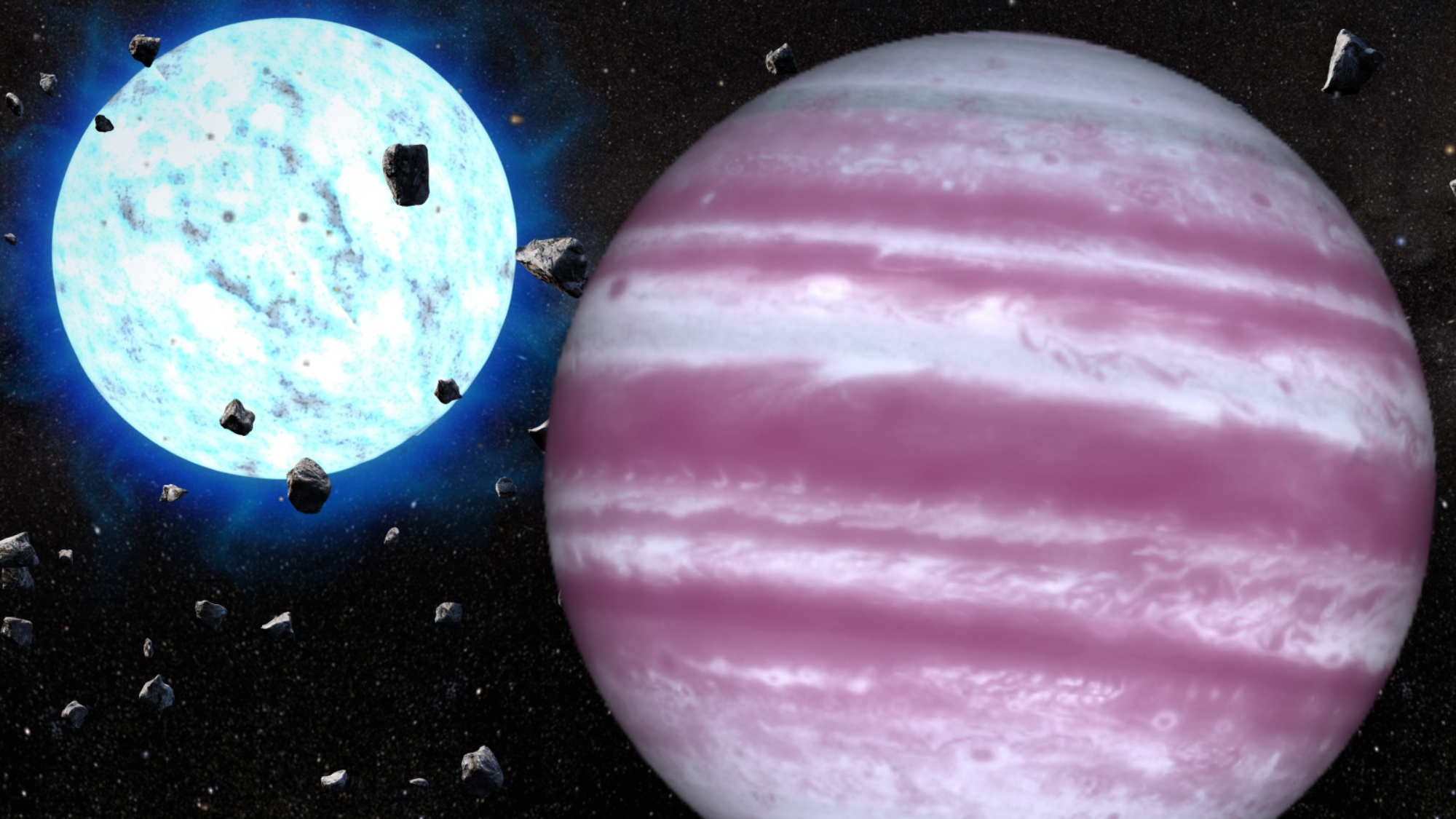
James Webb Space Telescope observes gas giant orbiting a dead white dwarf star, foreshadowing the solar system's distant future
Astronomers using the James Webb Space Telescope (JWST) observed the gas giant exoplanet WD 1856 b orbiting a white dwarf star 80 light-year
 space.com·2d ago
James Webb Space Telescope observes gas giant orbiting a dead white dwarf star, foreshadowing the solar system's distant future
Astronomers using the James Webb Space Telescope (JWST) observed the gas giant exoplanet WD 1856 b orbiting a white dwarf star 80 light-year
space.com·2d agoJames Webb Space Telescope observes gas giant orbiting a dead white dwarf star, foreshadowing the solar system's distant future
Astronomers using the James Webb Space Telescope (JWST) observed the gas giant exoplanet WD 1856 b orbiting a white dwarf star 80 light-year
Space·2d ago
Study suggests complex life on Earth could survive 500 million years longer than previous estimates
The article discusses how complex life on Earth may survive for up to 500 million years longer than previously estimated, as the sun gradual
 newscientist.com·9d ago
Cosmic-ray bath in a past supernova gives birth to Earth-like planets

New Thermodynamic Interpretations Challenge the Inevitability of Universal Heat Death
The article challenges the long-standing 'heat death hypothesis' - the scientific theory that the universe will eventually reach maximum ent
 noemamag.com·10mo ago
Comments
Sign in to join the conversation.
No comments yet. Be the first.