
























Study of blind Mexican cavefish reveals insights into brain evolution and sensory adaptation
By
Devin Reese
Summary
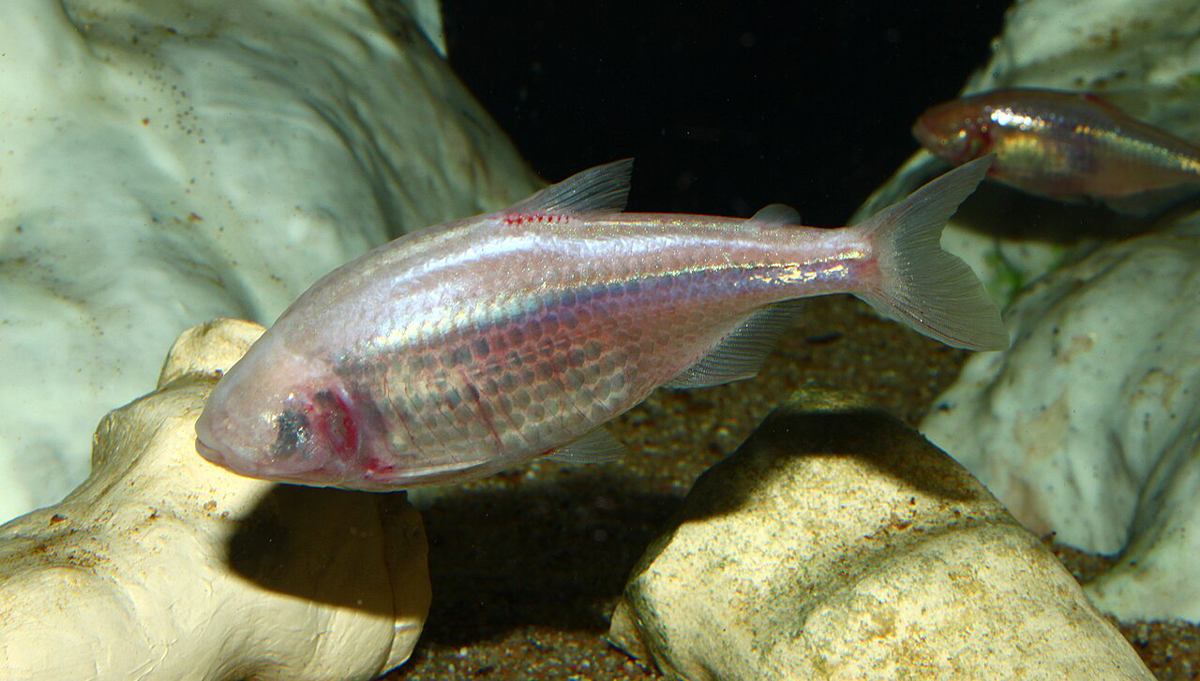
A new study published in Science Advances examines blind Mexican cavefish (Astyanax mexicanus) and their evolutionary adaptations to dark cave environments. The research compares cave-dwelling fish to their surface-dwelling relatives to understand how their brains have been rewired over hundreds of thousands of years to favor non-visual senses and survive with limited resources. The study suggests these neural adaptations could provide insights into brain evolution more broadly.
Source
 bskyStudy of blind Mexican cavefish reveals insights into brain evolution and sensory adaptationnautil.us
Key quotes
· 3 pulledIf a population of humans were to move entirely into dark, underground caves, you'd expect to see changes in their behavior.
They'd favor other senses over eyesight; their vision might adapt to favor low-light receptors; and they'd learn to subsist on limited resources.
While this scenario sounds apocalyptic for us, it's run-of-the-mill for blind Mexican cavefish (Astyanax mexicanus) as they've evolved over several hundred thousand years to survive in the dark world of caves.
You might also wanna read

Study suggests vertebrate ancestors had complex brains 500 million years ago, lamprey research shows
A Chinese-led study featured on the cover of Science suggests that the common ancestor of all vertebrates, including humans, may have posses
 news.cgtn.com·13d ago
Oxford study reveals ancient genome duplications enabled evolution of complex vertebrate brains
A new Oxford-led study reveals that whole-genome duplication events in early vertebrate evolution provided the genetic raw material for the
 ox.ac.uk·19d ago
How a transparent fish and $1 billion in funding could advance neuroscience research
The article profiles the Danionella fish, a tiny, transparent species that is emerging as a powerful model organism in neuroscience. Neurobi
 scim.ag·9d ago
Study finds jellyfish and sea anemones sleep similarly to humans, supporting early evolution of sleep for neuron repair
A study published in Nature Communications reveals that jellyfish and sea anemones, despite lacking a central nervous system, exhibit sleep
scim.ag·13d ago
Study of brainless hydra suggests sleep evolved before the central nervous system
Researchers from Kyushu University studied Hydra vulgaris, a cnidarian without a central nervous system, to investigate the evolutionary ori
 universal-sci.com·5d ago
Comments
Sign in to join the conversation.
No comments yet. Be the first.