
























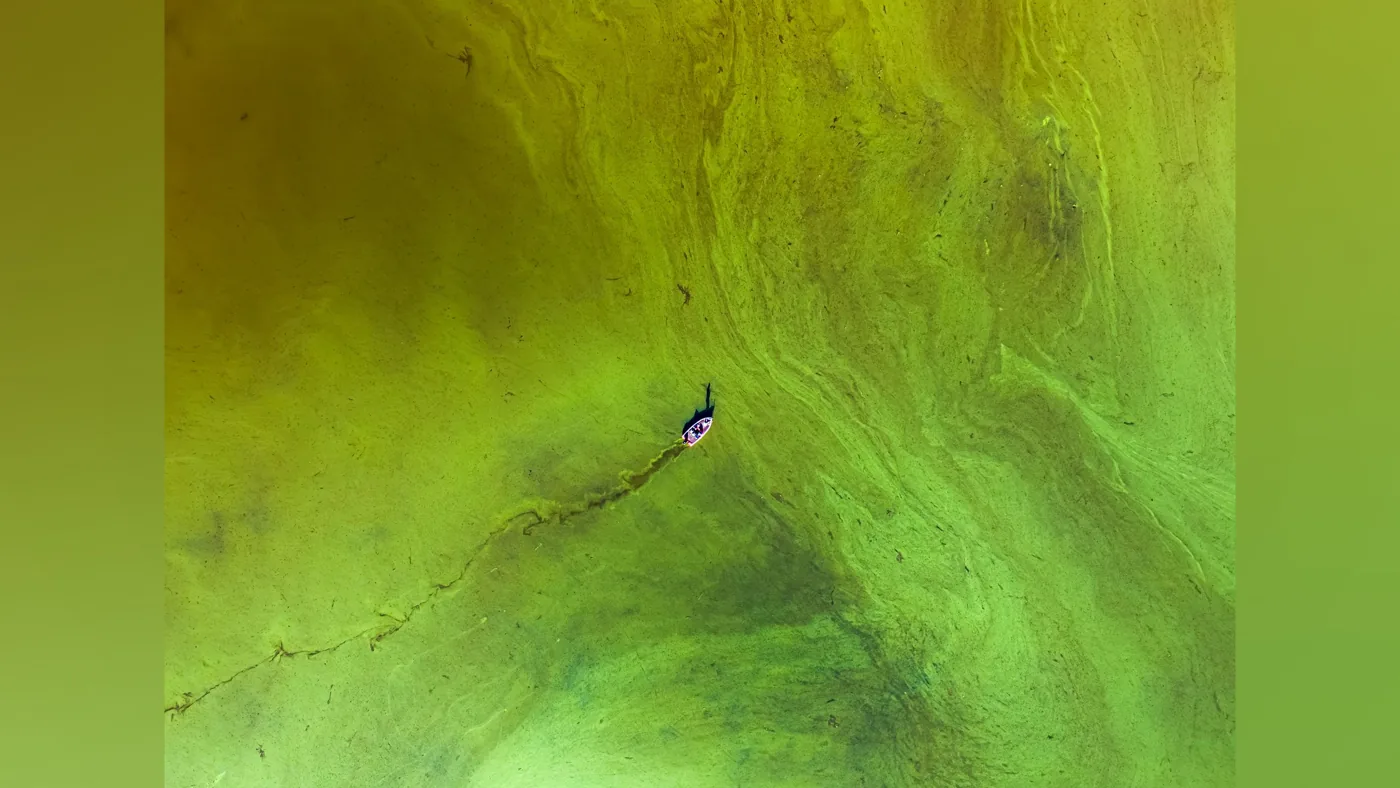
Drone photo captures researchers on algae-covered lake, highlighting human impact on freshwater ecosystems
By
Alan Palazon
Summary
A biological sciences PhD candidate at Queen's University, Haolun "Allen" Tian, used a camera drone to capture an award-winning photo showing researchers in a small boat on a slime-green-covered lake (Dog Lake, Ontario). The image juxtaposes human smallness against our massive environmental impact on freshwater ecosystems. The photo was taken during a 2021 water sampling project and won a Scientists at Work photo award.
Source
 bskyDrone photo captures researchers on algae-covered lake, highlighting human impact on freshwater ecosystemsdigitalcameraworld.com
Key quotes
· 3 pulledAs biological researcher Kelly Estrada Piedrahita and her assistant, Shirley Fench, made their way through a slime-green-covered lake in a small boat, fellow researcher and photographer Haolun 'Allen' Tian stood at the shore monitoring the pair with his drone.
Allen, currently defending his biological sciences PhD at Canada's Queen's University, Kingston, captured this camera drone image back in 2021 during a project to collect water samples from the lake.
The researchers specialize in freshwater ecosystems and this lake – Dog Lake, Ontario – is
You might also wanna read


Lancaster University Students Showcase Sustainable Projects Including Ecological Farm
The article highlights ten student projects from Lancaster University, including an ecological farm in the Lake District focused on food and
 Dezeen·11mo ago
Nature research paper: Global high-resolution mapping of seagrass to support conservation
Photo series on Arctic coastal erosion and permafrost thaw wins New Scientist Editors Award
Natalya Saprunova's photo series documenting coastal erosion and permafrost thaw across Inuvialuit territories in Canada's Arctic won the Ne
 newscientist.com·2d ago
Natur-Fotografie – Magische Momente: So schön ist unsere Natur
Researchers explore oyster-based water filtration for future space missions
Engineers at Harrisburg University and Monolith Space are researching the use of oysters and other "biogenerative" life support systems — li
 space.com·9d ago
Researchers explore oyster-based water filtration for future space missions
Engineers at Harrisburg University and Monolith Space are researching the use of oysters and other "biogenerative" life support systems — li
space.com·9d ago
Comments
Sign in to join the conversation.
No comments yet. Be the first.