
























Verification Becomes the Harder Problem for Advanced Coding Agents
By
[Submitted on 24 Jun 2026]
Summary
This paper challenges the classical intuition that verifying a solution is easier than producing one, arguing that for modern coding agents, verification has become the harder problem. The authors characterize verification signal quality along three dimensions—scalability, faithfulness, and robustness—and study four reward constructions (test verifier, rubric verifier, user as verifier, automated agent verifier) across different task types. Experiments show that targeted verification design can suppress reward hacking and improve task completion, but crucially, no fixed reward function remains effective as policy capability grows—verification must co-evolve with the generator.
Source
 bskyVerification Becomes the Harder Problem for Advanced Coding Agentsarxiv.org
Key quotes
· 4 pulledA classical intuition holds that verifying a solution is easier than producing one. For today's coding agents, this intuition is being inverted.
Every verifier we can build is only a proxy for human intent, never the intent itself.
No fixed reward function can remain effective as policy capability continues to grow; and verification must co-evolve with the generator.
Optimization widens the gap between proxy and intent — manifesting as reward hacking or signal saturation.
You might also wanna read

The Challenge of Verifying Code Quality from AI Coding Agents
The article discusses the author's experience building AI coding agents that work autonomously while they sleep, and the resulting challenge
 claudecodecamp.com·3mo ago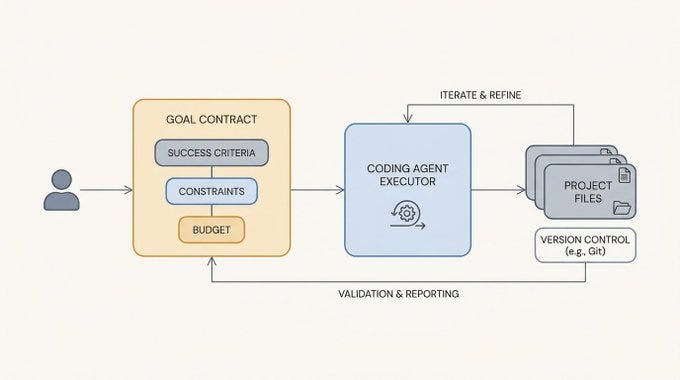
Autonomous Long-Running Coding Agents: The Shift from Prompting to Control Systems
The article discusses the evolution of autonomous coding agents from simple prompting systems to sophisticated control systems. The key insi
 nlp.elvissaravia.com·13d ago
Cross-Trace Verification Protocol: A Framework for Detecting Malicious Code in AI-Generated Programs
Researchers present Cross-Trace Verification Protocol (CTVP), a novel AI control framework for detecting malicious code generated by large l
arxiv.org·5mo ago
Practical Challenges in AI Agent Design and Development
The article discusses the ongoing challenges in building AI agents, highlighting that despite advancements, agent design remains difficult a
 lucumr.pocoo.org·7mo ago
Formal Framework for LLM-Verifier Systems: Convergence Theorem and 4/δ Latency Bound
This research paper presents a formal framework for integrating Large Language Models with Formal Verification tools, addressing reliability
arxiv.org·6mo ago
Code Review Skills Are Essential for Effective AI Agent Usage in Programming
The article argues that effective use of AI coding agents like Claude Code, Codex, and Copilot requires strong code review skills. The autho
seangoedecke.com·9mo ago
Comments
Sign in to join the conversation.
No comments yet. Be the first.