
























T Coronae Borealis could erupt as a 'new star' visible to the naked eye this week — a recurrent nova event occurring once every 80 years
By
Anthony Wood
Summary
T Coronae Borealis (T CrB), also known as the "Blaze Star," is a recurrent nova system located 3,000 light-years away in the Corona Borealis constellation. It consists of a red giant and a white dwarf in a binary orbit. Approximately every 80 years, the white dwarf siphons material from the red giant until it triggers a thermonuclear explosion, causing the star system to brighten dramatically — from magnitude +10 (invisible to the naked eye) to magnitude +2, as bright as Polaris, the North Star. The last eruption occurred in 1946, and astronomers predict another could happen anytime between now and September 2024. The article explains the science behind recurrent novae (distinct from supernovae, which destroy the star), the historical observations dating back to 1217 and 1787, and how skywatchers can locate Corona Borealis to witness this once-in-a-lifetime event.
Source
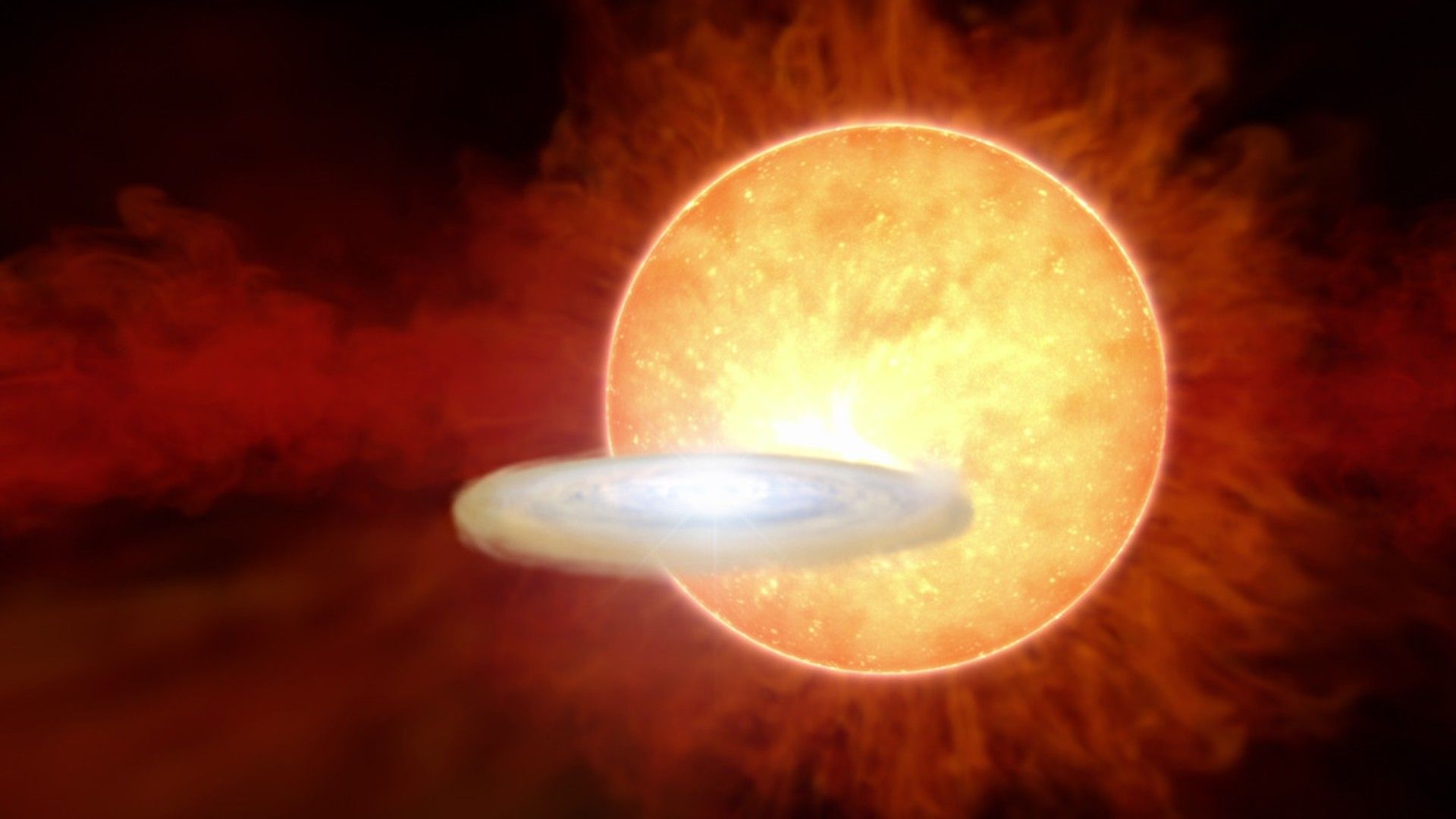
 Twitter / XT Coronae Borealis could erupt as a 'new star' visible to the naked eye this week — a recurrent nova event occurring once every 80 yearsspace.com
Key quotes
· 3 pulled'It's a once-in-a-lifetime event that will create a lot of new astronomers out there, giving young people a cosmic event they can observe for themselves, ask their own questions, and collect their own data.' — Dr. Rebekah Hounsell, NASA Goddard
'There are a few recurrent novae with very short cycles, but typically, we don't often see a repeated outburst within a human lifetime, and rarely one so relatively close to our own system.' — Dr. Rebekah Hounsell
'It'll fuel the next generation of scientists.' — Dr. Rebekah Hounsell
You might also wanna read

Seven notable night sky events to observe this summer
A guide to notable night sky events visible during the summer months, including a total solar eclipse (which occurs roughly every 18 months
 bbc.co.uk·1mo ago
A New Nova Just Appeared in the Night Sky – You Can See It with the Naked Eye

NASA's Hubble spots a stellar sparkler for the Fourth of July

Sun unleashes powerful X-class solar flare and Earth-bound CME that could spark northern lights for July 4 weekend

Microlensing Event in the Large Magellanic Cloud May Reveal Primordial Black Hole
A star in the Large Magellanic Cloud briefly brightened on December 18, 2019, in a smooth symmetrical event lasting about an hour, consisten
 twelvemountains.com·1mo ago
Comments
Sign in to join the conversation.
No comments yet. Be the first.