
























Long-read sequencing reveals Helitron-driven copy number variation of wax-related KCS genes in Populus trichocarpa
By
Michael R. Garvin
Summary
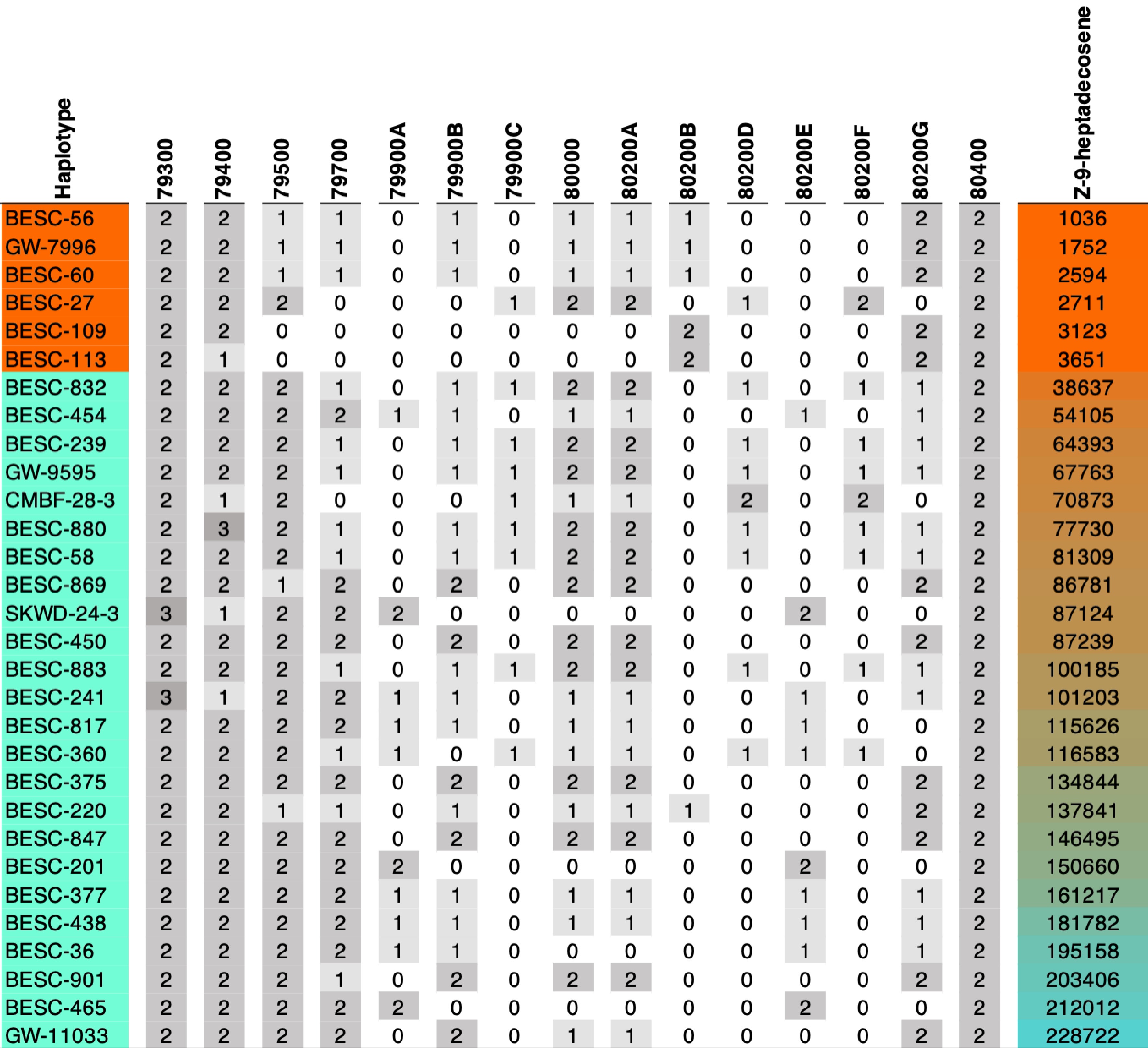
This study uses long-read sequencing to create telomere-to-telomere assemblies of chromosome 10 in Populus trichocarpa (black cottonwood), revealing complex adaptive variation in 3-ketoacyl-CoA-synthase (KCS) genes that drive wax cuticle diversity. The analysis of 78 long-read haplotypes identified more than twice as many KCS genes as previously reported with short-read assemblies, along with numerous non-synonymous substitutions. Random Forest models showed that alkene levels are best predicted by combinations of KCS copies rather than individual genes. Each KCS gene was linked to a Helitron transposon, and phylogenetic analysis suggests Helitrons are the evolutionary mechanism generating KCS tandem arrays. The research demonstrates that long-read sequencing is critical for interpreting complex genomic regions containing tandem copy number variants that are missed by short-read approaches.
Source
 bskyLong-read sequencing reveals Helitron-driven copy number variation of wax-related KCS genes in Populus trichocarpadoi.org
Key quotes
· 5 pulledLong-read sequencing enables the development of telomere-to-telomere resources to detect cryptic variation, including CNVs, which are currently missed.
Our analysis of 78 long-read haplotypes from chromosome 10 identified more than twice as many KCS genes as previously reported, and numerous intragenic non-synonymous substitutions.
Alkene levels are best predicted by the combinations of KCS copies.
A phylogenetic analysis suggests Helitrons are the evolutionary mechanism for generating KCS tandem arrays.
Our results highlight that, given current challenges in annotation and assembly, detailed and focused long-read sequences are key to interpreting complex genomic regions that contain tandem copy number variants.
The model woody plant
You might also wanna read


Genome sequencing of hallucinogenic Yunnan bolete reveals unknown compound behind visions
Researchers at the University of Utah have sequenced the genomes of 53 specimens of the Yunnan bolete mushroom, which causes hallucinations
 psychedelics.co.uk·10d ago
Nature research paper: Analysis of 173,303 exomes and genomes in the Pakistan Genome Resource

Breakthrough DNA "Page Numbers" Technology Enables Precise Construction of Long Genetic Sequences
Researchers have developed a breakthrough technology called DNA "page numbers" that enables precise construction of long DNA sequences, over
 caltech.edu·4mo ago
Stanford fruit fly study reveals 'dominance reversal' in genes, challenging classic genetic models
Stanford researchers tracked fruit fly populations in an outdoor orchard with controlled pesticide exposure, providing the first direct evid
 news.stanford.edu·9mo ago
He Jiankui PhD Thesis: Spontaneous Emergence of Hierarchy in Biological Systems

The Evolution of DNA Sequencing: From Sanger to Nanopore Technology
This article provides a comprehensive visual guide to DNA sequencing technologies, tracing the evolution from the Human Genome Project's ini
 asimov.press·3mo ago
Comments
Sign in to join the conversation.
No comments yet. Be the first.