
























Why Adding More Servers Can Increase Response Times: The M/M/c Queueing Paradox
By
Marc Brooker
Summary
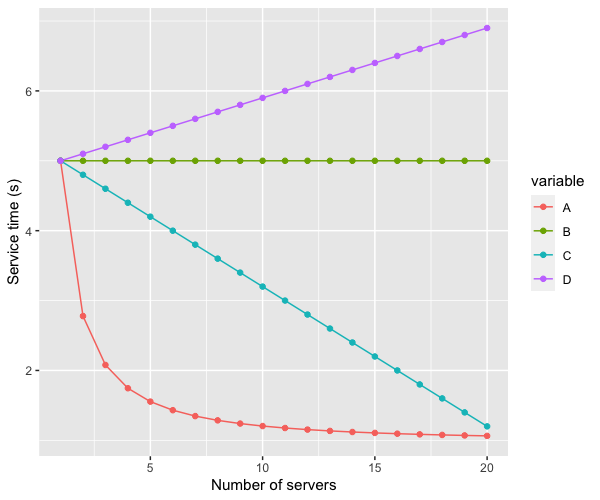
This article explores the counterintuitive behavior of the M/M/c queueing model, where increasing the number of servers (c) while keeping per-server load constant at 80% actually increases the mean request time experienced by clients. The author explains that while intuition might suggest more servers improve performance, the M/M/c model shows that queueing delays grow with the number of servers due to the probabilistic nature of request arrivals and the increased variability in the combined system.
Source
 Hacker NewsWhy Adding More Servers Can Increase Response Times: The M/M/c Queueing Paradoxbrooker.co.za
Key quotes
· 3 pulledThe M/M/c model may not behave like you expect.
I have a system with c servers, each of which can only handle a single concurrent request, and has no internal queuing.
How does the client-observed mean request time vary with c?
You might also wanna read


Competitive analysis of online paging algorithms may be based on a flawed model assumption
This academic paper argues that the Sleator-Tarjan model underlying competitive analysis of online paging algorithms contains a fundamental
 arxiv.org·10d ago
Why Database Utilization Remains High Despite Adding a Cache
This article explains why adding a cache in front of a database doesn't always solve high utilization problems. It argues that cache hit rat
 cstu.io·11d ago
Workers - Relaxed simultaneous connection limiting for Workers

New device promises 1,000x faster processors without extra waste heat, but details are scarce
This article briefly describes a new device that could enable computer processors to run up to 1,000 times faster without generating additio
 livescience.com·1mo ago
Workflows, Workers - Increased concurrency, creation rate, and queued instance limits for Workflows instances

The AI Productivity Paradox: Why Workers Are Doing More, Not Less
An exploration of how AI integration in the workplace is paradoxically increasing rather than decreasing workloads for many professionals. T
 prindleinstitute.org·5d ago
Comments
Sign in to join the conversation.
No comments yet. Be the first.