All Topics
All Topics
Technology
Technology
AI
AI
Business
Business
Entertainment
Entertainment
News
News
Programming
Programming
Science
Science
Design
Design
Environment
Environment
Finance
Finance
Crypto
Crypto
Politics
Politics
Sports
Sports
Education
Education
Gaming
Gaming
Art
Art
Music
Music
Health
Health
Security
Security
Books
Books
Food
Food
Travel
Travel
Personal
Personal
Bluesky
Twitter

Subspace Knowledge for Spectral Compressed Sensing

1mo ago

Source

IEEESubspace Knowledge for Spectral Compressed Sensingieee.org
Snippet from the RSS feed
We consider the problem of recovering a spectrally sparse signal from its partially observed entries. Traditional approaches leverage the low-rank property of such signals in the Hankel lifting domain. In this domain, we further incorporate subspace knowledge, initially estimated from test data and updated during signal recovery, to enhance performance. To quantify the impact of subspace knowledge on this enhancement, we propose a metric that integrates QR decompositions with the subspace direction number to assess its accuracy, as reflected in the recovery guarantee. The established guarantee demonstrates the local optimality of the proposed nonconvex method for signal recovery. Based on the local optimality, the proposed method achieves exact recovery with high probability, provided that the initial subspace estimate is sufficiently accurate to meet certain conditions. Compared to prior methods without subspace knowledge and those that exploit such knowledge, our method reduces the sample complexity by three and two logarithmic factors, respectively. Furthermore, we employ low-rank factorization techniques to incorporate prior information of the Hankel matrix rank, thereby enhancing the recovery precision and computational efficiency of the proposed method. The proposed method is efficiently optimized in an alternating minimization framework. Experimental results demonstrate the superior recovery precision and reduced sample complexity of the proposed method compared to existing methods, as well as its enhanced performance through low-rank factorization.

You might also wanna read

Deep Neural Networks Converge to Universal Low-Dimensional Subspaces Across Diverse Tasks

This research article presents empirical evidence that deep neural networks trained on diverse tasks converge to remarkably similar low-dime

arxiv.org·7mo ago

Computing Hessian Inverse Products for Deep Neural Networks to Speed Up Gradient Descent

This article presents a GitHub repository that demonstrates how to compute the inverse of the Hessian matrix for deep neural networks and mu

github.com·5mo ago

Generalized Two-Qubit Hamiltonian Improves Quantum Feature Maps for Machine Learning

This paper introduces a generalized two-qubit Hamiltonian-based Projected Quantum Feature Map (PQFM) that unifies encoding of classical feat

arxiv.org·24d ago

Variational Autoencoder Framework Enables Task-Specific Quantum Embeddings of Classical Data

This paper introduces a variational autoencoder framework for quantum machine learning that learns task-specific quantum embeddings of class

arxiv.org·12d ago

Limitations and improvements of chain rules for conditional entropies in quantum cryptography security proofs

This article discusses chain rules for conditional entropies in quantum cryptography, which are essential for security proofs against genera

arxiv.org·1mo ago
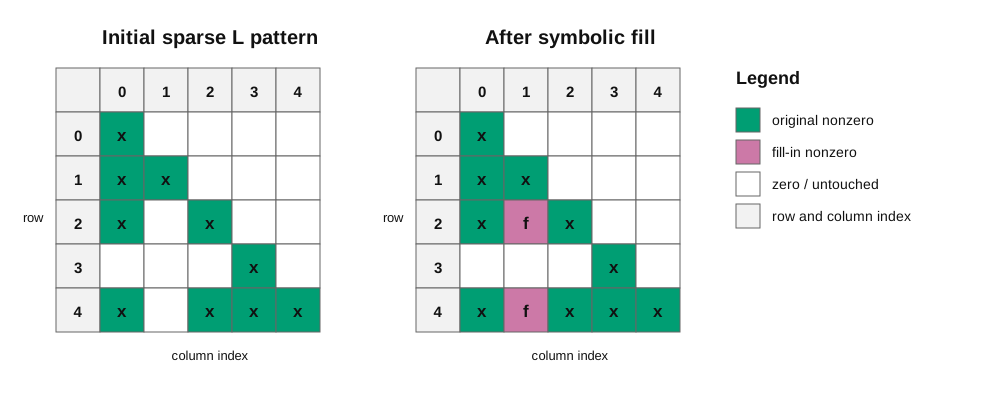
Deriving the Sparse Cholesky Elimination Tree for Matrix Factorization

This article provides a technical derivation of the elimination tree for the right-looking sparse Cholesky algorithm (A = LL^T) for sparse m

Math, Numerics, and Software·1mo ago

Comments

Sign in to join the conversation.

No comments yet. Be the first.