
























Why Your Second Brain Becomes a Note Graveyard — and How to Fix It
By
Matt Tilmann
Summary
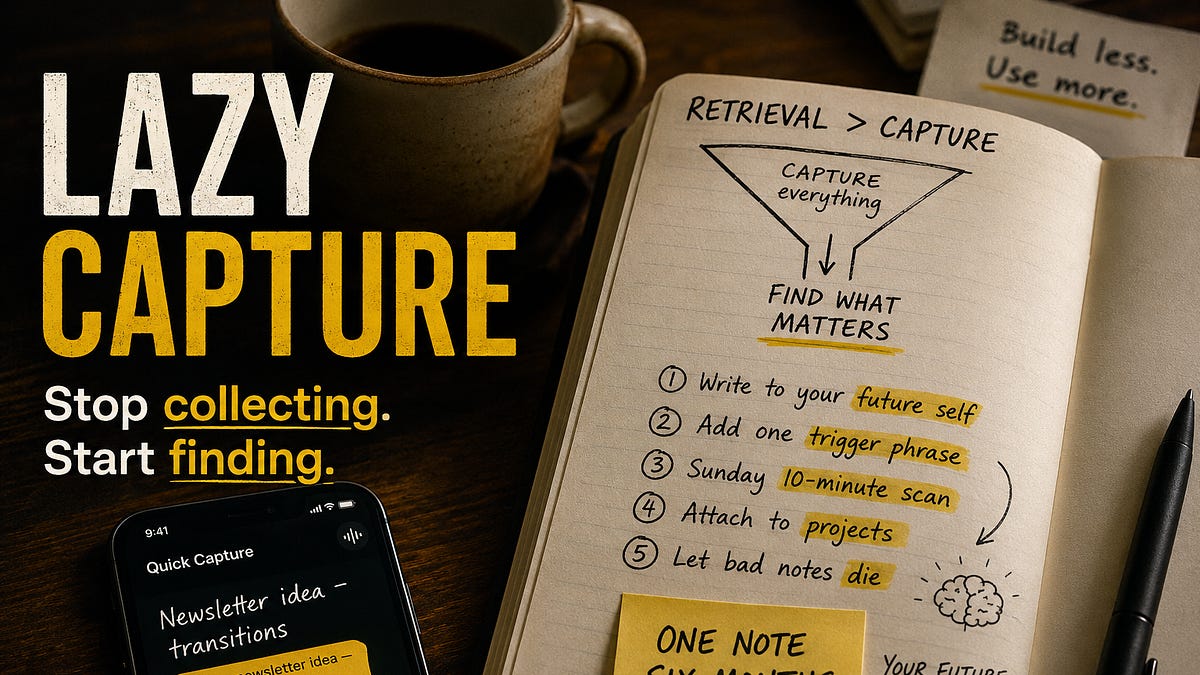
The article critiques the modern "second brain" / personal knowledge management (PKM) movement, arguing that most systems (like PARA, Zettelkasten, etc.) become graveyards where notes go in but never come back out. The author shares a personal story of repeatedly setting up elaborate systems that remain unused, then offers five practical shifts to make notes actually resurface when needed — focusing on retrieval over capture, reducing friction, and designing for the "future you" who will search for information.
Source
 bskyWhy Your Second Brain Becomes a Note Graveyard — and How to Fix Itmittendad.substack.com
Key quotes
· 4 pulledThe modern second-brain advice has a leak: everything goes in, nothing comes back out.
By Tuesday I had four notes. Two of them were reminders to use the system.
Five small shifts that turn a note graveyard into something that finds you when you need it.
The whole thing looked like a productivity influencer's screenshot — the kind where everything is named perfectly and nothing has been touched yet.
You might also wanna read


The Problem with Digital Hoarding: When Note-Taking Becomes Procrastination
The article discusses the common phenomenon of 'digital hoarding' where people collect notes, links, and information but struggle to convert
 news.ycombinator.com·4mo ago
The Liberation of Deleting My Digital 'Second Brain'
The author describes their decision to delete their entire digital 'second brain,' including years of notes, ideas, and productivity systems
 joanwestenberg.com·1y ago
The Myth of Memory-Free Learning: Why Search Engines and AI Still Require Deep Knowledge
The article debunks the long-standing myth that search engines, AI, and note-taking apps eliminate the need for human memory and active lear
 zettelkasten.de·9mo ago
Book Review: "There Is No Antimemetics Division" - Exploring Horror in Formal Systems and Memory
This book review analyzes "There Is No Antimemetics Division," a horror novel that explores the terrifying concept of antimemes—ideas that e
 stephendiehl.com·2mo ago
How Memory Replay Lets Your Brain Mentally Time Travel and Strengthen Recall
This article explores the neuroscience of memory replay — the brain's ability to mentally "time travel" by rewinding and replaying past expe
 popular-mechanics.visitlink.me·3d ago
Neurodivergent Thinking as an Asset in System Design and Problem-Solving
The article explores how neurodivergent thinking patterns, often seen as defects in social contexts, can be valuable assets in system design
 blog.drjoshcsimmons.com·5mo ago
Comments
Sign in to join the conversation.
No comments yet. Be the first.