
























Slack’s Slackbot can now pull your CRM data, generate charts, and send DocuSigns — all from a chat message.
By
[email protected] (Michael Nuñez)
5h agoen
Source
 VentureBeatSlack’s Slackbot can now pull your CRM data, generate charts, and send DocuSigns — all from a chat message.venturebeat.com
Five years and $27.7 billion after Salesforce acquired Slack, the two products are finally starting to function as a single system. On Tuesday, Slack launched an integration that connects Slackbot — the personal AI agent built into every workspace — to the entire Salesforce platform, including CRM data, Tableau analytics, Data 360 customer profiles, and a growing constellation of third-party applications, all through a single conversational prompt. The mechanism behind the expansion is a set of dedicated Model Context Protocol (MCP) servers from Salesforce that connect Slackbot to the company's Headless 360 infrastructure . In practical terms, a salesperson can now ask Slackbot for a customer's deal history, receive a live Tableau visualization of pipeline trends, update a CRM record, and trigger a DocuSign approval — without ever switching tabs or logging into another application. According to Slack, the Salesforce IT team has already used this architecture to save its 1,500-plus engineers "thousands of custom coding hours annually." The timing is not accidental. Slack is making this move amid escalating competitive pressure from Microsoft Teams, which claims 320 million-plus monthly active users and has Copilot embedded across the Office suite, and from Google, which continues to weave Gemini deeper into Workspace . And just days ago, The Information reported that some smaller companies are using Anthropic's Claude to r eplace Salesforce CRM entirely — one Atlanta-based property management firm with about 55 employees reportedly saved around $100,000 annually by building a custom replacement using Claude Code and Replit. Against that backdrop, Slack CMO Ryan Gavin sat down for an exclusive interview with VentureBeat to frame the announcement and argue that the company's future depends on an idea he calls "multiplayer AI" — and that the 25 years of customer data locked inside Salesforce is an asset no vibe-coded alternative can replicate. Why Slack's CMO believes 'multiplayer AI' is the next big enterprise battleground Gavin's core argument is that the enterprise AI conversation has been stuck in single-player mode for too long, and that Slack is uniquely positioned to break it open. "So much of what we've seen are just these incredible tools that have largely been single-player, incredible tools for individual productivity, helping people complete tasks and write code," Gavin told VentureBeat. "But as we've always known at Slack ever since our inception, work is a team sport. For AI to really take hold in the enterprise, it has to be multiplayer." The distinction matters commercially. Most AI assistants today — ChatGPT, Claude, Copilot — default to one-on-one conversations with a single user. A researcher queries a model, gets a response, and acts on it alone. The insight stays in a private chat window, invisible to colleagues. Gavin argues this creates a new version of the tab-switching problem that plagued pre-AI enterprise software, except now employees are also navigating dozens of individual agent interfaces on top of their existing applications. "It's going to benefit almost no one if every enterprise application out there spawns hundreds of agent babies, and employees end up in a worse world than they were before," Gavin said. Slack's answer is to make Slackbot the orchestration layer. Because everything happens in shared channels, any action an agent takes — pulling a customer profile, flagging a deal risk, updating a Jira ticket — is visible to the entire team. A colleague can redirect, build on, or correct the agent's work in real time. How MCP and Salesforce's headless 360 platform power Slackbot's new capabilities The technical backbone of the announcement is the Model Context Protocol , an open standard originally developed by Anthropic that defines how AI models discover and invoke external tools. MCP has seen rapid adoption across the AI tooling ecosystem. By early 2026, it had been adopted by Claude Code , Cursor , GitHub Copilot , and OpenAI's tooling, with managed hosting available from AWS , Cloudflare , and Vercel . As a DEV Community explainer puts it, MCP "is the closest thing the AI tooling ecosystem has to a standard." In this implementation, Salesforce exposes its platform capabilities — CRM records, Tableau visualizations, Data 360 customer profiles, Agentforce agents — as MCP servers. Slackbot operates as an MCP client, connecting to those servers and routing user queries to the appropriate back-end system. When a user asks Slackbot about a customer, the bot discovers which MCP tools are relevant, calls them, and synthesizes the results into a single response — all within the Slack conversation. Gavin explained the architecture in simple terms: "Salesforce is extending what has always been our open platform through our Headless 360 strategy — making all of these MCP endpoints available. And then Slackbot acts as an MCP client, connecting to those MCP servers and bringing all that data in within the confines of a trusted permission platform." That permission layer is critical. Slackbot respects each user's Salesforce permissions, meaning a marketing coordinator cannot accidentally access sales pipeline data they are not authorized to see. Validation rules, field-level security, and org-wide data boundary configurations carry over automatically. For admins, setup requires no custom integration code — Salesforce MCP servers can be discovered, installed, and governed from a single UI using the existing Slack-Salesforce connection. Salesforce first introduced the Headless 360 concept at its TDX developer conference in April, positioning it as an API-driven layer that exposes the platform's data, workflows, and governance controls so that software agents, rather than human users, can execute business processes directly. As CIO.com reported at the time, analysts viewed the move as an effort by Salesforce "to position itself as a central layer for managing agent-driven operations across different business functions." Slack says it's betting on openness, not on any single AI protocol When asked whether Slack is making a risky bet on MCP as a protocol — given that standards in AI tooling can shift rapidly — Gavin reframed the question entirely. "We're not betting on MCP, per se. We're betting on what we've always bet on, which is that Slack is an open platform," Gavin told VentureBeat. "MCP happens to be the best agent-to-agent protocol that the industry is rallying around right now, but if something better came out tomorrow, you'd see the same pattern from Slack — we're going to stay open. MCP and APIs are simply tools that facilitate that." That open-platform philosophy is central to Slack's identity and, Gavin argues, its competitive differentiation. Slack already hosts more than 2,600 app integrations . The new MCP-native partner ecosystem includes Atlassian , Box , DocuSign , Canva , Lucid , Zoom , and more than 25 additional companies, each of whose agents can be added directly to shared Slack channels. MuleSoft Agent , now connected to Slackbot, helps manage integrations for the team — checking system health or surfacing critical error alerts in the same workspace where the team is already collaborating. But MCP is not without trade-offs. The protocol requires tool discovery on every connection, and large tool libraries can consume significant context tokens. One technical analysis noted that a server exposing 300 tools could cost 5,000 to 10,000 tokens per session before the model does any useful work. For an enterprise like Salesforce with hundreds of potential tools across CRM, analytics, and service platforms, careful filtering and segmentation of MCP servers become essential design decisions — a challenge the company will need to navigate as the ecosystem scales. Inside Slack's complicated relationship with Anthropic and the Claude question Perhaps the most delicate topic in the interview concerned Slack's relationship with Anthropic, the AI lab behind Claude — and one of Slack's most visible power users. Just last week, Anthropic launched Claude Tag , a persistent AI teammate that works inside Slack channels, prompting confusion among Salesforce employees who worried it competes directly with Slackbot and Agentforce. The Information reported internal anxiety about whether Salesforce was welcoming a competitor into its own living room. Salesforce has financial reasons to maintain the partnership: the company reportedly expects to spend $300 million on Anthropic tokens this year and holds a stake in Anthropic. Gavin addressed the tension head-on, framing it as a feature of Slack's platform strategy rather than a threat. "We're incredibly excited and bullish about what Anthropic is bringing into Slack. Period. End of statement," Gavin said. He noted that Anthropic "is building roughly 65% of their code with Claude in Slack," and pointed out that ChatGPT was originally built in Slack, as was Perplexity. "Building nowadays happens in the open, and every company is going to be building in the open with tools like this, and you need a platform to build in the open," Gavin said. His argument is that feature overlap between Slackbot , Claude Tag , and other third-party agents is "actually a feature, not a bug" — a sign of a healthy platform rather than a competitive vulnerability. He compared it to an ecosystem where multiple products serve similar needs but win on craftsmanship, ease of use, and integration depth. "One of the reasons Slackbot has been the fastest-adopted feature in Salesforce history is the simplicity, the approachability — underpinned by the trust that comes from having an agent that knows me, knows my tone, knows my work, knows my people, knows my data," Gavin said. The distinction Slack draws is structural: Slackbot has access to a user's full workspace context, Salesforce data, permissions, and connected applications by default. Claude Tag, by contrast, only sees the channels it is explicitly added to. For Slack's leadership, that asymmetry is the moat. How Slack plans to compete with Microsoft Teams and Google in the AI era Asked directly about competitive positioning against Microsoft Teams and Google Workspace , Gavin pointed to Slack's open channel architecture as the differentiator no competitor can replicate. "If you spend any time in Teams, it's a lovely tool for chat, direct messages, and video, but it has no platform for open communication across organizations," Gavin said. "Its SharePoint-based architecture is fundamentally limiting." He cited Shopify as an example, where an internal AI agent called River is deployed across approximately 4,400 channels serving 6,000 employees. He also referenced a Fortune report noting that Microsoft's own head of AI mandated that his team run on Slack rather than Teams — a pointed detail Gavin clearly relished. "There's a reason for that," he said. "We're in an era right now where openness matters, and all the other tools you mentioned, they're still relatively closed." The competitive pressure is real and intensifying. Microsoft has integrated Copilot across its entire productivity suite, giving it a distribution advantage that reaches virtually every Fortune 500 company. Google has been similarly aggressive with Gemini across Workspace. And new entrants are crowding the market: a startup called Viktor , which embeds AI agents inside Slack and Teams workspaces, recently raised a $75 million Series A led by Accel — with Slack cofounders Stewart Butterfield and Cal Henderson participating as angel investors. Box , one of the enterprise customers highlighted in the announcement, told Slack it aims to have its sellers complete 75 to 80 percent of their work inside Slack. Gavin repeated that figure as evidence that the platform is becoming the default workspace for entire organizations, not just engineering teams — a shift he believes accelerates as AI makes every employee a builder. Slack's biggest long-term play is making Salesforce's CRM useful to everyone in the company Gavin saved what he considers the most underappreciated element of the announcement for last: the democratization of Salesforce's CRM. For 25 years, Salesforce's CRM has been used primarily by sales, service, and marketing professionals — a relatively modest percentage of a company's total workforce. The promise of Slackbot as a conversational interface is that any employee, regardless of their role or technical fluency, can now query and act on CRM data simply by asking a question in natural language. "What most people don't realize is that this democratization of CRM is going to take its usage from a modest percentage of employees to the entire enterprise," Gavin said. "When you can make systems like Data 360 or Agentforce for Sales accessible to the entire employee base — not just a percentage — think about how much more valuable those investments become." He cited Engine , a company that handles 800,000 customer inquiries a year, as an example. Previously, answering a customer inquiry required a specific employee with access to a specific tool to look up a customer's history. Now, anyone in the company can ask Slackbot and see a complete customer profile, review case history, and write updates — all without being retrained or learning a new interface. Engine's CEO Elia Wallen, in a statement sent to VentureBeat, described the integration as enabling employees to "make data-driven decisions and take action without leaving the conversation." The financial logic is straightforward: if Salesforce can make its platform useful to 100 percent of a customer's workforce rather than the 20 or 30 percent who currently hold licenses, the value of the existing Salesforce investment multiplies without requiring a proportional increase in spending. That pitch becomes especially potent at a time when CIOs are scrutinizing every line of their AI budgets. What analysts and CIOs should watch as Slack rolls out its biggest AI update yet The announcement is a significant architectural evolution for Slack, but several questions remain unanswered. First, pricing. The company did not directly address whether Slackbot's MCP-powered Salesforce integration will require additional SKUs or license tiers. As Info-Tech Research Group analyst Scott Bickley cautioned when Headless 360 was first announced in April, "Salesforce's MO seems to be to announce new capabilities that require SKUs. CIOs should be asking about pricing now." Second, performance. Routing user queries through MCP servers to Salesforce back-end systems introduces latency that could affect the conversational feel Slack prides itself on. Neither the press release nor the interview disclosed SLAs for MCP tool calls — a gap that enterprise buyers will want addressed. Third, the competitive dynamics of the platform play. Slack's open-platform philosophy invites powerful partners like Anthropic and OpenAI into its ecosystem, but those same partners are building their own surfaces for enterprise work. Anthropic reportedly plans to expand Claude Tag to Microsoft Teams, email, and other project management tools — meaning the partner Salesforce is paying hundreds of millions a year is building the infrastructure to be useful without Slack at all. And fourth, the broader existential question facing all enterprise software: whether AI agents will ultimately reduce the need for CRM systems entirely. Gavin's pitch — that Slack makes CRM more valuable by making it more accessible — is the inverse of the bear case. The market will ultimately decide which thesis prevails. Salesforce reported record first-quarter revenue of $11.1 billion in fiscal Q1 2027 , with Agentforce ARR surpassing $1 billion for the first time and combined AI and data ARR reaching $3.4 billion. Those numbers suggest the AI strategy is beginning to generate real revenue, even as the company navigates a market that remains uncertain about the long-term trajectory of legacy enterprise software. "Slack has quickly moved from this beloved collaboration tool from the last ten years to now this multiplayer AI platform that we call a work operating system," Gavin said. Five years ago, Salesforce paid $27.7 billion for what was, at its core, a very good group chat application. On Wednesday, it started trying to prove that group chat was never the product — it was the foundation. In the age of AI agents, the most valuable real estate in enterprise software may not be the database where the data lives. It may be the conversation where the decisions get made.
You might also wanna read

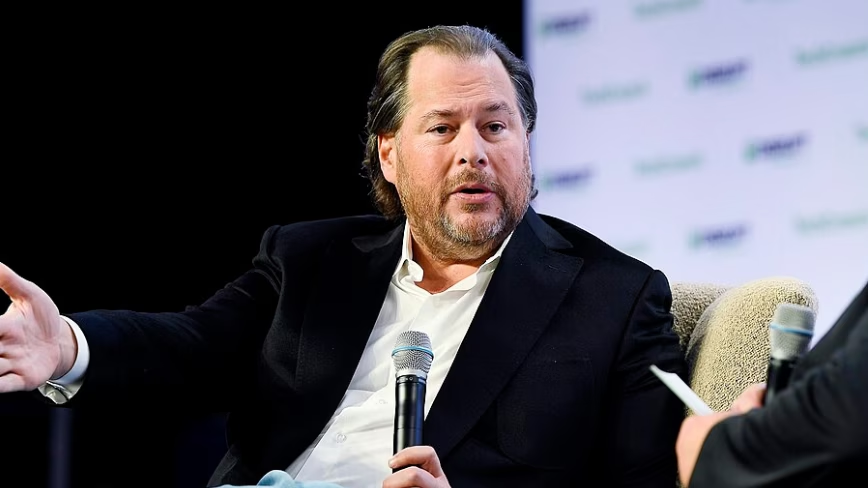
Salesforce promotes rival Anthropic AI product on Slack, confusing employees
Salesforce employees expressed confusion after the company promoted Anthropic's Claude Tag — a new AI product that functions as a persistent
 thenextweb.com·10d ago
Sales Agent is now generally available: Bringing customer and deal intelligence into the flow of work
Microsoft·6d ago
Salesforce's Headless 360 sees rapid adoption with 4.5 million MCP calls since April launch
Salesforce's Headless 360 product, which lets customers access Salesforce data through AI interfaces like Cursor, WhatsApp, ChatGPT, Claude,
 theregister.com·1mo ago
Salesforce's Headless 360 sees rapid adoption with 4.5 million MCP calls since April launch
Salesforce's Headless 360 product, which lets customers access Salesforce data through AI interfaces like Cursor, WhatsApp, ChatGPT, Claude,
theregister.com·1mo ago
Duolingo open-sources AI Slack agent that connects to 200+ engineering tools
Duolingo developed an internal AI Slack app that connects to over 200 tools (GitHub, Jenkins, Sentry, Grafana, etc.) to help engineers triag
 Duolingo·1mo ago
Anthropic launches ‘Claude Tag’ for team-based AI collaboration on Slack
storyboard18.com·14d ago
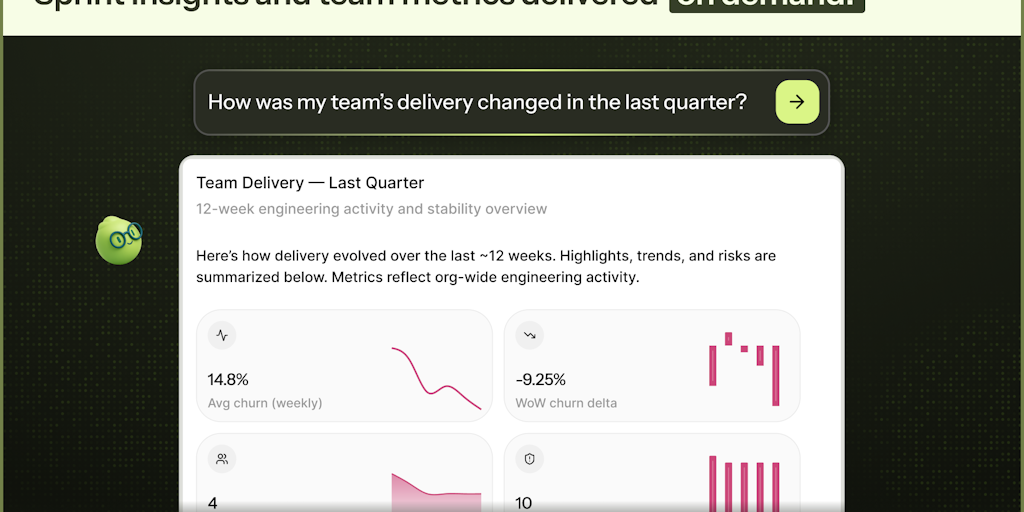
Ask Ellie: AI Chat Agent Integrates Engineering Tools into Slack
Ask Ellie is an AI chat agent that integrates engineering tools into Slack, allowing users to query code changes, PR status, sprint velocity
 Product Hunt·5mo ago
Comments
Sign in to join the conversation.
No comments yet. Be the first.