
























Experimental Simulation of Markovian Quantum Processes Using Quantum Collision Models on Trapped-Ion and Superconducting Quantum Computers
By
[Submitted on 26 Jun 2026]
Summary
This paper presents experimental simulations of Markovian quantum processes using quantum collision models on both trapped-ion and superconducting quantum computers. The authors overcome previous limitations (1-2 qubits, fewer than 12 time steps) by employing hardware-specific ancilla strategies, achieving simulations with up to seven system qubits (13 total qubits) and 40 time steps. The key finding is that optimal implementation strategy depends strongly on the hardware characteristics of the quantum computer, even for the same physical model.
Source

 bskyExperimental Simulation of Markovian Quantum Processes Using Quantum Collision Models on Trapped-Ion and Superconducting Quantum Computersarxiv.org
Key quotes
· 3 pulledHamiltonian dynamics have been widely implemented on noisy intermediate-scale quantum devices in recent years.
Quantum collision models provide a natural approach to this problem by coupling the system to ancillas to realize dissipation.
Our results demonstrate that, even for the same physical model, the optimal implementation strategy depends strongly on the hardware characteristics of the quantum computer.
You might also wanna read


A quantum computer based on trapped ions can connect any two quantum bits, reaching performance levels that conventional computers cannot match
A Classical RAM Design That Mimics Quantum Collapse and Entanglement"
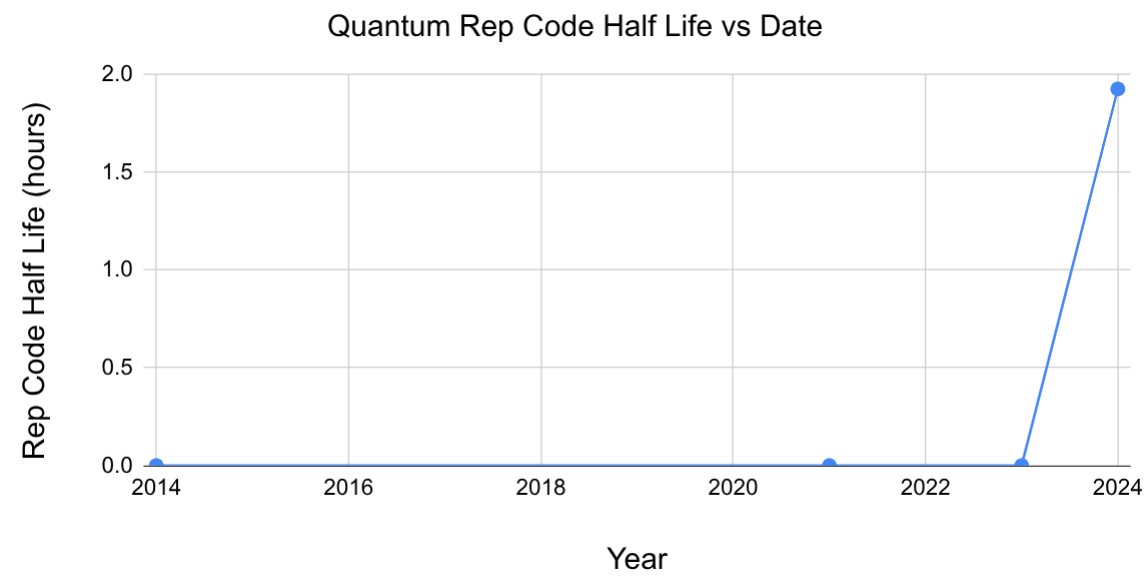
Quantum Error Correction Progress and Future Outlook for Qubit Quality
The article discusses the rapid advancement of quantum error correction, predicting that maximum achievable qubit quality will drastically i
 algassert.com·6mo ago
Researchers build million-p-bit probabilistic computer by networking FPGAs, breaking single-chip limit
Researchers have built a programmable probabilistic computer using networked FPGAs that achieves one million p-bits (probabilistic bits), br
arxiv.org·15h ago
Comments
Sign in to join the conversation.
No comments yet. Be the first.