
























Surge's GDP.pdf Benchmark Shows Frontier Models Need Structured Retrieval for Enterprise PDFs
By
Sid and RitvikJune 29, 2026
Summary
Surge released GDP.pdf, a benchmark designed to test frontier AI models on real-world professional PDFs like claims packets, technical manuals, clinical papers, and securities filings. The benchmark includes 100 document tasks across ten domains with 1,275 rubric criteria. The article argues that the bottleneck in enterprise document AI is not just model intelligence but also the need for structured, page-grounded evidence retrieval — a gap that Pulse AI's "Retrieval Layer" aims to fill.
Source

.png) Twitter / XSurge's GDP.pdf Benchmark Shows Frontier Models Need Structured Retrieval for Enterprise PDFsrunpulse.com
Twitter / XSurge's GDP.pdf Benchmark Shows Frontier Models Need Structured Retrieval for Enterprise PDFsrunpulse.comKey quotes
· 3 pulledThe public set covers 100 document tasks across ten domains, with 1,275 rubric criteria in total, an average of about thirteen graded requirements per task.
Our view is that the bottleneck is not only model intelligence.
Can a frontier model answer an expert-level question when the answer is buried inside a real professional PDF?
You might also wanna read

Benchmark Analysis: Comparing Document Parsing APIs for Enterprise AI Applications
The article presents a benchmark analysis comparing document parsing APIs, focusing on Tensorlake's approach to measuring what matters for e
 tensorlake.ai·7mo ago
SkillsBench: A Benchmark for Evaluating AI Agent Skills Across Diverse Tasks
SkillsBench is a new benchmark for evaluating how well AI agent skills work across diverse tasks. The benchmark includes 86 tasks across 11
 arxiv.org·4mo ago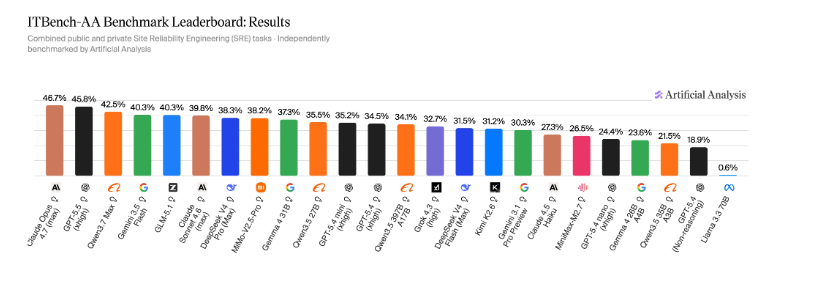
ITBench-AA Benchmark Launched: Frontier AI Models Score Below 50% on Enterprise IT Tasks
Artificial Analysis and IBM Software Innovation Lab have launched ITBench-AA, a new benchmark series evaluating AI models on agentic enterpr

AI Models Continue to Struggle with PDF Processing Despite Technological Advances
The article examines the persistent challenges that AI models like ChatGPT and Claude face in processing PDF documents, despite significant
 The Verge·4mo ago
Production RAG Implementation: Lessons from Processing 13+ Million Documents
The author shares practical lessons learned from building production RAG (Retrieval-Augmented Generation) systems that processed over 13 mil
 blog.abdellatif.io·8mo ago
Search-Augmented Agents Cut Token Usage by 36% and Outperform Raw File Processing
This article explores the inefficiency of giving AI agents raw files (like research papers) to process, comparing it to a raccoon rummaging
.png) lighton.ai·4d ago
lighton.ai·4d ago
Comments
Sign in to join the conversation.
No comments yet. Be the first.