
























Search-Augmented Agents Cut Token Usage by 36% and Outperform Raw File Processing
Summary
This article explores the inefficiency of giving AI agents raw files (like research papers) to process, comparing it to a raccoon rummaging through boxes. The author argues that providing agents with a search tool over documents — rather than the raw documents themselves — dramatically reduces token consumption and improves answer quality. Using a case study on efficient multi-vector retrieval research papers, the author demonstrates that a search-augmented approach cut tokens by 36% and won 75% of blind comparisons against the raw-file approach. The piece delves into the technical reasoning behind why search beats raw context, touching on context window limitations, attention mechanisms, and practical agent architecture design.
Source

.png) bskySearch-Augmented Agents Cut Token Usage by 36% and Outperform Raw File Processinglighton.ai
bskySearch-Augmented Agents Cut Token Usage by 36% and Outperform Raw File Processinglighton.aiKey quotes
· 3 pulledSpawn an agent into a folder of papers, and it will do what a motivated raccoon in an archive does: inspect labels, open boxes, and spend context figuring out where the answer might be.
Same model, same questions. Search cut tokens 36% and won 75% of blind comparisons.
The rabbit hole started with the excellent awesome-multivector-
You might also wanna read

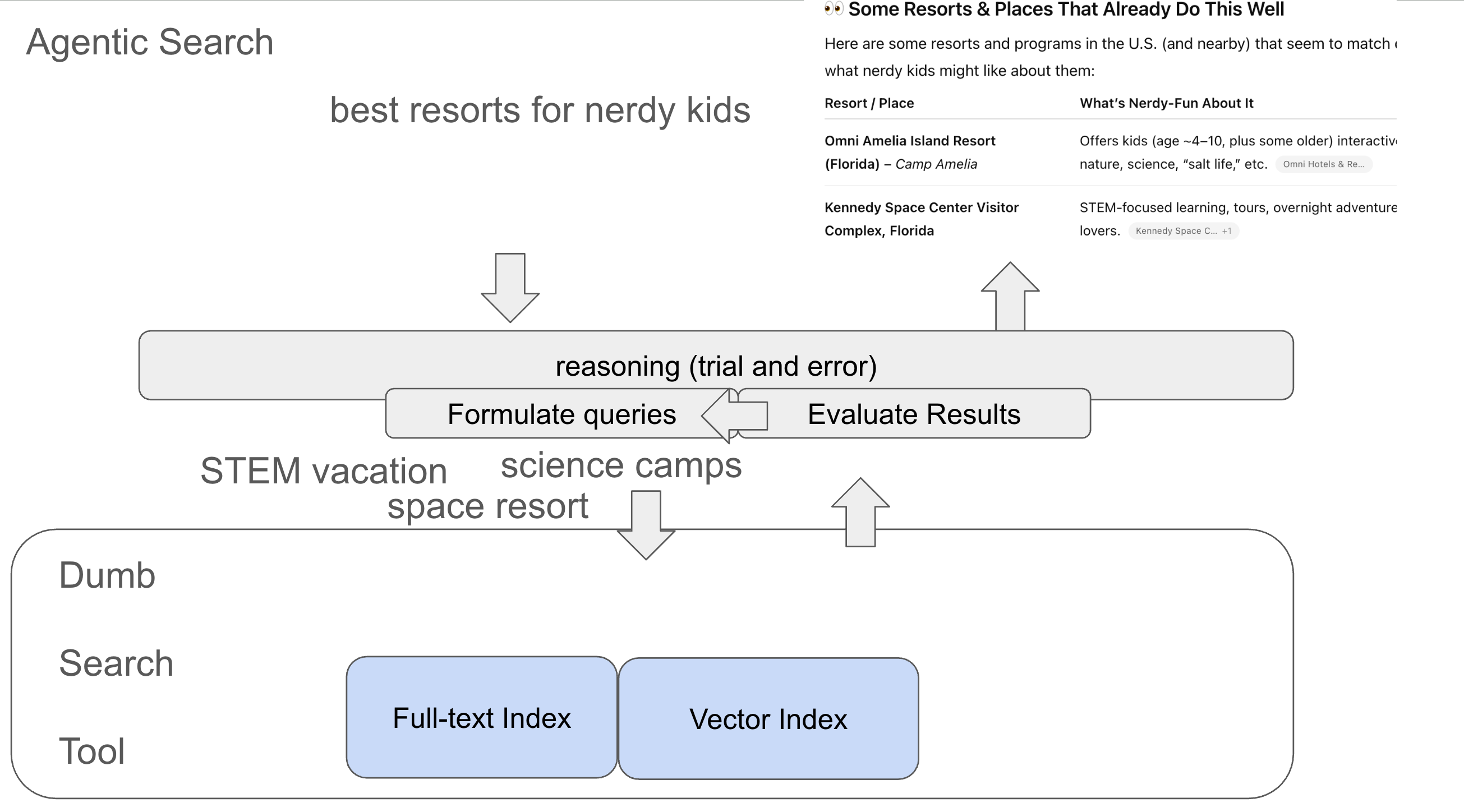
How AI agents are evolving RAG systems from keyword search to iterative, reasoning-based search experiences
The article discusses how AI agents are transforming traditional RAG (Retrieval-Augmented Generation) systems by moving beyond simple keywor
 softwaredoug.com·9mo ago
Direct Corpus Interaction: A New Retrieval Paradigm for Agentic Search Without Embedding Models
This research paper introduces Direct Corpus Interaction (DCI), a novel approach to retrieval for agentic search that bypasses traditional e
 arxiv.org·1mo ago
Rethinking Search: From Query-Answer Services to Programmable Primitives for AI Agents
The article argues that traditional search pipelines are becoming outdated for AI agent systems. It proposes rethinking search as a programm
 research.perplexity.ai·27d ago
Meta Superintelligence Labs' First Paper Focuses on Retrieval-Augmented Generation (RAG)
Meta Superintelligence Labs' first published paper focuses on Retrieval-Augmented Generation (RAG) rather than expected model layer innovati
 paddedinputs.substack.com·8mo ago
Production RAG Implementation: Lessons from Processing 13+ Million Documents
The author shares practical lessons learned from building production RAG (Retrieval-Augmented Generation) systems that processed over 13 mil
 blog.abdellatif.io·8mo ago
Paper2Agent: Converting Research Papers into Interactive AI Agents for Scientific Discovery
Paper2Agent is an automated framework that converts research papers into interactive AI agents, transforming static research outputs into ac
arxiv.org·9mo ago
Comments
Sign in to join the conversation.
No comments yet. Be the first.